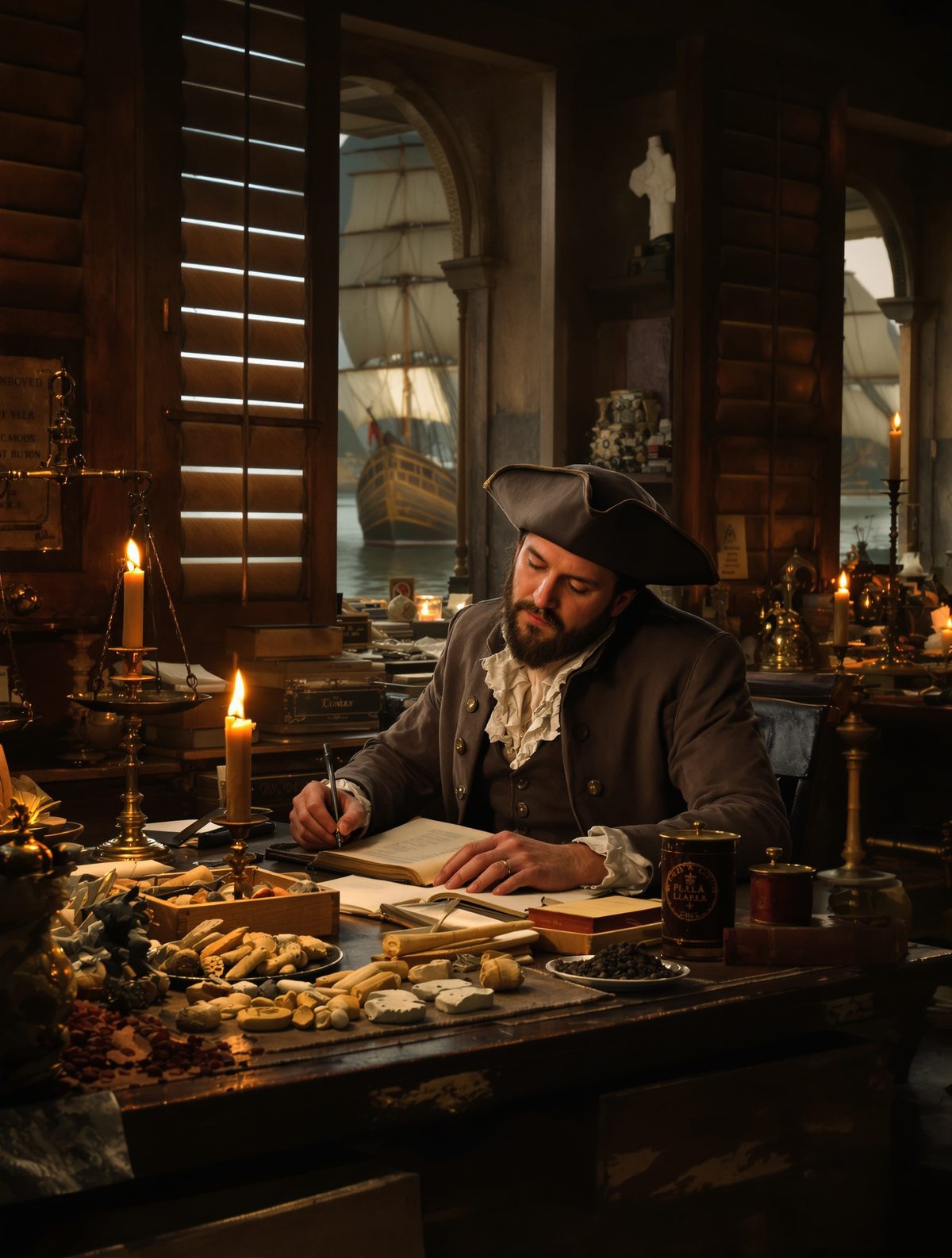
Picture this: In the autumn of 1888, a 65-year-old Scottish businessman sat in his London office, signing documents that would make him the effective ruler of an area larger than Spain. Sir William MacKinnon had never breathed African air or felt Kenyan soil beneath his feet, yet with the stroke of a pen, he became sovereign over 200,000 square miles of East Africa—from the bustling ports of Mombasa to the remote highlands of Uganda. His army? A handful of clerks. His navy? One rusty steamship. His budget? Laughably inadequate. What could possibly go wrong?
MacKinnon's Imperial British East Africa Company represents one of history's most audacious—and ultimately doomed—attempts at privatized colonialism. It's the story of how Victorian Britain outsourced empire-building to entrepreneurs, and how a shipping magnate's imperial dreams crashed against the harsh realities of African resistance, financial ruin, and administrative incompetence.
The Steamship King's Unlikely Rise
William MacKinnon didn't look like a future emperor. Born in 1823 to a Scottish farming family, he began his career as a grocer's apprentice before revolutionizing steam navigation in the Indian Ocean. By the 1870s, his British India Steam Navigation Company dominated the mail routes between Britain and India, making him one of the wealthiest men in the Empire. MacKinnon's ships carried everything from diplomatic pouches to pilgrims bound for Mecca, earning him a knighthood and the ear of prime ministers.
But MacKinnon harbored grander ambitions. He watched German and French companies carving up Africa and worried that Britain was falling behind in the "Scramble for Africa." When the German explorer Carl Peters began establishing German East Africa (modern-day Tanzania) in 1885, MacKinnon saw his chance. He convinced the British government that private enterprise could secure British interests in East Africa without burdening the Treasury—a seductive argument for a cash-strapped Victorian administration.
The irony was exquisite: a man who had built his fortune on predictable, profitable trade routes now sought to govern some of the most challenging territory on Earth. MacKinnon knew nothing about African politics, spoke no local languages, and had never managed anything more complex than a shipping schedule. Yet somehow, he convinced Queen Victoria's government to hand him an empire.
A Company to Rule Them All
On September 3, 1888, Queen Victoria signed the Royal Charter establishing the Imperial British East Africa Company (IBEAC). The document was breathtaking in its scope: MacKinnon's company could govern territory, collect taxes, maintain armies, build railways, and essentially function as a sovereign state. The only catch? They had to do it all without government funding.
The company's initial capital of £240,000 sounds impressive until you consider the challenge. MacKinnon needed to establish administrative control over territory stretching from the Kenyan coast to Lake Victoria, build infrastructure where none existed, and somehow turn a profit while competing with German and French colonial enterprises. His "headquarters" in Mombasa consisted of a converted warehouse manned by three British clerks and a handful of Indian administrators borrowed from his shipping company.
The absurdity of the situation becomes clear when you consider the numbers: MacKinnon was attempting to govern roughly 5 million people across 200,000 square miles with fewer staff than a modern McDonald's restaurant. His "imperial fleet" consisted of one aging steamship, the William MacKinnon, and his "army" was a motley collection of Sudanese ex-soldiers and local recruits armed with outdated rifles.
The Railroad to Nowhere
MacKinnon's masterstroke—or folly—was his obsession with building a railway from Mombasa to Lake Victoria. He believed this "Uganda Railway" would unlock the region's economic potential and provide the profits needed to sustain his company. What he got instead was one of the most expensive disasters in colonial history.
Construction began in 1896, five years after the British government had already taken over the company's territories. The project immediately encountered problems that would have challenged a modern engineering firm, let alone MacKinnon's understaffed operation. Workers faced malaria, sleeping sickness, and attacks by man-eating lions that literally ate their way through the workforce. The famous "man-eaters of Tsavo" killed an estimated 35 workers and halted construction for weeks while hunters tracked down the rogue lions.
The financial bleeding was even worse than the literal bleeding. The railway's final cost exceeded £9.5 million—roughly £1 billion in today's money—for a 584-mile track that wouldn't turn a profit for decades. MacKinnon's company hemorrhaged money so quickly that by 1895, the British government had no choice but to assume direct control of East Africa, transforming it into the East Africa Protectorate.
Resistance and Reality
What MacKinnon and his fellow empire-builders consistently underestimated was African resistance. The peoples of East Africa—from the Kikuyu in the central highlands to the Nandi in the Rift Valley—had no intention of quietly submitting to rule by a Scottish businessman they'd never met.
The Nandi people proved particularly troublesome for MacKinnon's skeleton administration. Led by their orkoiyot (traditional leader) Koitalel Arap Samoei, they launched a sustained resistance campaign that lasted over a decade. Using their intimate knowledge of local terrain and guerrilla tactics, Nandi warriors repeatedly ambushed company forces and disrupted railway construction. The company's small garrison was so overstretched that entire regions remained effectively independent for years.
Perhaps most humiliating for MacKinnon was his complete dependence on existing Swahili and Arab trading networks. Rather than replacing local power structures, his company found itself forced to work through the very merchants and chiefs it had supposedly come to supersede. The irony was stark: a company created to establish British control instead became a junior partner in existing African commercial systems.
The Empire That Never Was
By 1893, MacKinnon's imperial dream was clearly dying. The company had burned through its initial capital and several emergency fundraising rounds without establishing effective control over much of its territory. MacKinnon himself died in 1893, never having visited the empire he'd tried to build. His death symbolized the end of an era when Victorian Britain believed private companies could conquer continents on the cheap.
The final blow came in 1895 when the British government formally took over the company's territories, establishing the East Africa Protectorate. The transition was so seamless that many Africans barely noticed the change—perhaps the ultimate commentary on how little the company had actually accomplished during its seven-year existence.
What remained was debt, incomplete infrastructure, and a railway that historian Charles Miller would later call "the most expensive practical joke in history." The Uganda Railway did eventually help establish British control over Kenya and Uganda, but at a cost that far exceeded anything MacKinnon had imagined when he signed those confident documents in 1888.
Legacy of a Paper Empire
MacKinnon's story offers a fascinating glimpse into the chaotic reality behind Britain's seemingly ordered imperial expansion. While textbooks often present colonialism as a systematic process, the truth was messier: improvisation, financial desperation, and sheer luck played larger roles than careful planning or overwhelming force.
The failure of the Imperial British East Africa Company also marked the end of an era. After MacKinnon's debacle, the British government largely abandoned the fiction that private companies could govern empires. Future colonial expansion would be directly state-sponsored, with all the bureaucratic competence and financial resources that entailed.
Today, as we watch private companies accumulate unprecedented wealth and influence, MacKinnon's story feels surprisingly relevant. The same questions that doomed his East African empire persist: Can private enterprise effectively govern public goods? What happens when profit motives clash with governance responsibilities? And what are the human costs when powerful institutions attempt to impose order on societies they don't understand?
Sir William MacKinnon never saw the empire he tried to build, but his legacy lived on in the colonial state that replaced his failed company. The borders he helped establish still define modern Kenya and Uganda, while the railway his company began remains a crucial transportation link. Sometimes the most profound historical changes come not from grand successes, but from ambitious failures that force societies to confront uncomfortable truths about power, money, and the price of empire.