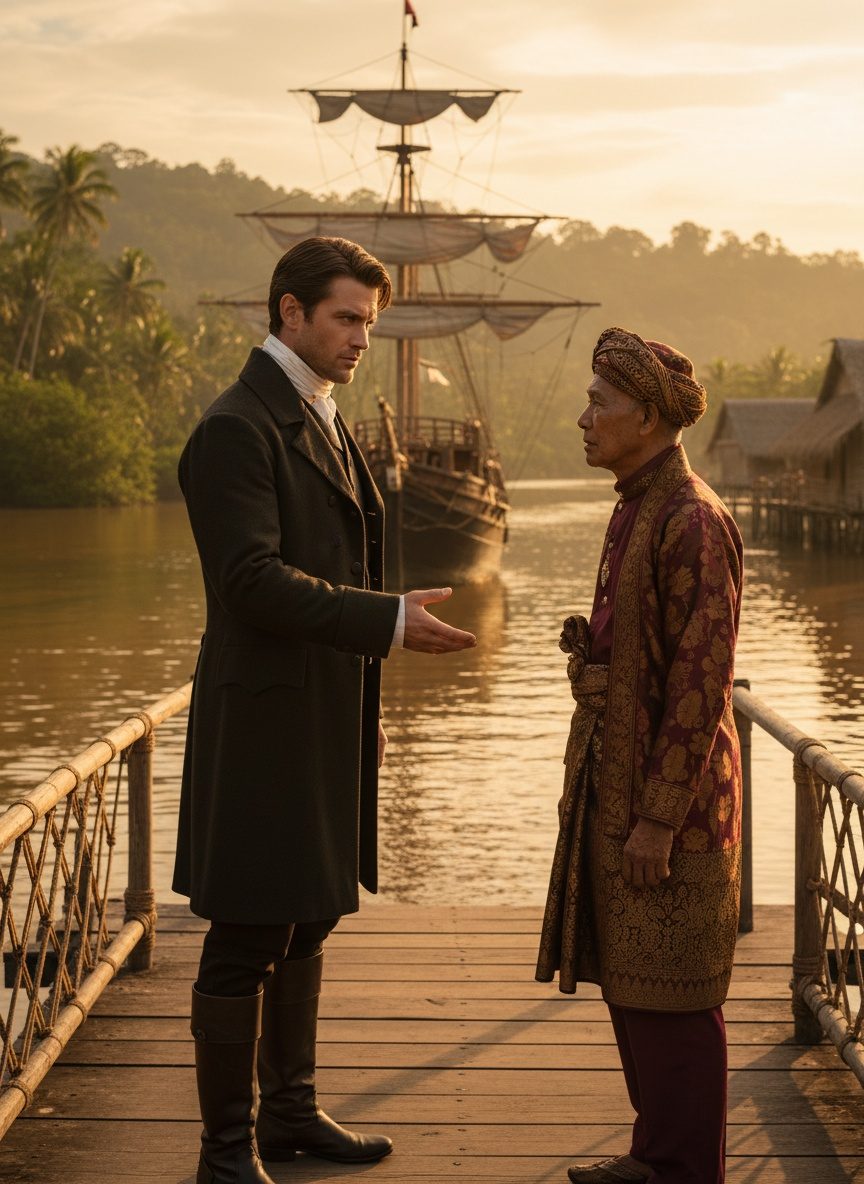
January 23, 1791. The sun's glare bounced off the shimmering paddy fields of Bengal.
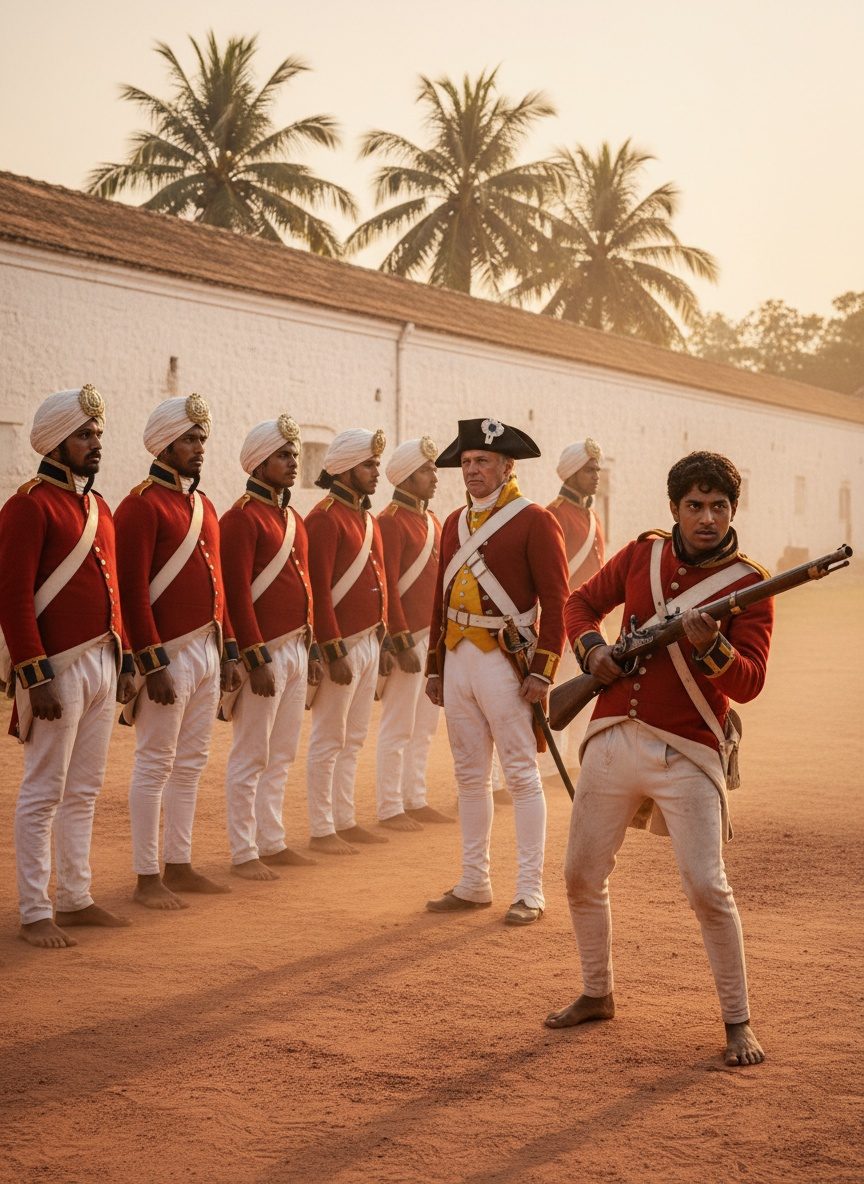
This was a land of rice farmers, where laboriously tilled earth yielded sustenance to generations who watched the monsoons decide their fate with capricious certainty. But the fields of rural India harbored more than just crops. Here, the East India Company laid its ideals of commerce and conquest, recruiting not seasoned warriors, but ordinary men from the villages that dotted the landscape. Within months, many of these men, who had known only the cycles of plough and harvest, donned the red coats of the East India Company, voluntarily transforming their lives on a scale previously unimagined.
In the historical tableau that is the Indian subcontinent between 1757 and 1857, the East India Company loomed large. Officially a trading enterprise, it soon embraced the paradoxical role of a commercial power with territorial ambitions, sustained by what became the largest and most organized private army the world had seen. Remarkably, this army did not spring from Europe's military academies nor did it emerge from the battle-hardened clans of Indian warriors. Instead, the fabric of this force was woven from the diverse and dispersed threads of society—farmers, weavers, barbers, and fishermen drawn from the rich tapestry of village life.
The initiative was as bold as it was unprecedented. Before this, armies were typically the domain of the noble and the brave. For the Company, however, necessity truly became the mother of invention. To protect its rapidly expanding commercial interests and nascent territories from rivals and rebellious nawabs, the East India Company needed to assemble a force swiftly, economically, and reliably. This necessity gave birth to the sepoy army, a rank-and-file drawn from the common man but uniformed and drilled in the ways of European military precision.
Imagine a young lad from the verdant fields of Awadh, accustomed to following the plough and whispering to the soil. His understanding of life, detailed in the rustling of crops and the spurt of water through an irrigation channel, suddenly broadened the day a recruiter arrived in his village. Armed with promises of regular pay—cash, not the village barter—security, and sometimes, a hint of adventure, the recruiter conveyed to these men an escape from the arbiters of unpredictable agricultural cycles. Thus, the head was turned, the plough exchanged for a musket.
What made these men extraordinary as soldiers? Initially, there were skepticism and cultural adjustments to endure. Language barriers, dietary concerns, and religious practices mixed restlessly with martial discipline. Yet, the Indian sepoys displayed adaptability, bringing their own native resilience to the training grounds. When juxtaposed with European rigidity, this adaptability proved to be a strength, not a weakness. They mastered the drill squares, adopting British tactics while imbuing them with their unique tenacity.
Few sepoys could have anticipated the sweep of history they would be swept into. Their involvement in key confrontations, such as the Battle of Plassey and many significant skirmishes, inadvertently laid the foundations for what would become the British Raj. The professional conduct of these sepoy units was often admired, even feared, by the Company’s European officers and adversaries alike. Their disciplined lines in pitched battle and silence before cannonades contradicted the rural chaos they had left behind.
Yet, amidst the thunderous acclaim and fear commanded by these sepoys, it was easy to forget that they remained men of the land. The sepoy mutiny of 1857, often referred to as India's first war of independence, shattered the myths of unyielding loyalty engrained in these men. It was a wake-up call that showed the tightly stretched cord of obligation and identity. The uprising was a consequence of festering discontent, triggered by insensitivities to local customs—the very things that had been delicate threads in the hearts of these recruited villagers. While the rebellion was ultimately quelled, it forced the British Crown to assume direct control over India, marking the end of the Company's rule.
Reflecting on this chapter of imperial exploits, one must ponder the magnitude of human transformation under duress and opportunity. The annals of history brim with tales of grand armies and conniving conquests, yet the story of the East India Company’s sepoys offers something subtly profound. A farmer becomes a soldier, carrying within him memories of dewdrops on rice stalks even as he marches to battle. The blend of harvesters and gunpowder challenged the stature of military history, embodying resilience, adaptation, and a cautionary tale of governance.
This unlikely ensemble reminds us that history is not merely shaped by those born into power or war but often by those who were common, drawn into the whirlpool of change. Their narratives, though overshadowed by leaders and emperors, remind us of the agency that even the unlikeliest individuals hold in altering the course of history. In the sepoy, we witness the dual everydayness and extraordinariness that comprise the bedrock of the human experience.