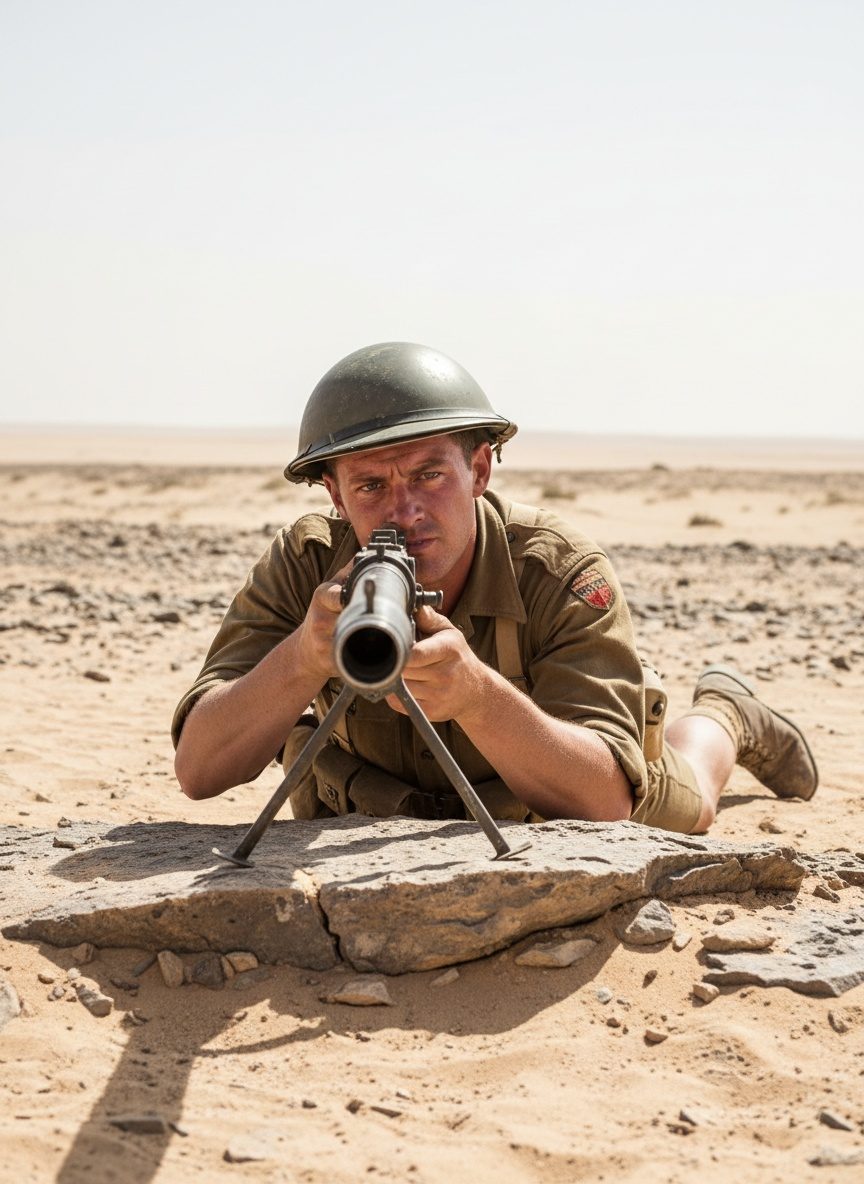
March 20, 1942. The dawn light revealed the scattered remnants of yesterday's battle – hulls of British tanks lay silent against the golden sands of the Western Desert.
The Desert Woes
In early 1942, British forces in North Africa were caught in an increasingly desperate struggle against German Field Marshal Erwin Rommel’s unstoppable panzers. The harsh, unforgiving terrain of the Western Desert compounded the overwhelming superiority of the German tanks, their armor shrugging off the feeble British attempts at hindrance. Most anti-tank measures available to British soldiers proved inadequate, the sound of their weapons’ fire tragically akin to pebbles bouncing off steel. Morale was slipping into a quagmire as deep as the desert sands themselves, with each metallic juggernaut advancing under the Axis flag spreading dread across the front lines.
The standard infantry weapons of the time, namely the Boys anti-tank rifle, offered little solace to troops staring down the barrels of German 88mm guns. Indeed, these were dark times, with the British Eighth Army finding themselves pushed further back by the mighty swings of an Axis pendulum – intent on clearing a path to the oil-rich Middle East.
A New Hope
Out of necessity, innovation often ascends, untamed by past constraints. Enter the Projector, Infantry, Anti-Tank (PIAT). Devised by the maverick British engineer Lieutenant Colonel Stewart Blacker, the PIAT was a marvel of crude ingenuity. Blacker had imagined a means to give individual infantrymen a fighting chance against the German armored behemoths. His vision was audacious – a portable anti-tank weapon, shoulder-fired but utilising a mix of springs and explosives that defied the conventional norms of artillery science.
Fueling the PIAT was the concept of a hollow charge, a novel method in weaponry that allowed a concentrated explosion capable of piercing the formidable steel carapace of tanks. British soldiers, accustomed to the fruitless ping of rounds ricocheting off armor, were suddenly equipped with 83mm of potentially tank-stopping power. The PIAT's projectile could punch through over 100mm of armor at an angle, igniting the ammunition inside a Panzer and turning the hunter into hunted.
The Weapon of Necessity
The PIAT's design was unorthodox. At over a meter long, it resembled a drainpipe more than a piece of military hardware. The weapon's firing mechanism involved an immense internal spring which, when compressed, launched the bomb forward. Yet this simplicity belied its effectiveness. Laden with an explosive kickback deserving of its legend, the weapon's recoil was notorious. Firing a PIAT was likened to being kicked by a mule, leaving soldiers both bruised and awed.
But on the battlefield, stopping Rommel’s panzers did not come without embodying courage. The PIAT was not a weapon for the faint-hearted. It required operators to fire from ungodly proximity to their armored targets—often mere meters away. Yet, for all its challenges, the PIAT turned the tide in many a skirmish, from North Africa to Italy and eventually through the hedgerows of Normandy.
Transforming the Tides
Amidst the stark dunes of the desert, where British soldiers now had a tool formidable enough to banish the specter of futility, the PIAT shone brightly. It birthed stories of daring and prowess, turning ordinary infantrymen into tank hunters - David amongst the Goliaths. As the flames of Empire burned ever so fiercely in defending these strategic desert sands, the PIAT was a game-changer that gifted hope and the means to finally stem Rommel’s portentous advance.
In the Italian Campaign, the PIAT allowed British, Canadian, and Commonwealth forces to hold the line against numerous German armored assaults. Each conquered valley and recaptured hill bore testament to its revolutionary impact. These victories, carved out by grit and explosive rounds born of the PIAT, filled the trenches with renewed resolve.
An Enduring Legend
The PIAT story is one of how innovation under duress provided the means to level the playing field in the grim theater of war. While the weapon itself bore the bruises of its harsh treatment upon soldiers, those who carried it bore the eternal mark of bravery. After the Normandy invasion, the PIAT continued to serve gallantly, even as new technologies began to overshadow its humble origins.
Today, the PIAT’s legacy underscores an enduring lesson: That even in the bleakest times of human conflict, a spark of ingenuity can fuel courage and alter the course of history. As time marches on, its echo is a reminder to adapt courageously and think unconventionally, for within us lie the powers to shape the world against overwhelming odds.