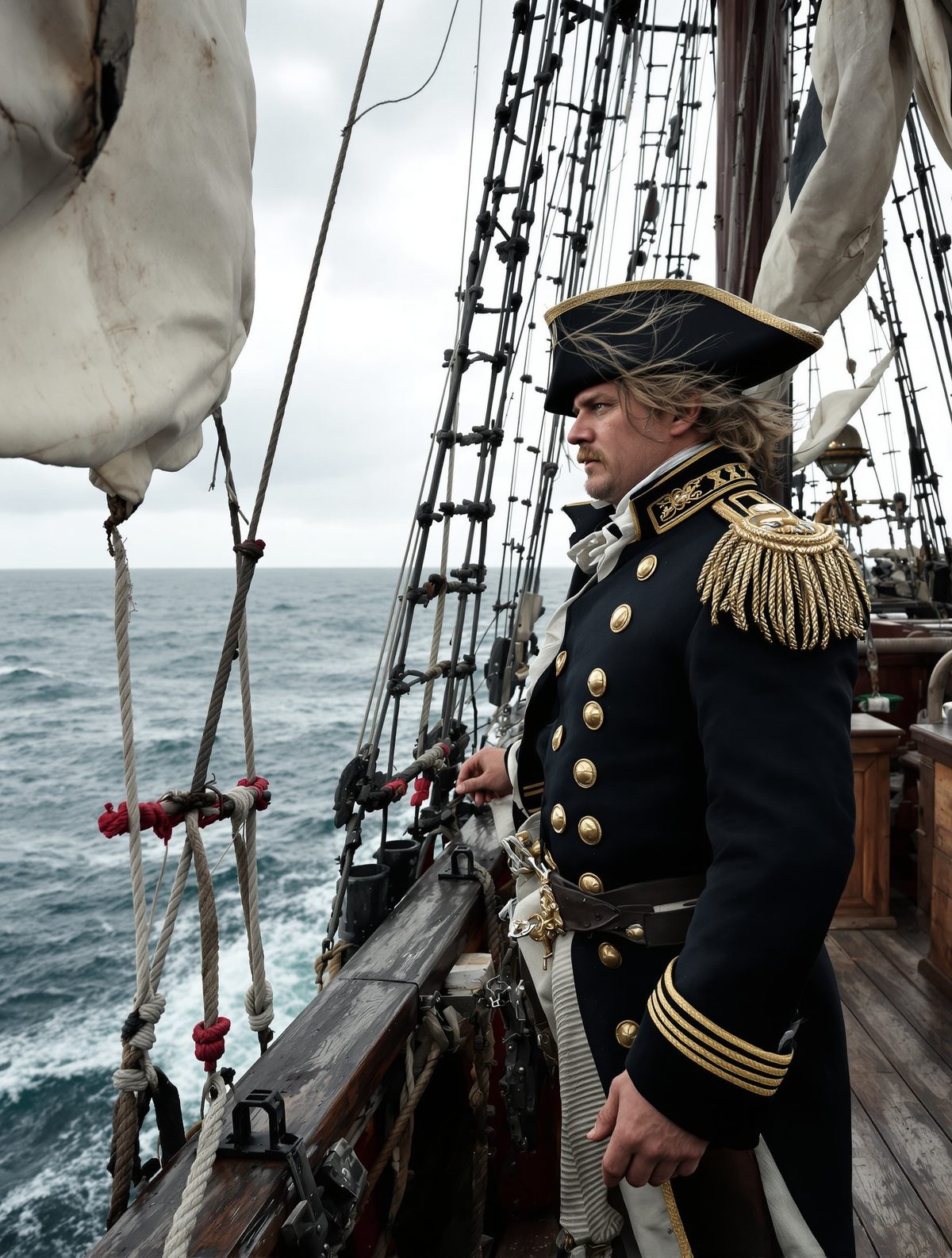
Off the rocky coast of Donegal, on a fog-shrouded morning in October 1798, a French naval squadron cut through the grey Atlantic waters. Aboard the flagship Hoche, a man in the blue uniform of a French chef de brigade stood at the bow, his eyes fixed on the emerald shoreline of his homeland. This was no ordinary French officer—beneath that uniform beat the heart of Theobald Wolfe Tone, the Protestant barrister who had abandoned his comfortable life to become Ireland's most wanted revolutionary. After years in exile, he had finally returned, not as a fugitive slipping quietly ashore, but as the military leader of an invasion force intent on nothing less than the complete liberation of Ireland from British rule.
What Tone couldn't know as he gazed at those familiar cliffs was that his homecoming would last mere hours, and that within weeks, he would face a choice that would echo through Irish history: die by his own hand, or suffer the public humiliation of a traitor's execution.
The Protestant Who Became Ireland's Revolutionary
The story of how Theobald Wolfe Tone—born into Protestant privilege in Dublin in 1763—became the father of Irish republicanism reads like the plot of a political thriller. A successful barrister with a comfortable practice and a young family, Tone seemed destined for the quiet prosperity of the Protestant Ascendancy. Yet by his thirties, he had thrown it all away to pursue what most considered an impossible dream: an independent Irish republic where Catholic, Protestant, and Dissenter would stand as equals.
The transformation began in the coffee houses and drawing rooms of Dublin, where Tone witnessed firsthand the brutal inequalities of the Penal Laws. Catholics—who comprised 75% of Ireland's population—were barred from voting, holding office, owning land, or even carrying weapons. Meanwhile, the Protestant Anglo-Irish elite controlled virtually all political and economic power, while remaining subservient to London. For Tone, this system was not just unjust—it was strategically foolish, dividing Ireland's people when they should unite against their common oppressor.
In 1791, Tone published his explosive pamphlet "An Argument on Behalf of the Catholics of Ireland," which articulated a radical vision: Ireland could only achieve true independence by uniting all its people, regardless of religion, in common cause against British rule. The pamphlet's success led directly to the formation of the United Irishmen, the secret revolutionary society that would orchestrate the 1798 Rebellion.
Exile and the French Connection
By 1794, British authorities had identified Tone as one of Ireland's most dangerous revolutionaries. Facing arrest and almost certain execution, he accepted a deal: exile to America in exchange for his life. But Philadelphia was never meant to be Tone's final destination—it was merely a waystation on his journey to Paris.
The French Directory, locked in a death struggle with Britain, proved receptive to Tone's audacious proposal: France should invade Ireland, where millions of oppressed Catholics would rise to welcome their liberators. Tone painted a picture of Ireland as Britain's Achilles' heel—a Catholic nation held in bondage, ready to explode into revolt at the first sight of French ships on the horizon.
What followed was one of history's most frustrating sequences of missed opportunities. In December 1796, Tone sailed with the massive Bantry Bay expedition—43 ships carrying 15,000 French troops under General Lazare Hoche. The fleet reached the Irish coast on December 21st, close enough that Tone could see the hills of Cork through his telescope. "I was now so near the shore that I could in a manner touch the sides of Bantry Bay with my right hand," he wrote in his diary. But savage winter storms prevented the landing, and after days of desperate attempts, the fleet was forced to return to France.
The failure devastated Tone, but he refused to abandon his dream. For two more years, he haunted the corridors of French power, pleading for another expedition while revolution finally erupted across Ireland in the summer of 1798.
Return of the Revolutionary
By October 1798, the United Irish rebellion had been brutally crushed. Perhaps 30,000 people lay dead in fields from Wexford to Antrim. Any rational analysis would have concluded that the moment for French intervention had passed. But General Jean Joseph Amable Humbert's brief success in Mayo that August—where 1,000 French troops and Irish allies had defeated larger British forces—convinced French planners that one more attempt might succeed.
The expedition that finally carried Tone home was a pale shadow of the Bantry Bay armada. Just eight ships under Commodore Jean-Baptiste-François Bompart, carrying fewer than 3,000 troops and military supplies for Irish rebels who were already dead or in hiding. Tone, now holding the rank of chef de brigade in the French army and wearing the uniform he had earned through two years of service, sailed aboard the flagship Hoche as both military advisor and political representative.
The expedition was doomed from the start. British naval intelligence had anticipated the move, and a powerful squadron under Sir John Borlase Warren was already moving to intercept. On October 12, 1798, off Tory Island near the Donegal coast, the two fleets met in battle.
The engagement was brief but decisive. The British ships, better sailed and more heavily gunned, systematically overwhelmed their opponents. One by one, the French vessels struck their colors or fled. Tone, aboard the Hoche, found himself in the thick of the fighting as the flagship became the focus of British attack. The ship's captain, recognizing the hopelessness of their position, finally surrendered after suffering heavy casualties.
Unmasking the Traitor
When British officers boarded the captured Hoche, they found among the prisoners a French officer whose accent seemed curiously Irish. Sir George Hill, a local magistrate who knew Tone by sight, was brought aboard to examine the prisoners. The moment Hill's eyes fell on the man in French uniform, the game was up.
"Mr. Tone," Hill said quietly, "I am sorry to see you in this situation."
"I am sorry for it myself," Tone replied with characteristic wit, "but I am ready to meet my fate."
The discovery sent shockwaves through the British establishment. Here was Theobald Wolfe Tone—the man they considered the mastermind of Irish rebellion, the traitor who had sought to bring foreign invasion to British shores—captured in enemy uniform, his treason now beyond any possible denial.
Tone was immediately transferred to Dublin under heavy guard, where he was imprisoned in the Royal Barracks to await court martial. The authorities were determined to make an example of him. His execution would demonstrate the futility of rebellion and the inevitable fate of all who dared challenge British rule in Ireland.
The Final Choice
On November 10, 1798, Tone faced his court martial before a panel of military officers. He was charged with treason—leaving the realm to serve the King's enemies and returning in arms to wage war against the Crown. The evidence was overwhelming: his presence aboard a French warship in French uniform made denial impossible.
But Tone's response revealed the depth of his revolutionary conviction. Rather than begging for mercy or claiming he had been coerced, he delivered a speech that transformed his trial from a legal proceeding into a political manifesto. He freely admitted his guilt under British law while utterly rejecting the legitimacy of that law over Ireland.
"I have attempted to establish the independence of my country," he declared. "I have failed in the attempt; my life is in consequence forfeited and I submit. The court will do their duty and I shall endeavor to do mine."
There was never any doubt about the verdict. Tone was sentenced to death by hanging—the standard punishment for treason, designed to maximize shame and suffering. But Tone made one final request: as a soldier in the French army, he asked to die by firing squad, a death befitting his military rank.
The request was denied. Tone would hang like a common criminal on November 12th. But early that morning, prison guards found him in his cell with his throat cut by a penknife he had somehow obtained. Whether this was suicide or a final act of defiance against his captors remains debated, but the result was clear: Wolfe Tone had denied the British government the propaganda victory of a public execution.
He lingered for several days before dying on November 19, 1798, at age 35. His last recorded words were characteristically defiant: "I have done my duty to my country. I have not been able to do more."
The Legend Born from Failure
In military terms, Tone's final expedition was a complete disaster—a minor footnote to a failed rebellion. But in the realm of ideas and inspiration, his return voyage achieved something far more lasting than any battlefield victory could have accomplished. By choosing death over submission, Tone transformed himself from a failed revolutionary into an immortal symbol of Irish resistance.
The image of the Protestant gentleman who abandoned privilege to fight for Catholic emancipation, who sailed back to certain death rather than live safely in exile, became central to Irish nationalist mythology. Every subsequent generation of Irish revolutionaries—from Robert Emmet to Patrick Pearse—would invoke Tone's memory as justification for their own sacrifices.
Perhaps most remarkably, Tone's vision of non-sectarian Irish unity—Catholic, Protestant, and Dissenter united as Irishmen—remains as relevant today as it was in 1798. In a world still torn by religious and ethnic divisions, the ideal for which Wolfe Tone died continues to offer hope that ancient hatreds can be overcome by a shared commitment to justice and equality. The man who sailed home to die may have lost his life, but his dream of a united, independent Ireland lived on to shape the destiny of a nation.