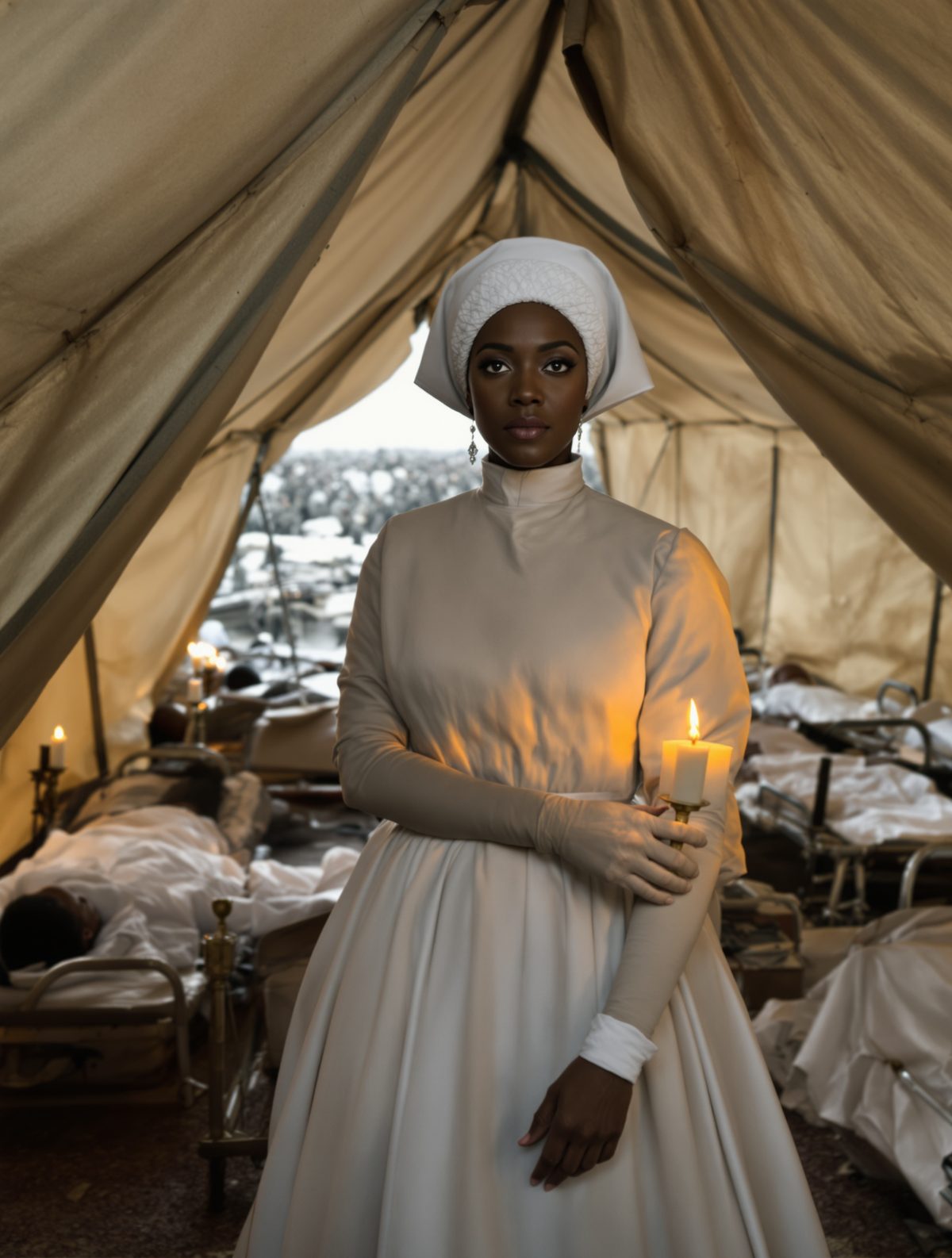
Picture this: it's 1855, and while the celebrated Florence Nightingale tends to wounded soldiers in the relative safety of Scutari Hospital—four miles from the fighting—a middle-aged Jamaican-British woman rides her mule directly onto the blood-soaked battlefields of Crimea. Russian shells whistle overhead as she kneels beside dying men, spooning brandy between their lips and bandaging their wounds with her own hands. The soldiers call her "Mother Seacole," and they love her more than any other figure of the war. Yet for over a century, history almost forgot her name entirely.
Mary Seacole's story isn't just about nursing—it's about a woman who refused to take no for an answer, who funded her own humanitarian mission when the establishment rejected her, and who quite literally rode into the valley of death to save lives. It's a story that reveals uncomfortable truths about Victorian society, and asks difficult questions about whose heroism we choose to remember.
The Doctress of Kingston
Mary Jane Grant was born around 1805 in Kingston, Jamaica, to a Scottish soldier father and a free Jamaican mother who ran a boarding house for invalid soldiers and sailors. This wasn't just any boarding house—it was a place where her mother practiced traditional Caribbean medicine, blending African healing knowledge with European techniques. Young Mary absorbed it all: how to treat tropical diseases, gunshot wounds, knife cuts, and the myriad ailments that plagued the colonial military.
By her twenties, Mary had earned the title "doctress"—a term of genuine respect in Jamaica. She traveled extensively, treating patients from Panama to the Bahamas, and even spent time in London, where she marveled at the city but noted the cold reception she often received due to her mixed-race heritage. When she married Edwin Seacole in 1836, she was already a successful businesswoman and healer, managing her late mother's boarding house and expanding her medical practice.
Here's what the textbooks don't tell you: Mary Seacole was probably more experienced in battlefield medicine than Florence Nightingale when the Crimean War began. She had spent decades treating military personnel, had witnessed and survived multiple cholera epidemics, and had even performed what she described as "surgical operations"—remarkable for any woman of that era, let alone a mixed-race colonial.
The Rejection That Changed History
When news of the disastrous conditions facing British troops in Crimea reached Jamaica in 1854, Mary Seacole made a decision that would define her legacy. She sold her possessions, sailed to London, and presented herself at the War Office. Her credentials were impeccable: decades of medical experience, fluency in battlefield conditions, and glowing testimonials from military officers she had treated. She had even nursed victims of the cholera epidemic that was devastating the Crimean Peninsula.
The response was swift and brutal: rejection. Not once, but repeatedly. The War Office wouldn't consider her. Florence Nightingale's nursing corps turned her away. Even the wives of prominent officials, organizing their own relief efforts, declined her services. Years later, Seacole would write with characteristic diplomacy: "Was it possible that American prejudices against color had some root here?"
The rejections might have crushed a lesser spirit. Instead, they ignited Mary Seacole's determination. If the British establishment wouldn't fund her mission, she would fund it herself. She formed a partnership with Thomas Day, a distant relative, created "Seacole & Day," and set off for Crimea as an independent entrepreneur and healer. She was 50 years old, traveling alone into one of the most brutal conflicts of the 19th century.
The British Hotel: A Miracle Near Hell
What Mary Seacole built on the Crimean Peninsula was unprecedented. She established the "British Hotel" near Balaclava, just two miles from the front lines—closer to the fighting than any other medical facility. This wasn't really a hotel in any conventional sense, but a combination of field hospital, supply depot, canteen, and sanctuary that operated 24 hours a day throughout the war.
The location was deliberately chosen for maximum impact. While Nightingale's hospital at Scutari was across the Black Sea, requiring a dangerous journey for wounded men, Seacole positioned herself where she could reach casualties within minutes of their injuries. She served hot meals to soldiers heading into battle, treated their wounds when they returned, and provided a space where men could write letters home, share a drink, or simply experience a moment of warmth in the midst of horror.
But here's where Seacole's story becomes truly extraordinary: she didn't stay safely behind her hotel's walls. Witnesses recorded her riding onto active battlefields during combat, her mule loaded with medical supplies and stimulants. At the Battle of the Tchernaya in August 1855, she was seen moving among the wounded while fighting continued around her. Russian soldiers, recognizing her mission, reportedly held their fire when they saw her distinctive figure tending to casualties.
Mother Seacole and Her Boys
The soldiers' love for Mary Seacole was immediate and profound. They called her "Mother Seacole" and "the Black Nightingale," though she preferred the former title. Unlike the more distant, administrative approach that characterized Nightingale's reforms, Seacole offered intensely personal care. She knew hundreds of soldiers by name, remembered their hometowns, and wrote letters to their families when they died.
Contemporary accounts reveal details that illuminate why she was so beloved. She would rise before dawn to prepare hot food for men marching to battle, often pressing extra provisions into their hands. When they returned wounded, she treated not just their injuries but their despair, sharing stories from her travels, singing songs from Jamaica, and maintaining an optimism that seemed miraculous given the circumstances.
War correspondent William Howard Russell, writing for The Times, called her "a warm and successful physician" and noted that she was "always in attendance near the battle-field to aid the wounded." Russell's dispatches helped make Seacole famous back in Britain, but they also revealed something else: many soldiers trusted her medical judgment more than that of official military doctors.
The statistics tell their own story. While official medical facilities struggled with mortality rates above 40%, soldiers treated at Seacole's establishment had significantly better survival rates. Her combination of traditional Caribbean medicine, battlefield experience, and personal attention created results that the formal medical establishment couldn't match.
Victory and Financial Ruin
When the war ended in 1856, Mary Seacole faced a bitter irony. The soldiers she had saved celebrated her as a hero, but she was financially ruined. Unlike Florence Nightingale, who had government backing and wealthy supporters, Seacole had funded her entire operation privately. The war's end left her with massive debts and no way to recover her investment.
What happened next reveals both the best and worst of Victorian society. When news of Seacole's financial distress reached Britain, ordinary people—particularly working-class families and former soldiers—responded with extraordinary generosity. A relief fund was established, benefit concerts were organized, and in July 1857, a spectacular four-day military festival at the Royal Surrey Gardens raised over £1,000 (equivalent to more than £100,000 today).
The festival was remarkable for its time: thousands of people, including many who had never seen a person of color before, cheering for a mixed-race woman from Jamaica. Punch magazine, not known for progressive views on race, published poems in her honor. Even Queen Victoria and Prince Albert contributed to her fund, though notably, they never offered her official recognition for her services.
The Legend They Tried to Forget
Here's perhaps the most troubling part of Mary Seacole's story: how thoroughly she was erased from historical memory. While Florence Nightingale became the iconic symbol of nursing and medical reform—deservedly so for her statistical work and hospital improvements—Mary Seacole virtually disappeared from the historical record for over a century.
This wasn't accidental. As the British Empire grew increasingly conscious of racial hierarchies in the late 19th century, the story of a mixed-race colonial woman who had succeeded where white officials had failed became inconvenient. Seacole's autobiography, Wonderful Adventures of Mrs. Seacole in Many Lands, published in 1857, was one of the first autobiographies by a mixed-race woman, but it fell out of print and wasn't republished until 1984.
The contrast in their legacies is stark: Nightingale received the Order of Merit, became the first woman awarded the Honorary Freedom of the City of London, and founded the modern nursing profession. Seacole died in relative obscurity in 1881, her contributions known only to aging veterans and their families.
It wasn't until the 1970s that historians and activists began recovering her story, leading to growing recognition of her achievements. In 2004, she was voted the greatest black Briton in a public poll. Today, there are statues, schools, and university buildings named in her honor, and she appears on the British £20 note proposal shortlist.
But perhaps the most fitting tribute comes from the soldiers she saved. In letters home, in memoirs, and in testimonials, they consistently described Mary Seacole as the person who embodied the best of British values: courage, compassion, and determination in the face of impossible odds. One veteran wrote simply: "She was the best friend the British soldier ever had."
Mary Seacole's story forces us to confront uncomfortable questions about whose heroism we celebrate and why. It reminds us that history is often written by those in power, and that some of our greatest heroes may be hiding in plain sight, waiting for us to notice their extraordinary contributions. In our own time of global challenges and social divisions, perhaps we need more people willing to fund their own missions of mercy, to ride into the valley of death for others, and to refuse to take no for an answer when lives are at stake.