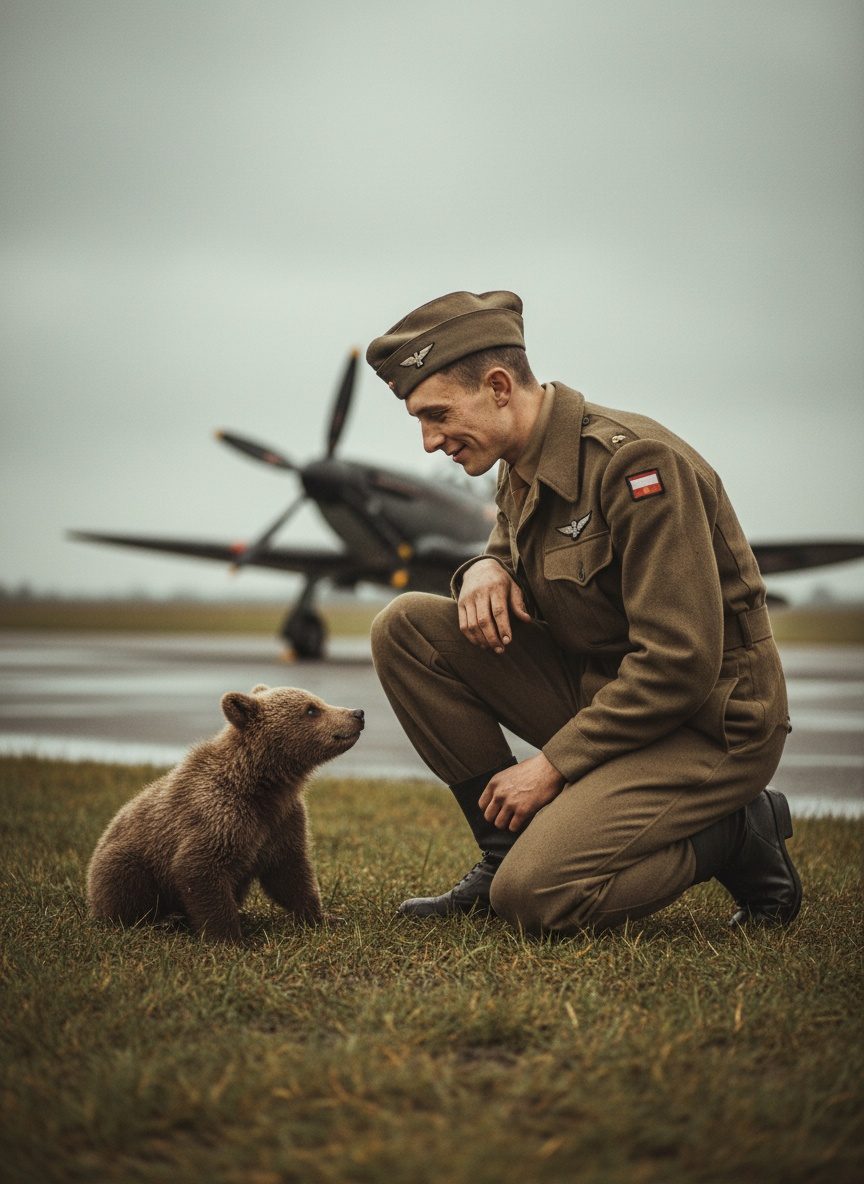
At RAF Northolt, the air always seemed to carry a damp chill, as if even the air itself was burdened by the weary struggles of war. The grey clouds hung low, occasionally parting to admit shafts of weak sunlight that glimmered off the metallic skin of Spitfires and Hurricanes lined along the tarmac. The persistent rumble of engines folding into the constant drone of air traffic above seemed a soundtrack to both defiance and despair. Nestled amidst this ceaseless activity stood a small, unexpected figure — a Syrian bear cub named Wojtek, a symbol of resilience, companionship, and a peculiar slice of home for the Polish airmen of No. 302 Squadron. They grappled with the profound loss of their homeland while drawing strength from this unlikely mascot amid the chaos of World War II.
The story of Wojtek reflects a curious intertwining of fate and fortune, offering a glimmer of comfort in the face of adversity faced by the exiled Poles. Having escaped the brutal dismantling of their country, the Poles who gathered at Northolt were a patchwork of displaced souls, each carrying the weight of his own losses. These aviators had seen a world torn asunder by forces beyond imagining, and distance from home had only deepened their hunger for touchstones from the lives they had left behind. Wojtek, with his playful antics and innocent curiosity, became an inadvertent balm for these fractured spirits, a vestige of normalcy in a world turned upside down.
Wojtek's arrival at Northolt was cloaked in the shadows of uncertainty. Adopted by the Polish Air Force as part of their journey through the Middle East, his presence was simply another stitch in the quilt of their battered camaraderie. The airmen had first encountered him as a cub wandering the rugged landscape, and his playful energy quickly earned him a place among the crew. As Wojtek's paws trod upon the very same earth where roaring engines and combat readiness dominated, he carved his niche not only in the hearts of those around him but also into the annals of legend. With a bounding stride and a clumsy grace, Wojtek was an embodiment of life at its most unguarded, a reminder that not all innocence was lost.
Beyond his novelty, Wojtek became an integral figure in the daily routine of the squadron. When scuffles arose between the men over minor squabbles or the encroaching shadow of despair threatened to engulf them, Wojtek's presence served as an unspoken mediator, easing tensions with his mischievous charm. His antics — from playful tumbles across the airfield to cheeky attempts at sneaking treats — worked their way into the shared lexicon of the squadron, a language that transcended their scattered backgrounds and bound them in a shared laughter.
In the heart of a conflict that had fueled their displacement, Wojtek embodied the intangible resilience of a nation that refused to surrender its identity. While spirits waned amid the grim reality that their battles were fought in foreign skies, the bear cub reminded them of what it meant to stand together. As the Poles took to the skies under a cause far removed from their immediate pain, Wojtek stood as a witness to their courage, an unspoken keeper of their stories and a guardian of their memories. This peculiar partnership between men and bear transcended the boundaries of reason, existing purely on an emotional plane where logic bowed to the heartbeat of hope.
Wojtek’s role expanded beyond his simplistic charms, becoming a metonym for persistence, solace, and shared destiny. While the air grew thick with the metallic tang of fuel and ambition high above spun the fate of nations, Wojtek’s companionship reminded the men that not all devotions necessitate grand gestures. In moments of fear and anguish, when the ground trembled under their feet, he was a steadfast presence, a reassurance that in a world so laced with division, unity could still be found within the most unexpected bonds.
The legend of Wojtek is one the textbooks perhaps deem peripheral, yet for those that lived it, it was intrinsic to their narrative. Against the cataclysmic backdrop of global conflict, Wojtek's story remains one of perseverance, stitched intricately into the tapestry of World War II's overlooked tales. It may have seemed insignificant to the broad sweep of history’s pen, but within the borders marked by personal loss and reclamation, immense importance was found in small wonders. In celebrating Wojtek, the Polish Squadron at RAF Northolt found a part of themselves preserved, a reminder that while lands may divide, the human spirit finds ways to tether itself to hope.