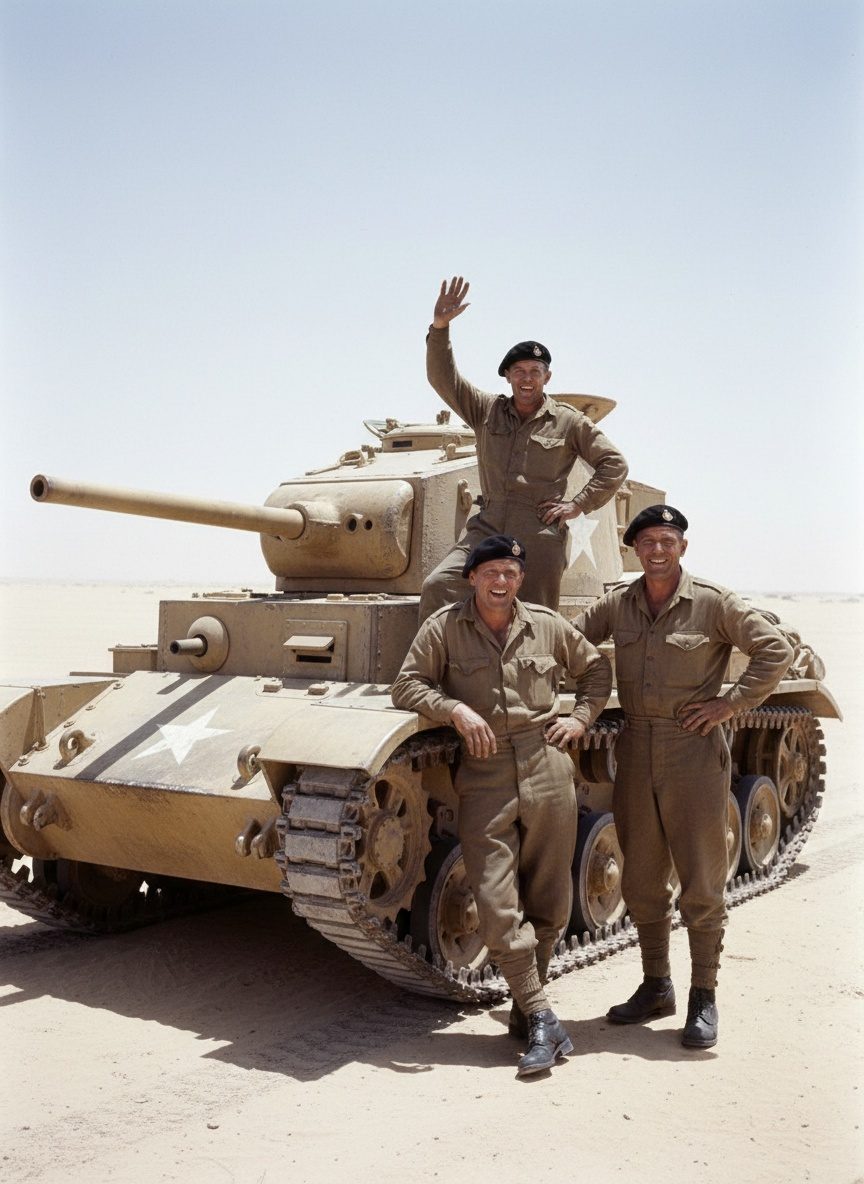
They were men hardened by battle, yet untouched by bitterness. Amidst the swirling sands of the Libyan desert in April 1942, a group of battle-worn soldiers did something unexpectedly tender. They took a photograph, not of war but of gratitude. Britain had sent them Crusader tanks, lifelines delivered across treacherous seas, and these men wanted to say "thank you" back home.
The Western Desert Campaign was a harsh theater of war, a colossal chessboard of men and machines where the sun-flooded terrain offered little mercy. Yet, here, survival often hinged as much on morale as it did on military might. For the British Eighth Army, the sight of a Crusader tank symbolized hope. It was more than steel and rivets; it was the embodiment of support that traversed oceans, braving enemy submarines and Luftwaffe raiders under constant threat.
The Crusader tank itself was not without faults. Its thin armor and mechanical unreliability were frequent complaints among crews who draped their hopes in its shadow. However, its speed made it a valuable asset in the vast expanses of desert warfare, where agility often meant the difference between life and death. For the men posed beside their Crusader, each flaw it bore was a minor hick to be remedied, each redeeming quality a vital lifeline.
The photograph itself, likely unremarkable in technical precision, captured an enduring sentiment—an emblem of wartime unity. In an era when victory was far from assured, such acts of acknowledgement served to tighten the bond between those on the front lines and the thousands who toiled back home to supply them with the tools of war. It was a simple gesture, a snapshot of acknowledgment sent towards invisible hands in assembly lines and those who sweated in factories far removed from the clamor of battle.
This oddity of gratitude was a human moment in an age where industrial war machines loomed large, yet the individual still held significance. Every Model Mk II built was a testament to the massive effort that transformed raw resources into armored behemoths. The journey of a Crusader began in Britain, in workshops where cast steel and frenzied labor fused into formidable forms, then shipped across waters that teemed with danger, a reminder of how victory was stitched together from countless meticulous threads.
As they took their places beside the tank, the camera’s click resonated like an echo of resilience. Behind the photographer's lens, the unassuming brightness of the desert seemed an eternal symbol of warfare's dual nature—its potential for both devastation and unexpected decency. Here, far from the temperate streets of their homeland, the unyielding sun bore down on these warriors' helmets and machine-gun caressed armor. Still, in this radiant host of a harsh environment, an indelible warmth simmered—not merely from the desert's searing embrace but from the shared acknowledgment of endurance against the odds.
The men who momentarily shifted from warriors to well-wishers did so with the understanding that gratitude could ripple outwards, traveling through post offices and across borders, to instill hope. Every letter and image sent back home was not just a communiqué but an emblem of resilience, binding disparate lives together in an understanding that though the theatre of war was staggeringly vast, the human spirit could bridge its expanses.
The photograph served as a bridge to countless families who found solace and pride in knowing their work and sacrifice bore fruit. Those who might never see these lands deeply invested in the lives of sons, husbands, and fathers—mobilizing an entire society in wartime sacrifice. In the absence of immediacy that modern technologies afford, such tokens rendered the distant struggle more immediate, ensuring that the man holding a welder or riveting machinery felt as intrinsic to the war effort as the gunner who aimed across dunes.
This slice of wartime life shared a poignancy that transcended its moment, a testament to interdependent survival forged in gratitude and unity. It whispered that amid artillery's roar, ordinary miracles of acknowledgment and thanks could sidle through the chaos. These gestures often overshadowed elsewhere by the grandeur of battle illustrated an essential truth—we remain bound by a thread of shared thankfulness through the darkest hours.
The tale of the Crusader tank crew is more than a sepia-tinted memory of a bygone era. It stands as a snapshot of human decency amidst the whirlwind of history, a reminder that involvement in war extends beyond the immediate combatants. When the soldiers posed for their photograph, they encapsulated the essence of a collective journey—a world in strife where acts of solidarity illuminate a path as bright as any Libyan sun. In recognizing each other's shared humanity and offering gratitude in the face of adversity, they gave tribute to the enduring power of unity transcending the battlefield's ephemeral fury.