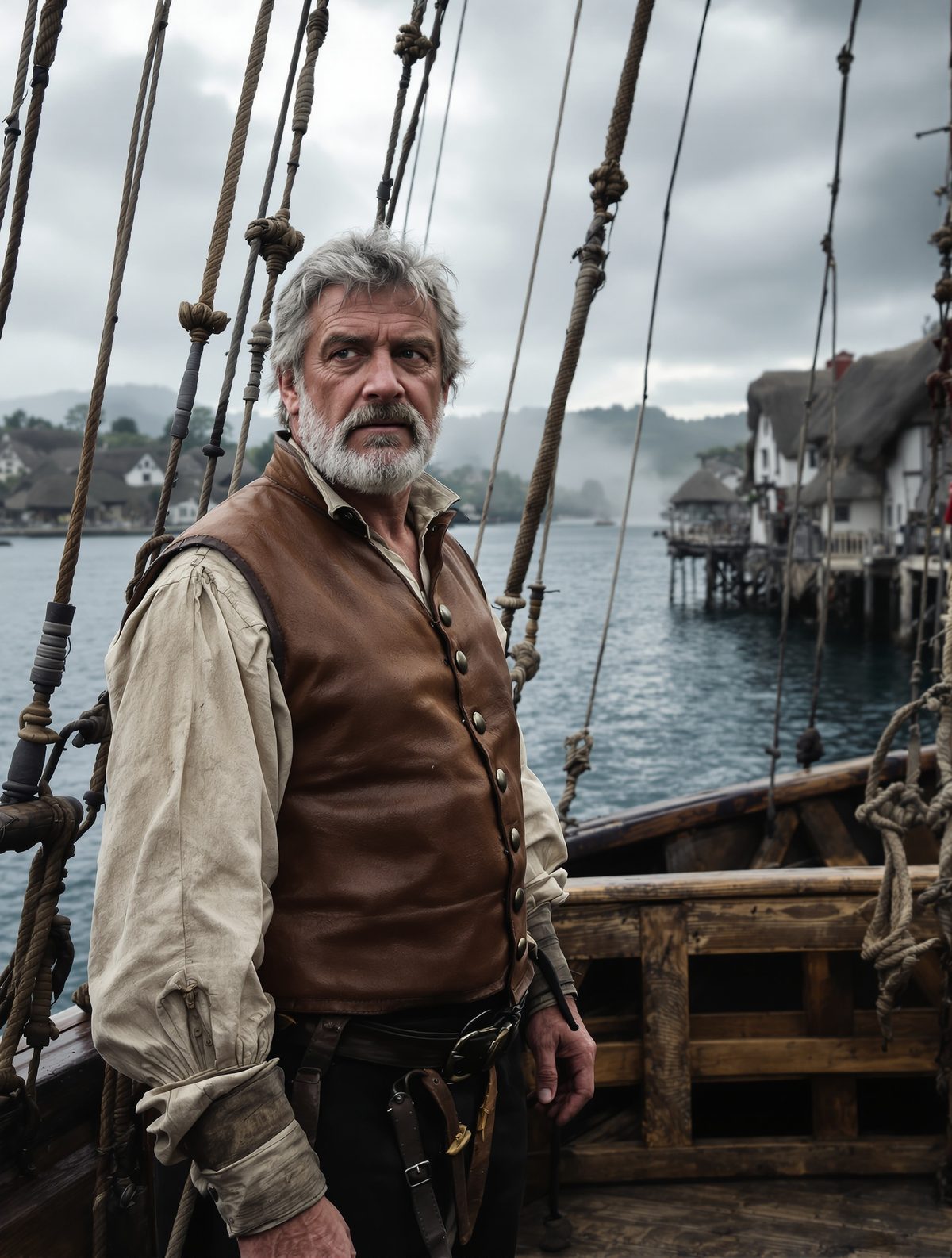
The lookouts on HMS Royal George could barely see through the driving rain as mountainous waves crashed over her bow. It was November 20th, 1759, and Admiral Edward Hawke was chasing the French fleet into what his terrified pilots called "the mouth of hell itself" – the rock-strewn waters of Quiberon Bay. Behind him sailed the most powerful naval force Britain had ever assembled. Ahead lay 21 French warships racing for the safety of shallow water, carrying the dreams of an invasion that would bring Britain to its knees.
What happened next would be fought in conditions so savage that seasoned sailors would later swear they had witnessed the wrath of God himself.
The Gathering Storm
By late 1759, Britain was fighting for its very survival. The Seven Years' War had drained the royal treasury, and French armies were winning decisive victories across Europe. King Louis XV's master plan was breathtakingly simple: while British forces were scattered across distant battlefields, Admiral Hubert de Brienne, Comte de Conflans, would lead a massive invasion fleet across the Channel to land 20,000 troops on British soil.
The French had been preparing for months. In the port of Brest, Conflans had assembled a formidable armada: 21 ships of the line, bristling with over 1,500 cannon and carrying enough firepower to reduce any British coastal town to rubble. His flagship, the mighty Soleil Royal, was one of the largest warships in the world, mounting 80 guns on three towering decks.
There was just one problem: Admiral Edward Hawke and his Western Squadron had been blockading Brest for months, trapping the French fleet in port like caged tigers. But on November 9th, a violent storm scattered Hawke's ships, and Conflans seized his chance. Under cover of darkness and driving rain, the entire French fleet slipped out to sea.
When Hawke returned to find an empty harbor, he knew that Britain's fate hung in the balance. Somewhere out there in the gray Atlantic, 21 enemy warships were racing toward his homeland's undefended coast.
The Chase Begins
Hawke's response was immediate and ruthless. Gathering every available ship, he set off in pursuit with 23 ships of the line, including some of the most famous names in naval history: Royal George, Union, Magnanime, and Resolution. These floating fortresses carried over 1,400 guns between them, but they would be useless if they couldn't catch the French fleet before it reached the invasion transports waiting at Morbihan.
For ten days, the two fleets played a deadly game of cat and mouse across hundreds of miles of storm-lashed ocean. Hawke drove his ships mercilessly, knowing that every hour's delay brought the French closer to their goal. His sailors, already exhausted from months of blockade duty, worked through howling gales to keep their ships on course.
Then, on the morning of November 20th, Hawke's lookouts spotted the enemy. Through the spray and rain, they could make out the distinctive silhouette of French warships ahead – not scattered and fleeing, but formed into battle line and ready for a fight. Conflans had decided to make his stand in Quiberon Bay, using the treacherous coastal waters as protection against Hawke's superior numbers.
It was a trap that would have deterred any sensible admiral. Quiberon Bay was a graveyard of ships, littered with underwater rocks that could rip the bottom out of a 74-gun ship of the line. Local pilots refused to enter the bay in anything worse than perfect weather, and the storm that was building promised to be the worst of the season.
Into the Teeth of the Gale
As Hawke's fleet approached the bay, his own pilots begged him to reconsider. The wind was rising to hurricane force, driving massive swells toward the rocky coastline. Visibility was dropping to mere hundreds of yards, making navigation virtually impossible. Even if they survived the approach, fighting a battle in these conditions would be tantamount to suicide.
Hawke's response has become the stuff of naval legend. "You have done your duty in warning me," he told his chief pilot. "Now lay me alongside the enemy." He ordered the signal hoisted that would send his entire fleet charging into the maelstrom: "General Chase."
What followed defied every principle of naval warfare. In conditions that should have made sailing impossible, 44 ships of the line – the largest, most expensive, and most complex machines of their age – began a running battle through waters that local fishermen avoided in rowboats. The noise was indescribable: the howling of the wind mixing with the crash of waves, the thunder of cannon, and the splintering of timber as ships scraped against underwater rocks.
Captain Augustus Keppel of HMS Torbay later wrote that the scene resembled "nothing so much as the end of the world, with wooden castles hurling fire at each other while the very ocean tried to swallow them whole."
When Giants Collided
The first ships to engage were HMS Magnanime and the French Héros. Captain Lord Howe had managed to overhaul the French rear guard, and at 2:30 PM, the two ships opened fire at point-blank range. The sound of their broadsides was audible above the storm, and within minutes, both vessels were trailing debris and wounded men.
But the real drama was unfolding between the flagships. Hawke in Royal George was hunting Conflans in Soleil Royal, and the French admiral was being forced deeper and deeper into the bay's treacherous waters. Conflans found himself caught between the devil and the deep blue sea – literally. Behind him came Hawke's pursuing ships, their guns run out and ready. Ahead lay the shoals and rocks that had claimed hundreds of vessels over the centuries.
The turning point came when HMS Resolution caught up with the French Formidable. Captain Robert Duff's ship had been chasing the French vessel for hours, and when they finally came within range, both ships were rolling so heavily in the storm that their lower gun ports were underwater. The Formidable struck her colors after a savage twenty-minute engagement, but not before a French cannonball had taken off Captain Duff's head, spattering blood across his quarterdeck.
Perhaps the most extraordinary sight of the day was the fate of the Thésée. This 74-gun ship of the line was attempting to come about when she was struck by a massive wave. Her lower gun ports had been left open after firing, and the ocean poured in like a green avalanche. Within minutes, one of France's most powerful warships had simply vanished beneath the waves, taking 750 men with her.
Victory from the Jaws of Disaster
As darkness fell, the storm reached its full fury. Ships that had been locked in mortal combat just hours before were now fighting simply to survive the night. The French fleet, scattered and demoralized, sought shelter wherever they could find it. Soleil Royal and two other ships ran themselves aground on the beach rather than face the combined threat of British guns and French rocks.
Hawke, meanwhile, performed perhaps the most audacious feat of seamanship in naval history. Rather than retreat to open water, he anchored his entire fleet in the middle of Quiberon Bay, surrounded by the very hazards that had terrified his pilots. All night long, his ships rode out the storm just miles from a hostile shore, their cables stretched to breaking point and their crews ready to cut and run at the first sign of danger.
When dawn broke on November 21st, the scale of the British victory became clear. Seven French ships had been destroyed, captured, or driven ashore. The rest were scattered and fleeing. The invasion fleet that was supposed to bring Britain to its knees had been shattered in a single afternoon.
Most remarkably, Hawke had achieved this triumph while losing only two of his own ships – and both of those to the rocks and weather, not enemy action. In the most dangerous naval battle ever fought, British seamanship and courage had prevailed against overwhelming odds.
The Legend They Left Out
The Battle of Quiberon Bay saved Britain from invasion and effectively ended France's dreams of naval supremacy for a generation. Yet this extraordinary victory is often overshadowed by more famous battles like Trafalgar. Perhaps it's because Hawke's triumph was won not through tactical genius, but through sheer audacious courage in the face of impossible odds.
In our modern age of precision-guided weapons and satellite navigation, it's hard to imagine the raw courage required to sail a wooden ship into battle during a hurricane. Hawke and his captains made split-second decisions that risked not just their own lives, but those of thousands of sailors, based on nothing more than experience, instinct, and an unshakeable belief in their cause.
The lesson of Quiberon Bay isn't just about naval tactics or British pluck – it's about the moments in history when ordinary people are called upon to do extraordinary things. Sometimes, the greatest victories come not from playing it safe, but from having the courage to sail straight into the storm.