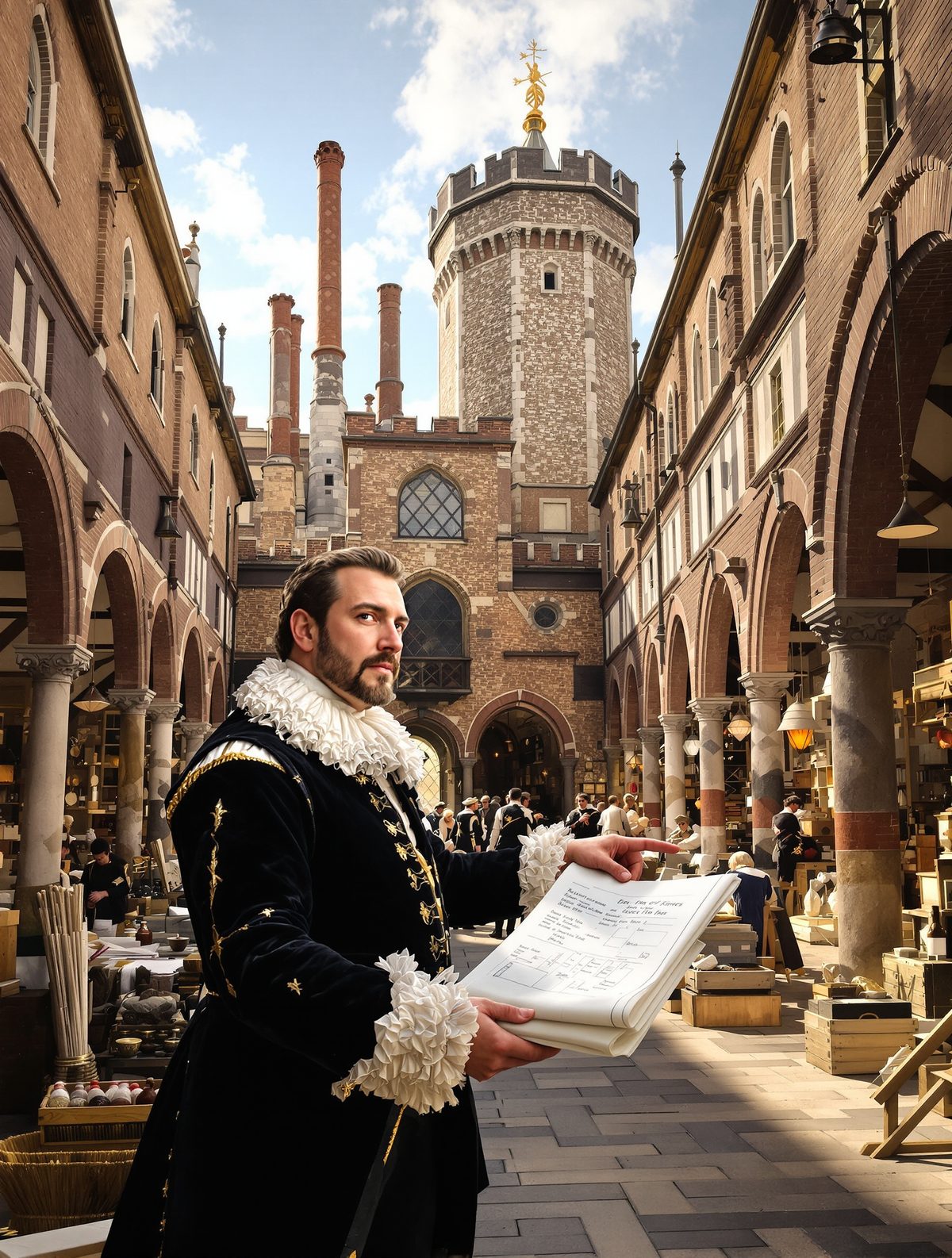
On the morning of December 21st, 1825, the tallest Gothic tower in England swayed gently in the winter wind before crashing to earth in a thunderous roar of stone and timber. For twenty-nine years, Fonthill Abbey had dominated the Wiltshire skyline like some medieval fever dream—a 276-foot spire that had no business existing in the rational Georgian world. Its collapse marked the end of one of history's most spectacular architectural follies, built with money soaked in the blood and sweat of Caribbean sugar slaves by a man who considered himself England's greatest romantic.
William Beckford didn't just inherit wealth—he inherited an empire. At age ten in 1770, he became the richest child in Britain, master of vast Jamaican plantations that produced more sugar than entire nations. What he did with that fortune would scandalize Georgian society, bankrupt his family, and leave behind one of the most extraordinary tales of excess in British history.
The Boy Who Inherited an Empire
When William Beckford senior died in 1770, he left behind more than just money—he bequeathed his son the profits of human misery on an industrial scale. The Beckford plantations sprawled across 22,000 acres of prime Jamaican soil, worked by over 3,000 enslaved Africans who toiled in conditions so brutal that mortality rates often exceeded 10% annually. The family's flagship estate alone produced 1,400 hogsheads of sugar yearly, each one representing months of backbreaking labor under the Caribbean sun.
Young William's inheritance of £1 million—roughly £150 million in today's money—made him richer than most European princes. By his twenty-first birthday, his annual income had swollen to £100,000, derived almost entirely from what contemporaries euphemistically called "West India interests." While other aristocratic children learned Latin and dancing, Beckford was already master of an economic machine that helped fuel Britain's global dominance.
But this was no ordinary heir to an ordinary fortune. Tutored by the brilliant but unstable painter Alexander Cozens and raised in the exotic splendor of Fonthill Splendens—his father's Palladian mansion—young William developed tastes that ran toward the theatrical, the romantic, and the decidedly un-English. He collected rare books in multiple languages, corresponded with Voltaire, and harbored dreams of architectural immortality that would consume his entire inheritance.
Dreams of Gothic Grandeur
In 1796, at the height of his powers and wealth, Beckford made a decision that would define his legacy: he would tear down his father's sensible Palladian mansion and replace it with something England had never seen. His vision was nothing less than a Gothic cathedral for private use—not merely a house, but a statement about the sublime power of individual imagination over conventional taste.
The design Beckford commissioned from architect James Wyatt defied every principle of Georgian restraint. Fonthill Abbey would stretch over 300 feet in length, its central octagonal tower soaring to 276 feet—taller than many actual cathedral spires. The building would contain a Great Hall 120 feet long and 80 feet high, with walls thick enough to support the massive weight above. Windows would stretch nearly floor to ceiling, flooding cavernous rooms with colored light filtered through stained glass depicting romantic medieval scenes.
But Beckford's most audacious demand was speed. Obsessed with seeing his vision realized, he insisted that work proceed around the clock. Teams of laborers worked by torchlight through winter nights, laying foundations in frozen ground and raising walls at a pace that horrified experienced builders. Contemporary accounts describe the construction site as resembling "a scene from Dante"—hundreds of workers swarming over the emerging structure like ants, their tools sparking in the darkness as they raced to satisfy their patron's impatience.
Building the Impossible
The construction of Fonthill Abbey became the talk of fashionable England, though not always in ways Beckford intended. Costs spiraled beyond all reason as his demands grew ever more extravagant. The tower alone required specially quarried stone transported from Bath at enormous expense, while the interior called for exotic materials shipped from across Europe and beyond.
Beckford spared no expense on details that few would ever see. The library was fitted with shelves of the finest mahogany to house his collection of over 40,000 volumes. The Great Hall featured a vaulted ceiling painted with scenes from medieval romance, lit by candles held in silver sconces worth a king's ransom. Even the servants' quarters were appointed with a luxury that exceeded most aristocratic homes.
Yet beneath the splendor lay fundamental problems that Beckford's impatience had created. The tower's foundations, rushed to completion in mere months, were inadequate for the massive weight they were meant to support. Experienced masons warned that the structure was inherently unstable, but their concerns were dismissed as pessimism. After all, what did English craftsmen know of the sublime? This was to be architecture as poetry, not mere engineering.
By 1813, the total cost had reached £273,000—nearly Beckford's entire inherited fortune. The sugar revenues that had once seemed inexhaustible were dwindling as plantation profits fell and debts mounted. Yet still the work continued, driven by an obsession that had long since passed rational bounds.
The Scandal That Brought Down a Dynasty
While Beckford poured his fortune into stone and mortar, scandal was gathering around his personal life like storm clouds. Rumors of an affair with young William Courtenay—son of a prominent aristocratic family—had been circulating in society since the early 1780s. In an age when aristocratic indiscretions were often overlooked, this particular transgression proved unforgivable, not because of its nature but because of its publicity.
The scandal erupted in 1784 when Beckford fled England for the continent, effectively confirming the whispered accusations. His exile lasted eight years, during which he wandered through Portugal and Spain, collecting art and writing Gothic novels while his reputation crumbled at home. Though he eventually returned, he would never again be received in polite society—a social death that for a man of his background was almost worse than physical demise.
This ostracism only intensified Beckford's focus on Fonthill Abbey. If society would not accept him, he would create his own world—a realm where Gothic romance trumped Georgian respectability, where individual vision mattered more than collective approval. The Abbey became both fortress and statement, a magnificent middle finger raised toward the society that had rejected him.
The Fall of Everything
By 1822, even Beckford could no longer ignore financial reality. The man who had once been England's richest commoner was facing bankruptcy. The sugar empire that had funded his dreams was crumbling under debt, changing markets, and the gradual erosion of plantation profitability. With creditors circling, he made the agonizing decision to sell Fonthill Abbey and its contents.
The sale, conducted by auction over multiple days, became a society sensation. Crowds flocked to Wiltshire to gawk at the treasures Beckford had accumulated—medieval manuscripts, Renaissance paintings, Oriental artifacts, and furnishings of almost unimaginable luxury. The building itself sold to John Farquhar, a wealthy merchant who paid £330,000 for Beckford's life's work.
But the Abbey's new owner would enjoy his purchase for barely three years. On that fateful December morning in 1825, structural problems that had plagued the building since its hasty construction finally reached their inevitable conclusion. The great tower, that soaring monument to romantic ambition, collapsed in a heap of rubble that took hours to stop settling.
Beckford, by then living in modest quarters in Bath, reportedly received news of the collapse with characteristic wit: "It was built on a foundation of sugar," he observed, "and like most sweet things, it could not last."
Legacy of Sugar and Stone
William Beckford died in 1844, aged 84, in relative obscurity. The man who had once commanded wealth beyond imagination left an estate worth less than £80,000. Yet his story resonates far beyond the mere rise and fall of a fortune. Fonthill Abbey represents something uniquely modern—the transformation of colonial exploitation into cultural expression, the dark alchemy by which suffering in one corner of the world became beauty in another.
Today, only fragments remain of Beckford's Gothic dream. A single tower still stands on the Fonthill estate, and scattered ruins mark where the great Abbey once rose. But perhaps this is fitting. Beckford's folly was always more about the building than the built, more about the grand gesture than lasting achievement. In our own age of spectacular inequality and architectural excess, his story feels remarkably contemporary—a reminder that the greatest fortunes are often the most fragile, and that even the most soaring ambitions remain subject to the law of gravity.
The sugar that built Fonthill Abbey was harvested by hands that would never see England, processed by people who died nameless and forgotten. Their labor, transformed through the peculiar magic of Georgian capitalism, became Gothic spires and romantic dreams. In the end, both the wealth and the wonder it created proved as ephemeral as morning mist—leaving behind only stories, and the enduring question of what monuments our own age is building on equally uncertain foundations.