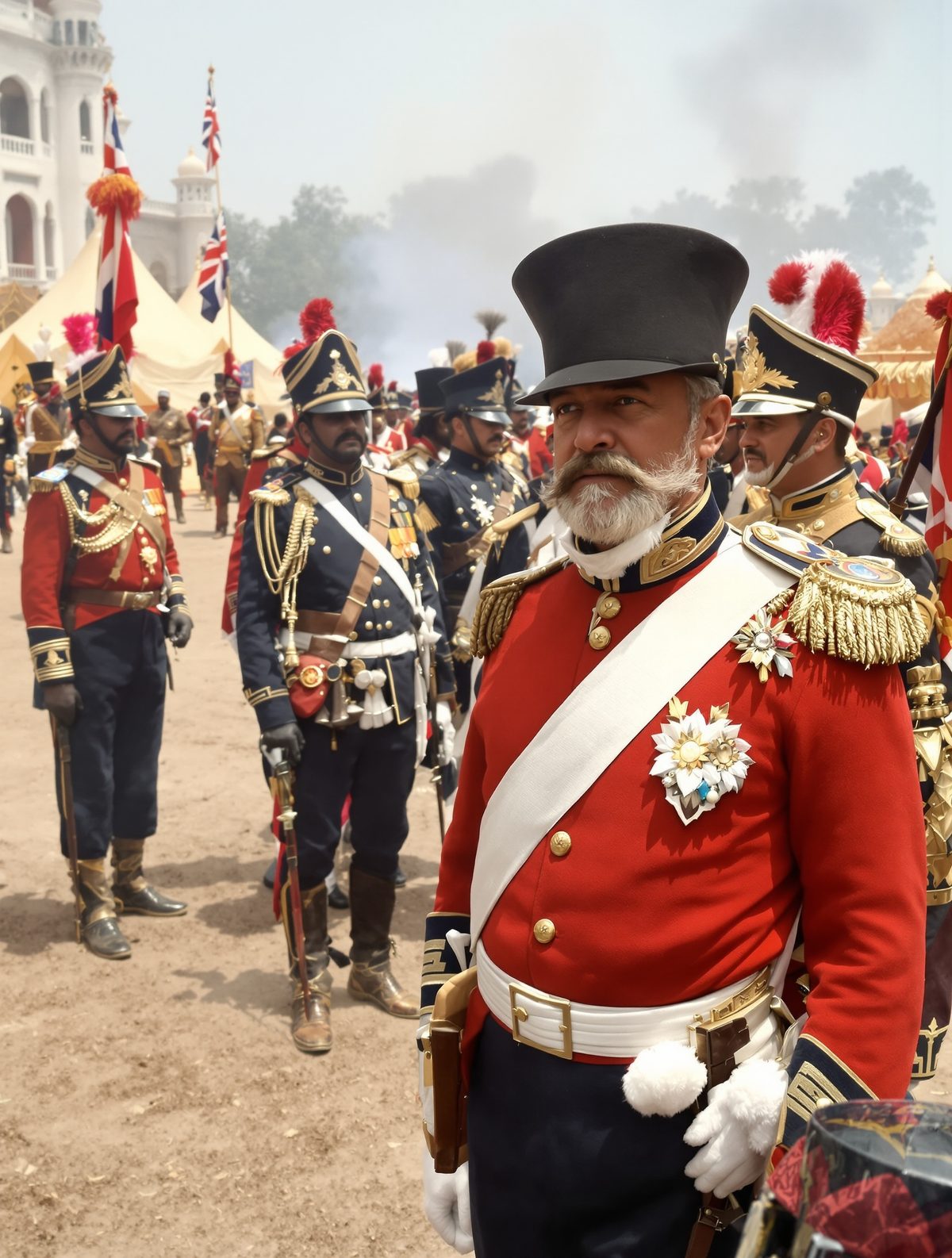
The thunder of 150 naval cannons echoed off the limestone cliffs as Admiral George Rooke watched his fleet pound the ancient fortress of Gibraltar into submission. It was July 21st, 1704, and the fate of empires hung in the Mediterranean air. Four hours earlier, the Rock had been Spanish. By noon, it would belong to Britain forever—though nobody realized it at the time. What began as a desperate admiral's last gamble would become the foundation stone of British naval supremacy for the next three centuries.
Rooke had sailed from England six months earlier with grand ambitions and a powerful Anglo-Dutch fleet. Now, staring at Gibraltar's towering ramparts through the acrid gun smoke, he was a man with his back against the wall, fighting to save not just his career, but his reputation as one of Britain's most celebrated naval commanders.
The Admiral Who Couldn't Afford to Lose
George Rooke was no stranger to victory. At 54, he had already distinguished himself in the battles against Louis XIV's France, earning knighthood and the admiration of Queen Anne herself. But his latest mission—a joint operation to capture the French naval base at Toulon—had been an unmitigated disaster. The fortress proved impregnable, and Rooke's fleet had limped away with nothing to show for months of preparation and enormous expense.
As his 51 ships sailed westward through the Mediterranean in July 1704, Rooke faced a career-ending crisis. The political winds in London were already shifting against him. His enemies at the Admiralty were sharpening their knives, ready to blame him for the Toulon fiasco. He needed a victory, and he needed it fast.
That's when his eyes fell upon Gibraltar—the massive limestone monolith that guarded the entrance to the Mediterranean like a sleeping giant. For over 700 years, it had been in Muslim and then Spanish hands. The fortress seemed formidable, its walls carved from the living rock itself. But Rooke was a desperate man, and desperate men take desperate gambles.
The Rock That Time Forgot
What Rooke discovered as his fleet approached would have made him smile if he'd known the full extent of Spanish neglect. Gibraltar in 1704 was a shadow of the mighty fortress it appeared from a distance. The garrison consisted of just 150 Spanish soldiers—barely enough to man the walls, let alone defend them against a determined assault.
The fortress's commander, Diego de Salinas, was a capable officer, but he'd been given impossible odds. The ancient walls, built centuries earlier by Moorish engineers, had never been updated for the age of artillery. Worse still, many of the fortress's own cannons were obsolete, and gunpowder stores were dangerously low. Madrid had treated Gibraltar as a backwater posting, never imagining that anyone would be bold enough to attack what appeared to be an impregnable position.
As Rooke's lookouts surveyed the defenses through their telescopes, they spotted something that must have seemed like divine providence: the Spanish flag was flying at half-mast. Unknown to the attackers, this wasn't a sign of surrender—the garrison was mourning the recent death of a popular officer. But to Rooke's men, it looked like weakness, and they prepared for battle with renewed confidence.
Four Hours That Changed History
At 6 AM on August 4th, 1704, Rooke gave the order that would echo through history. His fleet moved into position, and 150 cannons opened fire simultaneously. The sound was described by one witness as "like the very gates of hell opening." The limestone cliffs amplified the thunder until it could be heard 20 miles away across the Spanish countryside.
What followed was one of the most devastating naval bombardments of the 18th century. Rooke's gunners, veterans of countless sea battles, poured shot after shot into Gibraltar's walls with mechanical precision. The ancient masonry, never designed to withstand such concentrated firepower, began to crumble like chalk.
By 10 AM, great sections of the fortress wall had collapsed entirely, creating gaping breaches that looked like broken teeth. Spanish return fire was sporadic and largely ineffective—many of their cannons had been dismounted by the bombardment, and several powder magazines had been hit, creating spectacular explosions that further demoralized the defenders.
But perhaps the most crucial blow came when a lucky shot severed Gibraltar's water supply. The fortress depended on rainwater collected in ancient cisterns, and when these were damaged, de Salinas knew his position had become untenable. Without water, his 150 men couldn't hold out for more than a day or two.
Marines Storm the Impregnable Rock
As the bombardment reached its crescendo, Rooke launched the second phase of his attack. Prince George of Hesse-Darmstadt, the nominal leader of the expedition's land forces, led 1,800 English and Dutch marines toward the smoking breaches in Gibraltar's walls.
The assault was a masterpiece of 18th-century amphibious warfare. Marines landed on the narrow beaches at the foot of the Rock while naval gunfire continued to suppress the Spanish defenders. Using scaling ladders and sheer determination, they clawed their way up the limestone cliffs and poured through the gaps created by Rooke's cannons.
What's remarkable is how little resistance they encountered. de Salinas, recognizing the hopelessness of his situation, had already begun evacuating his men to the Spanish lines further north. By noon, the Union Jack was flying over Gibraltar's highest tower, and British marines were exploring the vast network of tunnels and chambers that honeycombed the Rock.
The entire operation—from the first cannon shot to complete victory—had taken just six hours. Rooke had achieved in a single morning what would elude Napoleon, Hitler, and every other would-be conqueror for the next three centuries.
The Victory That Nobody Expected to Keep
Here's the twist that makes Gibraltar's capture even more extraordinary: Rooke never intended to hold it permanently. In 1704, British strategy in the Mediterranean focused on temporary bases and hit-and-run tactics. The plan was to use Gibraltar as a bargaining chip in future peace negotiations, then hand it back to Spain in exchange for concessions elsewhere.
But Gibraltar proved too valuable to give up. Its position at the mouth of the Mediterranean meant that whoever controlled the Rock could control all naval traffic between the Atlantic and the Mediterranean. British merchants immediately recognized its potential, and the Royal Navy began using it as a permanent base for Mediterranean operations.
When the Treaty of Utrecht was signed in 1713, ending the War of Spanish Succession, Britain's negotiators insisted that Gibraltar be ceded permanently to the Crown. Spain agreed reluctantly, never imagining that this "temporary" concession would last for centuries.
The Rock That Built an Empire
Today, more than three centuries later, Gibraltar remains British territory—a 2.6-square-mile reminder of Admiral Rooke's desperate gamble in 1704. What began as a career-saving operation became the cornerstone of British naval power in the Mediterranean.
From Gibraltar's harbors, British fleets would control the sea lanes to India, protect convoys during the Napoleonic Wars, and project power throughout the Mediterranean basin. During World War II, Gibraltar's airfield and naval base proved crucial to Allied operations in North Africa and the invasion of Italy.
Perhaps most remarkably, the fortress that fell in four hours of bombardment has never been successfully recaptured. Spain besieged it for nearly four years during the American Revolutionary War, using some of the most advanced siege techniques of the age. They failed completely. Hitler's generals drew up detailed plans for Operation Felix, the capture of Gibraltar, but never dared attempt it.
In our age of precision missiles and cyber warfare, Gibraltar's strategic importance might seem diminished. But the Rock remains a vital symbol of how a single day's bold action can reshape the balance of power for centuries. Admiral Rooke's four-hour bombardment didn't just win a fortress—it won the foundation of a global empire, secured with just 1,800 marines and the courage to gamble everything on one desperate throw of the dice.