The sun hung low in the endless sky, casting its amber glow across a sweeping landscape of icy blues and whites. The wind whistled eerily past skeletal trees and danced playfully over the snow-draped ground, where every footprint was swallowed by the vastness of the wilderness. This was Canada’s untamed north in 1908—a place where few dared venture and fewer still lived to describe. Amidst this stark beauty, a woman named Agnes Deans Cameron defied every norm and expectation to chart a course to the Arctic Ocean, her determination as unyielding as the ice beneath her feet.
The Ignition of Defiance
Agnes Deans Cameron was no stranger to defiance, and she wore it like a badge of honor. Before embarking on her Arctic odyssey, Cameron had already earned a reputation for challenging the status quo as an educator in the bustling halls of Edwardian Canada. As one of the first female school principals, she had fought tirelessly against the antiquated methods and prejudiced decrees that stifled both instructors and students alike. Her dismissal on the grounds of insubordination only fanned the flames of her resolve. Dubbed 'too old', 'too female', and undoubtedly 'too stubborn', Cameron was warned at every turn that the northern wilds were no place for a woman of her station and age.
Nevertheless, Cameron saw something in the north that others refused to acknowledge: untapped potential. Where others perceived a barren, inhospitable expanse, she envisioned untold stories and uncharted opportunities. It was this stubborn vision that led her to defy the cautionary tales of railway officials and the ridicule of newspapers alike. She announced her journey northward with a tenacity honed in the face of adversity, determined to prove that the Arctic was not a desolate frontier, but a vibrant part of the Empire.
The Preparations and the Skeptics
Packing her bags was the easy part. Cameron knew that the grueling journey ahead was not merely about the physical challenges she would face, but the ideological barriers she would smash through. Nearly every advisor she consulted attempted to dissuade her, painting a picture of the Arctic as a frozen hinterland, unworthy of exploration. Undeterred, she meticulously compiled her equipment—provisions, maps, and the basic necessities to survive what would be a 2,000-mile trek across Canada’s formidable northern reaches.
The English press fanned her cause, as they often do with eccentrics who tread unfamiliar paths. While some dismissed her endeavor as a folly of an obstinate spinster, others found in her audacious plans the seeds of intrigue. What they could not anticipate was how her journey would transform her into an unyielding advocate for Canada’s north, a region that until then had been largely written off in the Empire’s collective consciousness.
Traversing the Wilderness
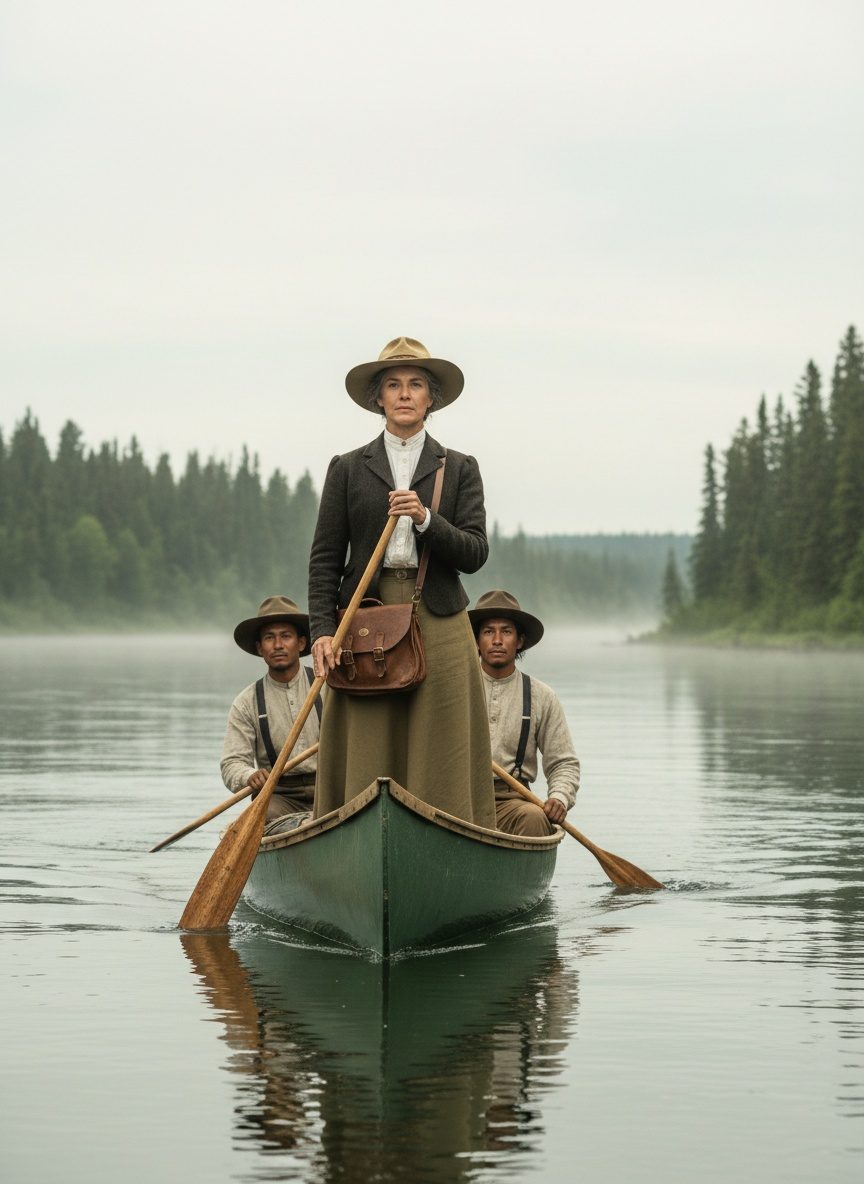
With a grizzled smile and an indomitable spirit, Cameron set off into the wilderness. She glided through tranquil waters by canoe, balancing against river currents and slipping through the sinewy grips of frigid shores. Her journey was an evolving tapestry of rugged landscapes—from whispering pines to sprawling tundras, from silent, snow-capped peaks to meandering, icy rivers. Each step forward was both a conquest and a dance; with no guide but her inner compass, she marked the pages of her journal with the ink of discovery.
The First Nations communities she encountered offered her both hospitality and wisdom, though much of their lives and legends had yet to be transcribed into the annals of imperial acknowledgment. Cameron listened intently, observed respectfully, and in turn shared her own narratives from the cities down south. Every interaction, every shared fireside tale, fueled her resolve to depict the north’s value—the vibrancy of its people, the richness of its resources—and its irreplaceable importance to Canada's identity.
Bringing the Arctic South
After months traversing the heart of the Empire's northern extremes, Agnes Deans Cameron emerged from the Arctic wilds not as a weather-beaten relic, but an enlightened emissary. Her return was underpinned by something solid: proof. She had collected a treasure trove of photographs, sketches, and anecdotes that served to illuminate the misunderstood mysteries of the north. Her vividly detailed letters and articles soon flooded the very newspapers that had once doubted her capacity, each piece a testament to what she had realized: the northern wilderness was alive—thriving, even—abundant with potential that waited only to be harnessed and understood.
Cameron's accounts, laden with the striking and raw beauty of the Arctic, inspired those ensconced in the comforts of southern society to see the frozen crust not as a barrier, but a bridge to untapped promise. Her articulation moved the lens of the Empire, allowing a shift from imperial complacency to potential investment. Through her eyes, the Arctic was no longer a statistic or a mere space on the map; it became a topic of discourse, exploration, and intrigue.
Beyond the Footprints
Cameron did not simply return from her journey; she returned with a voice amplified by her convictions and informed by her experiences. Her journey dared to shift perceptions and challenged the narratives that confined Canada’s vast northern spaces to a frozen afterthought. Agnes Deans Cameron’s legacy lies stout and unyielding, like the frozen ground she crossed, in the knowledge that inertia is the true opponent of progress. Her story, unknown to many textbooks, is a reminder that beyond every frontier waits not only adventure, but the opportunity to reshape how we perceive the world.
Agnes Deans Cameron’s remarkable journey north offers a portrait of persistence and innovation, carved into the frigid folds of the Arctic itself. Her footprints remind us that stories are not just written in ink or printed on pages, but engraved in deserts of snow and whispers of history. The north was and remains a testament to her vision—one that beckons future generations to heed life's untraveled paths, armed with questions, courage, and perhaps, too, the wisdom to defy a whispered "no."