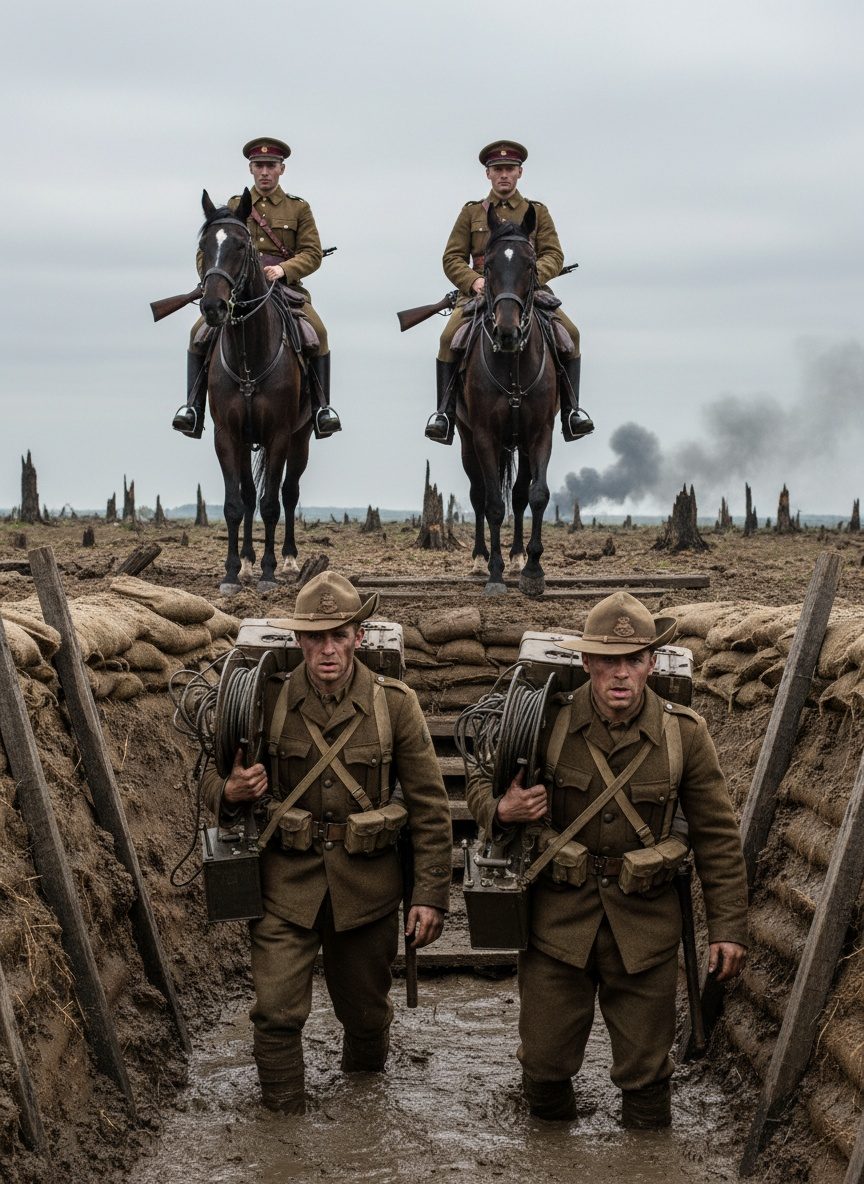
They were men without words, moving beneath and above the earth with equal determination. Two years earlier, the thought of hauling wire could hardly compare to the exhilarating allure of a horse charge. But May 1917 was a time for the unprecedented. Near Neuve-Église, France, a British cavalry unit met an Australian signaller troop, and two worlds of warfare shifted, if silently, together.
The Slow March of Progress
By 1917, the winds on the Western Front had begun to smell less of the earthy breath of horse and rider, and more of the thick, heady aroma of industry. The land beneath the cavalry's feet was carved into trenches webbed with communication lines that connected commands to their charging arms. Amid the endless mud, dust, and danger of France in the spring, soldiers from the Australian Imperial Force worked tirelessly to maintain the lines of communication that had become the army's backbone.
It was a thankless task, unromantic compared to the thundering gallop of the cavalry that occasionally danced above them. The signallers carried a job both essential and unsung. Without these lines, the battlefield would dissolve into chaos, a loss more crippling than any cavalry charge. Yet, the traditional image of a soldier on horseback, saber raised, still captivated and drew admiration. But as they crossed paths near Neuve-Église, a sense of transfiguration swept through them all, even if unspoken. The warriors of horseback and wire were carving the rules of the future battlefield.
A Meeting of Old and New
The Australians were veterans of mud. Clad in weather-dampened uniforms, they laid the groundwork for efficient communication under fire. As they moved stealthily through the trench, they were caught in the strange shadow of a British cavalry unit making its cautious crossing overhead. The cavalry, still esteemed for their past glories, picked their way across a war-torn tapestry destined for their obsolescence.
Cutting through the chilled May air was the horsemen’s intense concentration, their silhouettes against the sky seeming part of a fading tableau. This crossing, captured by the camera, symbolized more than a simple logistical endeavor. It marked the convergence of two worlds — one archaic, one modern — both struggling to define their place in a war that defied expectations. How that moment, trivial to its participants, encapsulated a broader transformation in military strategy, highlights the intricate bridle between tradition and innovation.
The Imperceptible Shift
As the war stretched on mercilessly, so too did the role of communications. The telephone lines, the buzzing telegraph signals, and the coded whispers carried much without boasting the steely clatter of sabers. These signallers, crouched and keen-eyed, were the modern-day Hermes, ferrying secrets and commands crucial to both saving and clinching lives.
Their anonymity was their power; their uncelebrated toil was their legacy. To them, the wires were lifelines, binding the scattered elements of a vast military force into a coherent organism capable of responding to an enemy's every move. Meanwhile, the cavalry, shackled to an archaic prestige, was entangled in its transition from warriors to mere tactical players. No longer the spearhead, they were becoming roving supporters, a far cry from the battlefield dominion their predecessors knew.
Two Worlds Passing
Yet, it was not so simple as the mourning for a past era, nor the unbridled celebration of the new. For both the cavalrymen and the signallers who day by day tread beneath and above each other, their dedication exhibited the ineffable human spirit. On that day in May 1917, the signallers reminded the war of its new voice and maintained the rhythm of its beating heart, while the cavalry continued to dream of open fields, distant thunder echoing beneath striking hooves.
This tale resonates not for its grand strategic maneuvers or its towering military victories. Rather, it captivates for its quiet revolution, the moment when silence spoke louder than disarray, and foot soldiers carrying spools of wire held as much might as mounted warriors. They lived two different battles, yet their paths — literal and metaphorical — converged. It is a reminder of war’s evolution, where the unseen became indelible, and where, in the lull of a May morning, the horse truly gave way to the wire.