Birsa Munda never lived to see his 26th birthday. Yet, in his short life, he became a legend who dared to challenge the British Raj on its own turf. This tribal boy from Jharkhand was no ordinary rebel; he was a visionary leader who could unite thousands with his words, igniting a spark that would burn brightly in the annals of India's struggle for freedom.
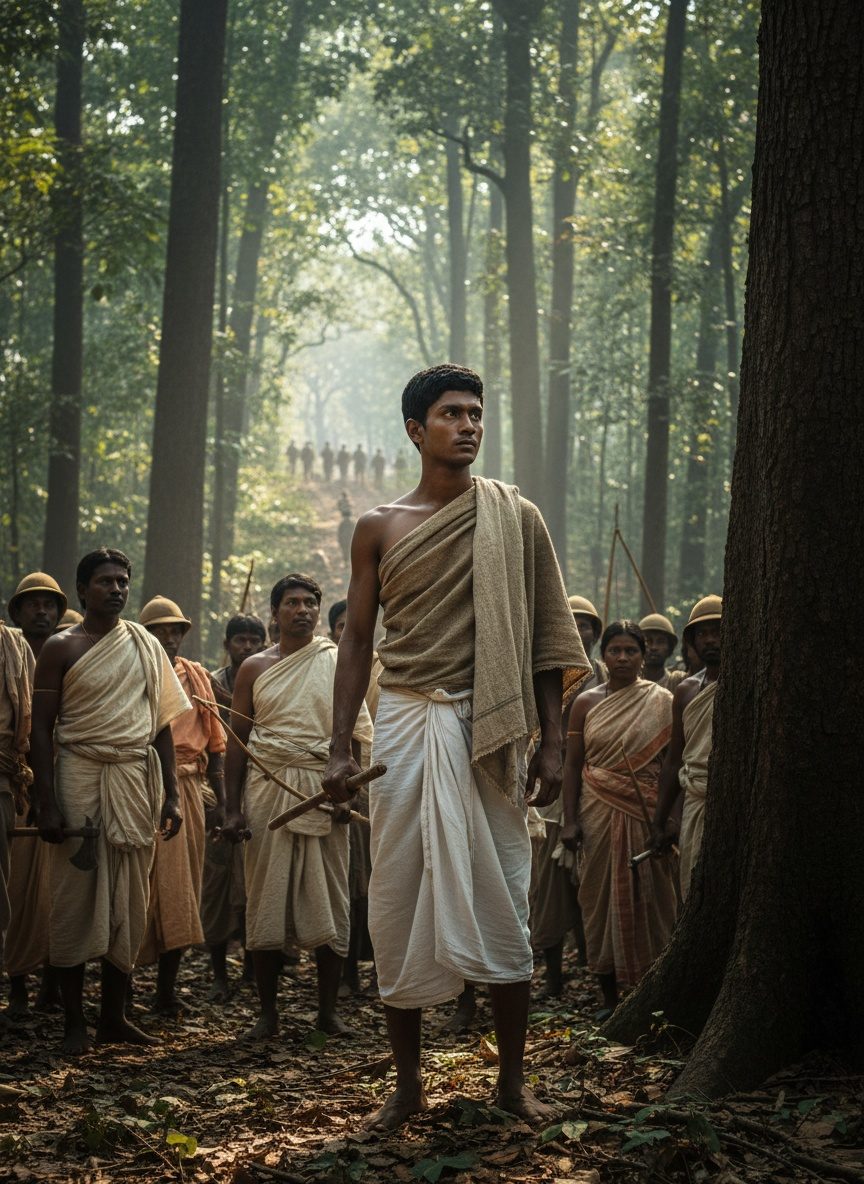
The dense forests of Jharkhand, with their verdant canopies and hidden trails, became the backdrop of a fierce rebellion in 1899. Here, Birsa Munda rose as a prophet among his people, the Munda tribe. His revolutionary spirit was infectious, spreading through the tribal community like wildfire. Born in 1875 in the small village of Ulihatu, located within the thick woodland terrain of present-day Jharkhand, Birsa grew up amid endemic poverty and exploitation. The British colonial officers and dikus, or outsiders, imposed heavy taxes on the Mundas and systematically appropriated their lands. This ruthless exploitation was commonplace, yet it sowed the seeds of rebellion in Birsa's heart from a very young age.
In the late 19th century, the Mundas were feeling the crush of increasing British pressure as they encroached upon indigenous lands, forcing many tribal communities into bonded labor. The oppressive tactics of the Raj and the encroachment of dikus compelled them to rise, guided by Birsa’s clarion call of “Abua raj ete jana, maharani raj tundu jana” — Let the kingdom of the Queen be ended and our kingdom be established. Unlike other leaders, Birsa was no mere administrator of justice. He proclaimed himself a prophet, claiming divine visions and blessings. Under his leadership, the movement took on an almost mystical fervor. As he preached the salvation of his people and the rejuvenation of their lost sovereignty, Birsa became more than just a leader; he was their dharti aba, the father of their land.
Birsa Munda’s revolt, known as the Ulgulan or "The Great Tumult," was no spontaneous uprising but a strategically planned offensive against the British structures of power. His followers formed an army wielded in traditional guerrilla warfare, utilizing bows, arrows, axes, and the intimate knowledge of their land. In late 1899, this ragtag band of warriors decided to challenge an empire that spanned continents. They attacked police stations and government outposts, effectively dismantling symbols of British authority wherever encountered. The dense forests provided both sanctuary and strength, with the familiar terrain acting as their steward in battles against the more mechanically advanced British forces.
The colonial administration was initially dismissive, underestimating this barefoot prophet and his followers. They soon realized the extent of their error. British troops, led by seasoned officers, found themselves drawn into the jungles, confounded by their adversaries’ guerrilla tactics and the unforgiving landscape. The British deployed columns of infantry, tasked with snuffing out the resistance, only to find the Munda fighters striking with agility and vanishing into the woods. The dense canopy overhead, combined with the resounding chorus of the burgeoning forest, muffled the sounds of battle to all but those who dared to venture inside.
Birsa’s image as a young man of immense charisma resonated with his people, not just as a militant leader but as a champion of social reform. He advocated for a tribal society free from alcohol and urged the Mundas to embrace agrarian self-sufficiency, cloaked within a spiritual revival. His influence was significant, enough to incite both fear and respect among colonial officials. In this capacity, the British saw him as a formidable foe. Rather than a mere military challenge, Birsa's movement became a comprehensive socio-political challenge to the Raj, emphasizing indigenous rights and cultural revival.
The British, determined to stifle whispers of insurrection, launched a manhunt across Jharkhand to capture the elusive Munda leader. By January 1900, Birsa was the most wanted man in the region. However, the pressure on his cadres mounted. The movement’s momentum began to wane as the British adapted to the guerrilla warfare tactics, capturing key tribesmen and isolating Birsa from potential sympathizers. Despite the encircling pressure, Birsa's defiance never wavered. He stayed steadfast in the belief that his cause was just. Ultimately, he was captured on February 3, 1900, at Jamkopai forest, Chakradharpur, torrential rainstorm aiding his pursuers.
Imprisoned in Ranchi, Birsa’s health deteriorated rapidly. The harsh prison conditions took their toll, leading to his untimely death on June 9, 1900. Though the British declared his death the result of cholera, the circumstances remain shrouded in mystery, fuelling narratives of martyrdom among his people. Nonetheless, his legacy endured, echoed by the continued resistance of the Munda tribe against colonial rule.
Birsa Munda's story is often eclipsed by the tales of better-documented freedom fighters, yet his impact on his people endures. His brief yet galvanizing rebellion provided a template for resistance that echoed through future uprisings, showing that even the most formidable empires could be shaken by the determined cries of justice. Up to this day, Birsa remains a revered figure, symbolizing the struggle for indigenous rights and self-determination. His spirit is enshrined in the very land he sought to protect, a land that echoes his call for freedom and dignity. The Birsa Munda Hockey Stadium in Jharkhand is a living testament to his enduring influence, serving not only as a ground for sport but also as a memorial to the indomitable will of a young tribal leader who dared to dream of a nation free from tyranny. Birsa Munda may have been only 25 when he died, but in those 25 years, he created a legend that could never be silenced.