
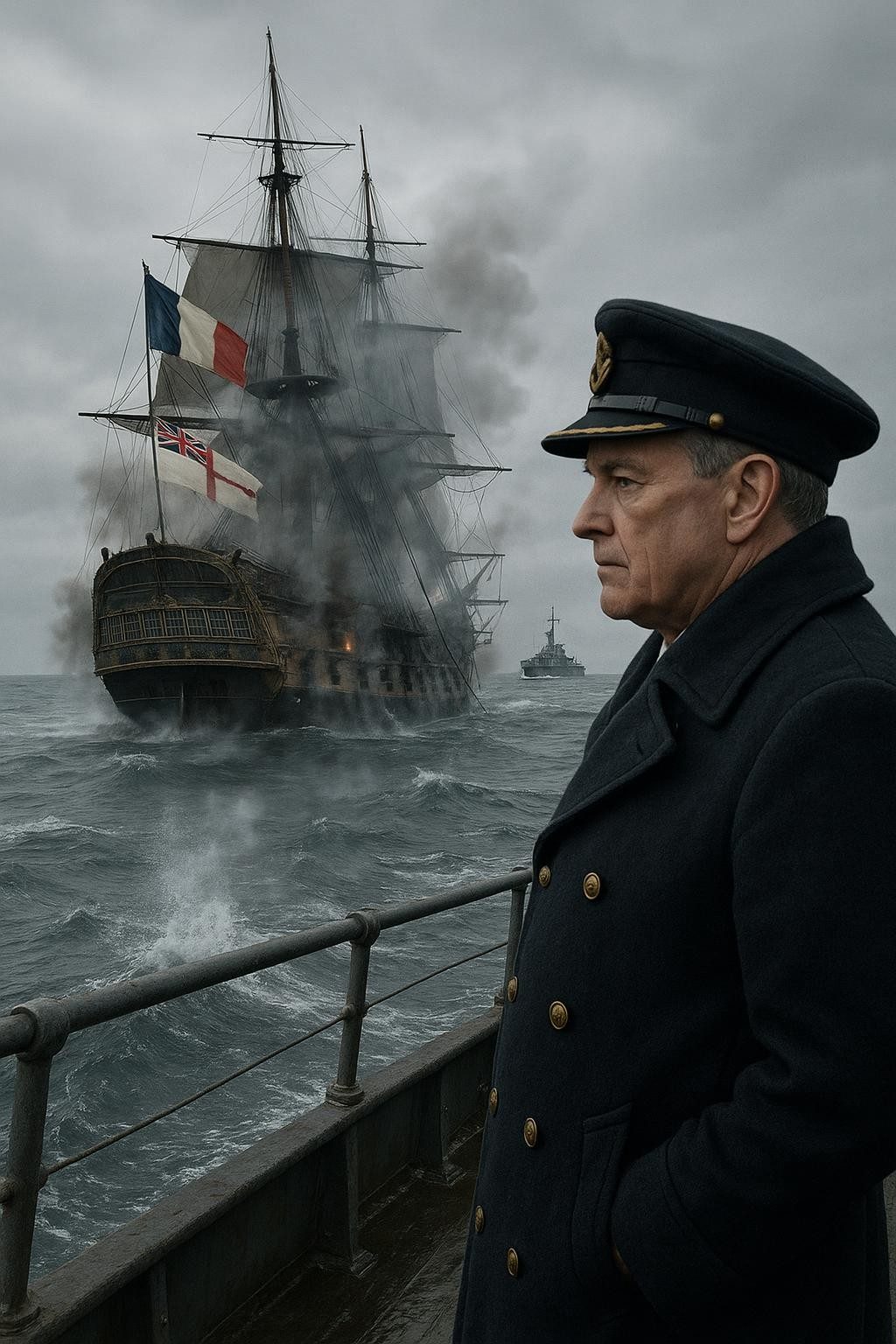
December 2, 1949. The old ship creaked one last time as the water embraced her hull.
A Legend Born in Battle
The life of the HMS Implacable could have filled several books rather than space on a ledger that signaled her end. Born as the French ship Duguay-Trouin in the early 19th century, she was more than just timber and sail. Her keel was laid during the volatile era of Napoleonic ambition, aimed at challenging British naval supremacy. Her design was both elegant and formidable, reflective of the might Napoleon sought to wield across Europe.
In 1805, amid the gunpowder smoke and roar of cannon at the Battle of Trafalgar, the Duguay-Trouin found herself on the losing side of an engagement that reshaped naval warfare. It was a battle that saw the British Royal Navy, under Lord Nelson, dismantle a combined fleet of France and Spain with ruthless precision. Captured by the British, she was recommissioned as the HMS Implacable, fittingly named for the relentless ferocity she had witnessed and would herself come to symbolize.
The Implacable did not fade into obscurity after her capture. For decades, she served under the White Ensign, an enduring trophy of Britain’s dominance at sea. Her timbers, once symbols of French ambition, were a testament to British resilience and naval ingenuity. As the years rolled on, she became a storied veteran, outlasting many of her peers and echoing tales of a bygone era where sail gave way to steam.
The Quiet Years and Fading Glory
By the end of the 19th century, HMS Implacable was already considered an artifact of history. While the world advanced into the age of ironclads and dreadnoughts, the old wooden warship appeared as a relic from a past world. She was repurposed as a training vessel, stationed at Portsmouth, teaching the new generations of sailors the ancient art of seamanship. Though her guns had long since fallen silent, her decks ran with the clatter of boots and the laughter of young men shaping the future of the Navy.
Even in these quieter years, Implacable retained her dignity. Navy cadets learned to tie their first knots in her rigging and to navigate their first courses amid her weathered masts. The stories she inspired in these young minds kept the memories of Trafalgar alive. Yet, as the decades waned, so too did the finances and the will to maintain her. The ravages of time and the weight of two World Wars left little room for nostalgic preservation in post-war Britain.
By 1947, HMS Implacable was one of the last remaining links to the fleets of Nelson. Only HMS Victory, Nelson's own flagship, was older. Discussions arose around preserving her as a piece of history, a tangible connection to a past that shaped Western oceans. Yet, the country’s economic status dictated otherwise. The ravages left by the war required that every shilling be accounted for, and there was no room in the budget for sentiments, no matter how grand.
The Decision to Scuttle
Everyone involved understood what scuttling such a venerable vessel would mean. Weighed against the cold arithmetic of post-war recovery, sentimentality wafted like smoke from its faded figurehead. Despite passionate appeals from historians and naval enthusiasts, the decision fell to the cabinet members who saw the ship more as a fiscal burden than a heritage museum.
The final day of HMS Implacable was set, and on December 2, 1949, she was towed to her watery grave in the English Channel's embrace. Maritime officials, historians, and loyal crew members stood silently on the decks of the attending vessels as she was sunk. Rather than allowing her to rot away in ignominy, this last act held a modicum of dignity, permitting a seamless transition from treasure of the surface world to guardian of the ocean floor.
In her sinking, a powerful symbol endured: Implacable sailed for two nations under complex circumstances. In an act of poignant remembrance, both the French Tricolore and the British White Ensign flew on her stern in silent accord, signaling a complex but shared maritime legacy. Her submergence marked not an end, but a ceremonial farewell to an era that had sailed into history.
The Significance of Implacable’s Journey
The story of the HMS Implacable is one of shifting identities and allegiances, illustrating the transmutable nature of heritage and memory. Her bones now lie beneath the waves, yet her voyage resonates through history’s soggy annals. What remains is the tale of a ship that served under two flags and homes, a tangible link to the grand maritime narratives of the 19th century.
In today’s scaled digital sprawl, the discipline and craftsmanship of her sailors seem to belong to another universe. Nevertheless, Implacable’s tale underscores the impermanence of cultural relics alongside the enduring narratives they buoy. The potentially salvaged past easily surrendering to the pragmatic needs of a nation's future speaks to the ongoing dance between history and modernity.
As history inevitably ebbs, much like the tides covering her resting place, we are left pondering the weight of decisions made at watershed moments. Trafalgar may have been her first significant encounter, yet her scuttling resonates equally — a reminder that while ships may succumb to the sea, the legacy of their voyages eternally cuts through time.