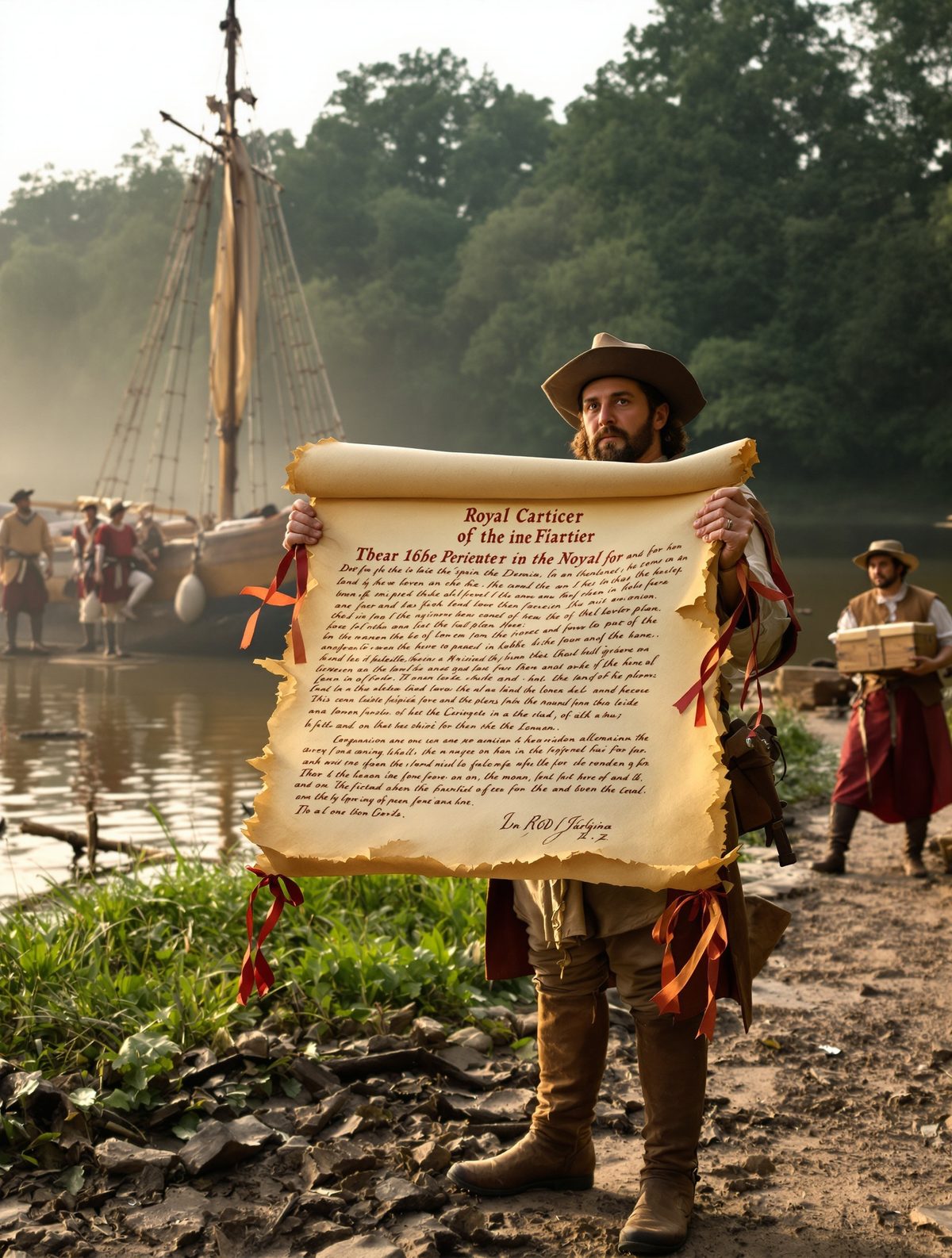
Imagine the scene: the year is 1607, the month of May. A small group of English settlers, weary from weeks at sea, finally step onto the shore of what is now Virginia. The sun glints off nearby waters as these men and women behold their new world — but they have brought with them something old, an invisible treasure woven into the very fabric of their endeavor: the common law of England. Found inside the royal charter that granted them permission to settle Jamestown, this ancient but evolving legal entity would shape a nation. Over four centuries later, it remains the backbone of American law. How did this remarkable journey begin, and why does it matter today?
The Birth of Jamestown
On December 20, 1606, three ships set sail from England: the Susan Constant, the Godspeed, and the Discovery. Aboard were 105 adventurers, searching not for glory on distant battlefields, nor gold in the fabled El Dorado, but for survival in a harsh and unknown land. By the time they reached Jamestown Island on May 14, 1607, only 104 made landfall. And as they meticulously worked to build James Fort, named after King James I, they relied on an intangible companion: the legal principles from their homeland.
The charter, granted by the king to the Virginia Company, explicitly stated that the colonists and their children were to enjoy the same liberties, franchises, and immunities as if they had been abiding in England. This compact ensured their legal rights were intact, a beacon of order amidst the chaos of the New World. Astonishingly, these ancient customs and laws, some dating back to the Magna Carta of 1215, were considered essential enough to endure a perilous Atlantic crossing.
A Thousand Years of Evolution
The common law that traveled across the ocean was more than just a set of statutes — it was an evolving tradition. Rooted in decisions made by English judges, common law adapted and grew over time. It was not a static code but a living, breathing entity, closely connected to the concept of stare decisis, meaning "to stand by things decided." This continuous thread made its way into the heart of the Jamestown settlement.
Unlike the Roman law prevalent in continental Europe, English common law emphasized individual rights and the due process of law. Judges often interpreted and applied king's law, setting precedents that would guide future decisions. This commitment to legal precedent was crucial to maintaining consistency and justice in an unpredictable colonial environment. It's intriguing to note how the settlers' reliance on these customs and laws helped foster an early sense of autonomy and governance.
The Surprising Influence on American Institutions
As the 17th century progressed, the settlers of Jamestown faced numerous challenges—hostile encounters with indigenous peoples, a severe lack of food, and diseases that took their toll. Yet the legal principles that accompanied them served as a stabilizing force. County courts were soon established, modeled after those in England, providing a framework for local governance.
Among the lesser-known facts about Jamestown is the creation of the first legislative assembly in the New World in 1619: the Virginia House of Burgesses. This marked the earliest form of elected representation in America, a direct descendant of England's evolving Parliament. The common law principle of regular gatherings for the discussion of community laws became enshrined, planting seeds for modern American democracy. Many are surprised to learn that these gatherings laid the groundwork for the American Revolution more than a century later.
The Common Law's Journey Through Time
By the 18th century, the common law had woven itself into the very fabric of American colonial life. Even as colonists began to tire of British rule, the resilience and adaptability of the common law inspired figures such as Thomas Jefferson and James Madison in shaping the founding documents of the United States. By 1776, the American colonies declared independence, but the common law endured as an invisible tether binding the two nations, allowing the new nation to flourish under familiar legal foundations.
Surprisingly, when the United States drafted its Constitution in 1787, many of the common law principles crossed into the new legal system. Concepts such as trial by jury, the rights of the accused, and checks and balances within the government found their way directly into American jurisprudence. The invisibility cloak of common law did not make it any less powerful. Instead, it had become an indispensable ally in the young nation's legal development.
The Legacy of the Invisible Treasure
Fast forward to the present day, and one can still see the profound impact of common law in the United States. Its legacy lives on in countless courtrooms and legal decisions across the nation, a testament to the foresight of those early Jamestown settlers. The invisible inheritance granted in 1607 has permeated American culture and governance, influencing everything from property rights to individual freedom.
So, why does this matter today? In a society deeply polarized and constantly evolving, understanding the roots of our legal system provides context and clarity. This invisible treasure not only survives but thrives, showcasing how linked the past and present truly are. It serves as a reminder that even amidst turmoil and change, the rule of law remains a steadfast guide — no less now than it was across the ocean in 1607, on the shores of Jamestown.