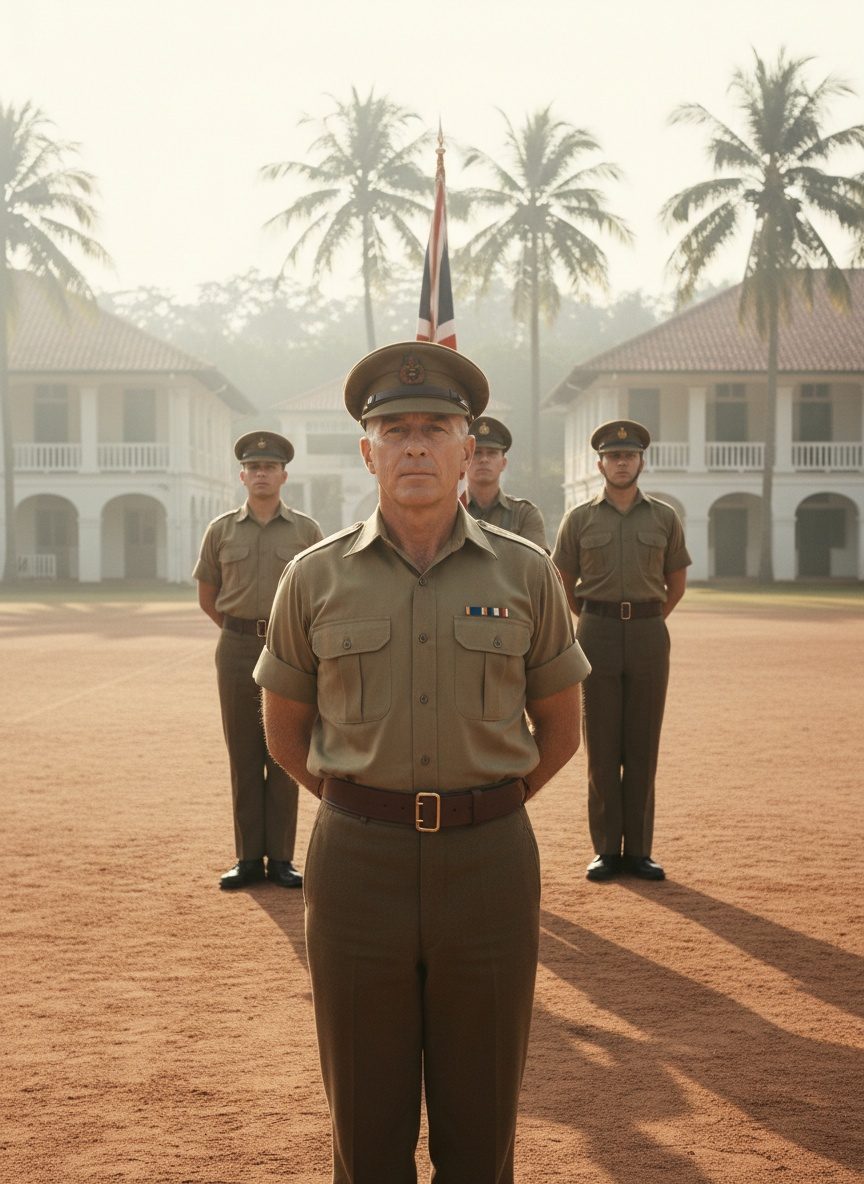
The British military presence in Singapore ended quietly. It marked the closing of an imperial chapter that had once echoed loudly throughout the world.
The Final Farewell
On that fateful October day in 1971, Singapore's harbor lay beneath a sullen sky, a fitting backdrop for the withdrawal of the last British troops. Soldiers, soon to be memories, meticulously packed their olive-drab kit bags. The air vibrated gently with the somber notes of a military band; no triumphant fanfare, merely a respectful nod to an era rapidly slipping into history. There was no grand ceremony to demarcate this poignant moment. Just men, committed to their sworn duties, readying for the inevitability of departure.
It was a scene steeped in nostalgia, one that felt more personal than political. The Union Jack, flying high for decades since the end of World War II, was slowly lowered, folding once, twice, and then again. Each crisp fold seemed to capture a piece of the past, and as the red, white, and blue faded from view, the political realignment of Southeast Asia crystallized. Britain's presence had not simply been military; it had been a function of its identity as an empire of dominion, bridging East and West. As soldiers bid their goodbyes to this strategic outpost, it symbolized the end of an epoch steeped in complex imperial legacies.
A Legacy of Fortification
For over a century, the British garrison in Singapore stood as a testament to fortified power at the edge of Southeast Asia. Singapore’s strategic location as a bustling maritime crossroad meant it was more than a geographic anchor; it was envisioned as an impregnable fortress, famously labeled the 'Gibraltar of the East'. This was not just about defending territory; it was about showcasing unequivocal imperial might.
The island had witnessed a turbulent passage through history, most notably its occupation by Japanese forces during World War II. Many forget that it was the widely regarded nadir of British military failure when Singapore fell in 1942, leading Winston Churchill to call it the "worst disaster and largest capitulation" in British military history. Yet, only three years later, British forces retook control, liberating the island and reinstating it as a cornerstone of their global presence.
Throughout the post-war decades, Singapore evolved from a critical military stronghold into a microcosm of Britain’s gradual retreat from its colonial zenith. New alliances were forming, new nationalists rising; the world was reshaping, and post-colonial currents accelerated the winds of change.
The Changing Tides of Empire
As Singapore blossomed into a hub of economic innovation and growth, the very same forces that had erected cannons and built bunkers were now tempering steel and sparking industries. The withdrawal of troops in 1971 was symptomatic not solely of waning military need but reflected a broader realignment. It was more than a show of setting East adrift; it was an acknowledgment of Southeast Asia's emergence as an empowered, independent arena.
In Britain's corridors of power, the debate over retention versus retrenchment was fierce and multilayered. Domestic policies were shifting; budget constraints and diminished power dynamics in a post-imperial world led to the recalibration of priorities. Under the 'East of Suez' policy, Britain signaled its strategic retreat from areas east of the Suez Canal, heralding a reduced military footprint across Asia.
While some saw this retraction as inevitable, reflecting the changing geopolitical landscape post-World War rhetoric, it was also seen as a chance for Britain to redefine its global role. Historically, the empire's shadow loomed long, yet here was an opportunity to cultivate new alliances within a multilateral framework.
A Quiet but Profound Exit
The departure of British troops from Singapore was an understated exit from the canvas of empire. Still, within that silent withdrawal echoed a profound statement on the nature of power and transition. It was a departure not just marked by the lowering of flags but by the demarcation of national identity and independence finally unshackled from colonial pasts.
Though unadorned by pomp or circumstance, the exit speaks to the larger arc of history where empires ebb and republicanism flows. The soldiers who once dotted the vibrant streets and nourished the island’s defense posture, left behind a legacy of cultural exchange, infrastructural advancements, and, most pivotally, a testimony to imperial endgames.
Today, as global alliances shift and nations continue to grapple with the legacies of imperialism, the story of Singapore’s quiet yet significant transition away from British control remains ever significant. It offers insights not only into the nature of withdrawal but also into the resilience that underpins the rise of nations in the aftermath of empire. For many, understanding these silent moments of closure can reveal as much about the past century as any declaration of independence or trumpet-blared battle. They remind us that sometimes history's loudest revolutions occur in silence as empires step back and newly forged paths begin.