He was twenty-five years old. He had never seen the Arctic Ocean before that summer. Alexander Mackenzie embarked on a journey that history enthusiasts celebrate but is often overshadowed by larger-than-life tales of imperial conquest. Yet, his exploration cuts through the very core of what it meant to chart the unknown in the 18th century — particularly in a wilderness as vast and daunting as Canada.
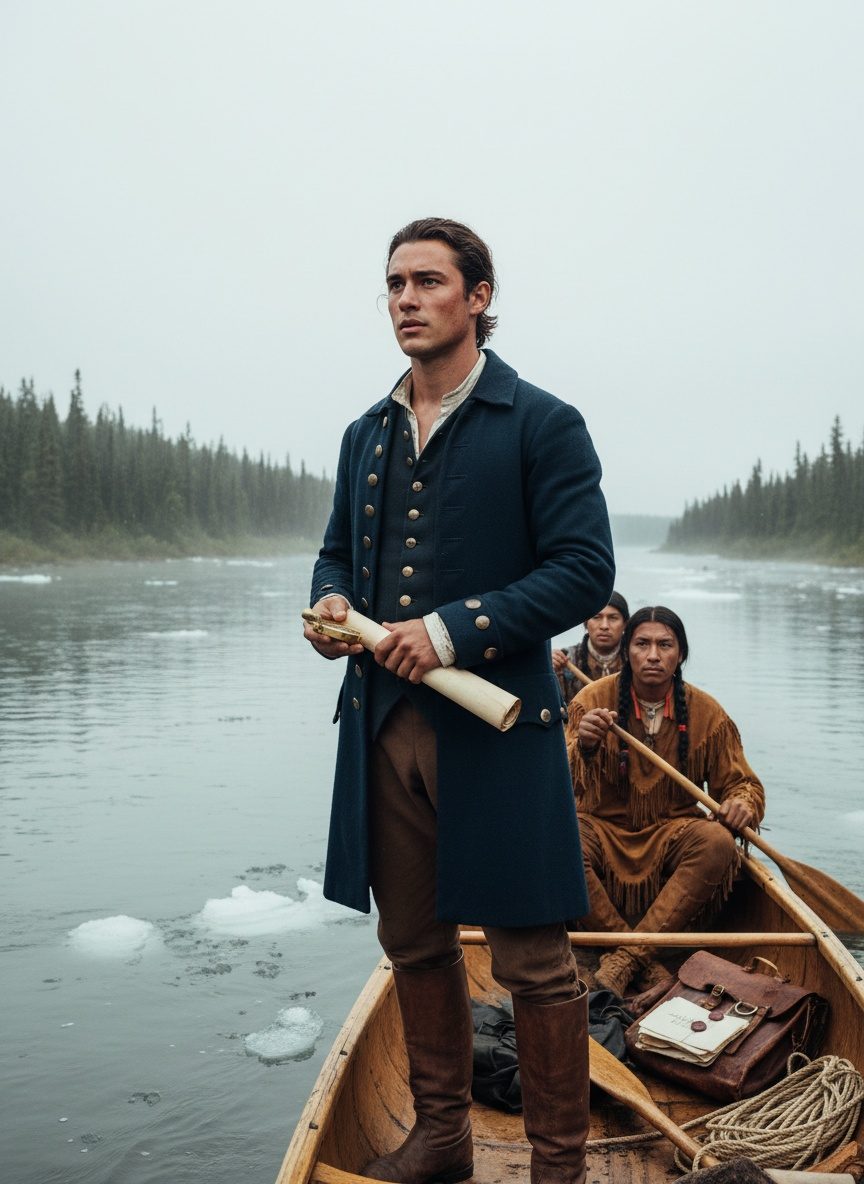
In June 1789, when Mackenzie first set a canoe into the waters of an uncharted river, his heart might have felt heavier than his cargo. A young Scottish fur trader navigating the dense tapestry of North American wilderness, he was tasked with finding a route to the fabled Pacific. But it was the siren call of exploration — the allure that tugged at the heartstrings of men eager to reshape the edges of the known world — that likely pushed him to paddle deeper into Canada's northern expanse. The river he set upon would later bear his name, yet the Arctic, not the Pacific, was his eventual destination. A grand, unintended detour that etched both his name and story into the annals of history.
The river emanated from the Great Slave Lake, a vast expanse that seemed to reflect the boundless skies above it. Mackenzie, accompanied by a small crew of voyageurs and Native guides, felt keenly the absence of any map to guide him. There was only the fluid logic of the river, its bends both inviting and menacing, leading ever northwards, away from the imagined ports of the Pacific, towards icy solitudes none among them had known before. The thick-walled forests, with their ghosts of towering pines, shielded them from familiar sights. It was a journey conjured by the bold spirit of its leader, the terrain, and above all, sheer will.
For seventy-two days, the canoe bore Mackenzie and his companions along waters that shifted between serene and tumultuous. It was a path marked by both enchantment and peril, a balance of human endurance and nature's might. On days when the currents slowed to a languid pace, the group would be greeted by endless vistas of the untouched taiga, a wilderness that felt eternal, unconstrained by the machinations of human time. As the sun refused to set and the nights remained twilit, it might have seemed as if they had entered a different world.
The further they traveled, the more starkly the landscape changed. The rich greens of the boreal forest began to give way to the muted tones of tundra, and they were enveloped by the vast silence of the North. Animals rarely seen by Europeans soon became their companions: the caribou watching from a distance, the occasional grizzly who emerged from behind a knoll to watch this procession of strange travelers. It was, in a very real sense, a communion with the Earth, one where Mackenzie and his team formed the most transient of brokering parties.
Mackenzie’s venture was not one of leisure but of survival, punctuated by challenges both minute and monumental. Rapid waters would occasionally tilt their canoe with the grace of a leviathan eager for mischief. There were days marked by gnawing hunger, and nights when the ceaseless drizzle soaked their spirits alongside their clothes. Yet, Mackenzie’s journals reflect an understanding of and respect for this new landscape, a testament to the learned whispers from their Native guides and the necessities identified by the seasoned voyageurs.
Upon reaching the mouth of the river, Mackenzie faced the ultimate realization of his unintended journey. Instead of the warm lapping of Pacific waters, they were confronted by the frigidity of the Arctic Ocean — a vast, unending expanse dominated by a horizon that seemed designed to challenge the bravest of spirits. It was a discovery both humbling and transformative. Though geographically it was a divergence from his initial goal, the clarity it offered about the course of the river was invaluable, securing the famous pathway that served as an artery through northern Canada.
As news of Mackenzie's voyage trickled back to the crossroads of empire and commerce, excitement and national pride colored the narratives circulated among the drawing rooms and trading posts. Yet, his journey was much more than an expedition against geographies unwritten in books; it was an exploration into the tenacity of the human spirit — the relentless search for discovery and understanding no chart could capture.
Despite the accolades following his navigation, Mackenzie’s quest stands quietly in the realms of memory occupied by greater distances and novel faraways. It is a story encapsulated not just by a river that bore new knowledge but by personal resilience that overcame adversity. Amidst the roar of history, cloaked by names and dates, his journey whispers: sometimes the greatest maps are those unplanned routes in the world and within oneself.