
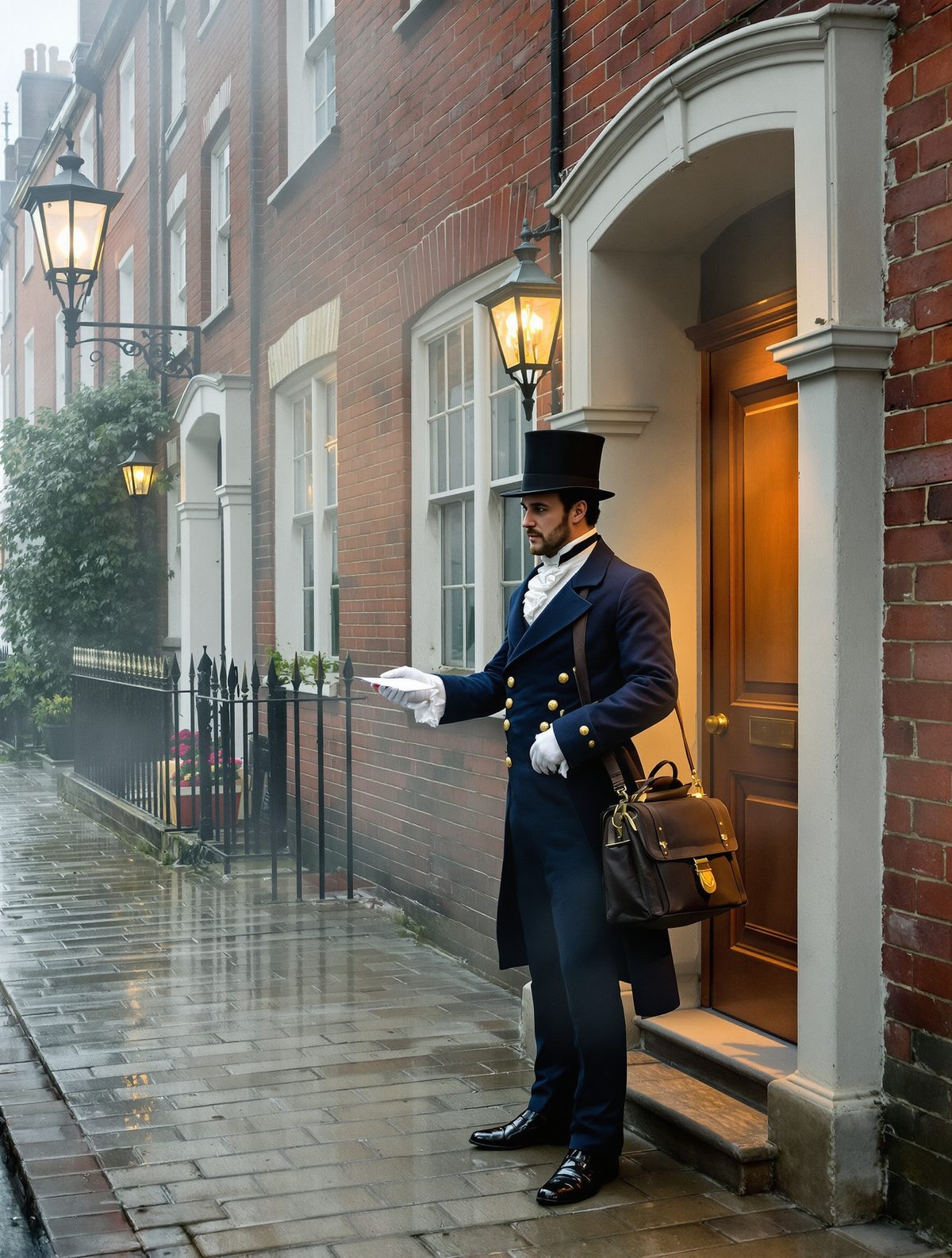
Picture a bustling Victorian London where the air buzzes with the excitement of an industrial age expanding its horizons. The year is 1840. In the heart of this dynamic capital, a modest, unassuming sheet of paper is about to transform the very way Britons connect to each other and to their world. This is the story of Rowland Hill’s Penny Post and how it united an entire nation with just a penny.
The Heavy Price of a Pen Stroke
Before Hill's revolutionary idea, sending a letter in Britain was an affair of financial burden, destined only for the rich or truly desperate. The costs were exorbitant — often as much as a week's wages for the average laborer — based on the number of miles traveled and the sheets of paper sent. Many letters went unpaid, returning to their senders, dreams deferred by restrictive postal laws.
Imagine you are a seamstress in Manchester wishing to send news to your ailing mother in Cornwall. The journey could span over 300 miles, the postal charge mounting with each mile traversed. For many, it was easier to remain silent and distant, prisoners of postal economics.
A Visionary Mind at Work
Enter Rowland Hill, a former schoolmaster with a knack for innovation and a heart for societal reform. In 1837, Hill published a pamphlet titled "Post Office Reform: Its Importance and Practicability," which would act as a catalyst for change. His proposal was as radical as it was simplistic: uniform postage rates regardless of distance. One penny, one letter, any distance.
Hill based his belief on compelling mathematics, insisting that reducing postal rates would increase usage so drastically that the resultant volume of mail would more than compensate for the lower charge. Skeptics scoffed, ministers hesitated, but Hill persisted, earning him a position at the Treasury in 1839 to implement his ideas.
The Transformative Power of the Penny
January 10, 1840, marked the date that would democratize communication. With the dark, swirling fog of London’s winter skies as a backdrop, people sent their first penny letters. Within a year, the number of letters handled by the post office soared from 76 million to more than 168 million. It was an unprecedented surge that left postmen panting and post offices bustling like city markets.
The postal workers, clad in their iconic uniforms, became the new connectors of great ideas, whispered secrets, and heartfelt sentiments. This newfound access meant that lovers could exchange daily letters, business negotiations sped through written words, and political ideas flowed with the ink on each page.
The Postal Revolution Ripples Across Society
Hill’s Penny Post became a social unifier, breaking the silence of isolation for the working masses. Education and literacy rates rose as the upper crust of politicos and poets found their voices mingling with those of factory workers and farmers. Correspondence was no longer a luxury, it was universal.
An often-overlooked impact was on the arts and literature. Authors such as Charles Dickens, who once decried the burdensome postal system, could now reach a broader readership with serialized novels. Businesses flourished as merchants corresponded with newfound ease, fueling the Industrial Revolution's roaring engines even further.
Unveiling Lesser-Known Pennies of History
While many know of Rowland Hill’s design, fewer recognize that the penny black postage stamp, introduced in May 1840, was a side product of his reform. It featured the profile of a young Queen Victoria and remains one of philately’s most prized possessions.
Incredibly, Hill’s idea was inspired by a conversation with his sister — a detail often overshadowed in the tale of his the reform. She recounted to Rowland the difficulties of communicating with a family friend, evoking his empathy and entrepreneurial spirit.
The Threads Binding Time
In a world dominated by digital immediacy, it's easy to overlook the significance of a penny post. Yet, Hill’s vision transcends its Victorian origins. It whispers a truth relevant today: the democratization of communication always transforms societies. It teaches us that accessibility, affordability, and simplicity in how we connect and share ideas can shatter class barriers and unite nations.
In Rowland Hill’s time, similar to today, great changes began with one courageous step, one ingenious idea, and, yes, one small penny.