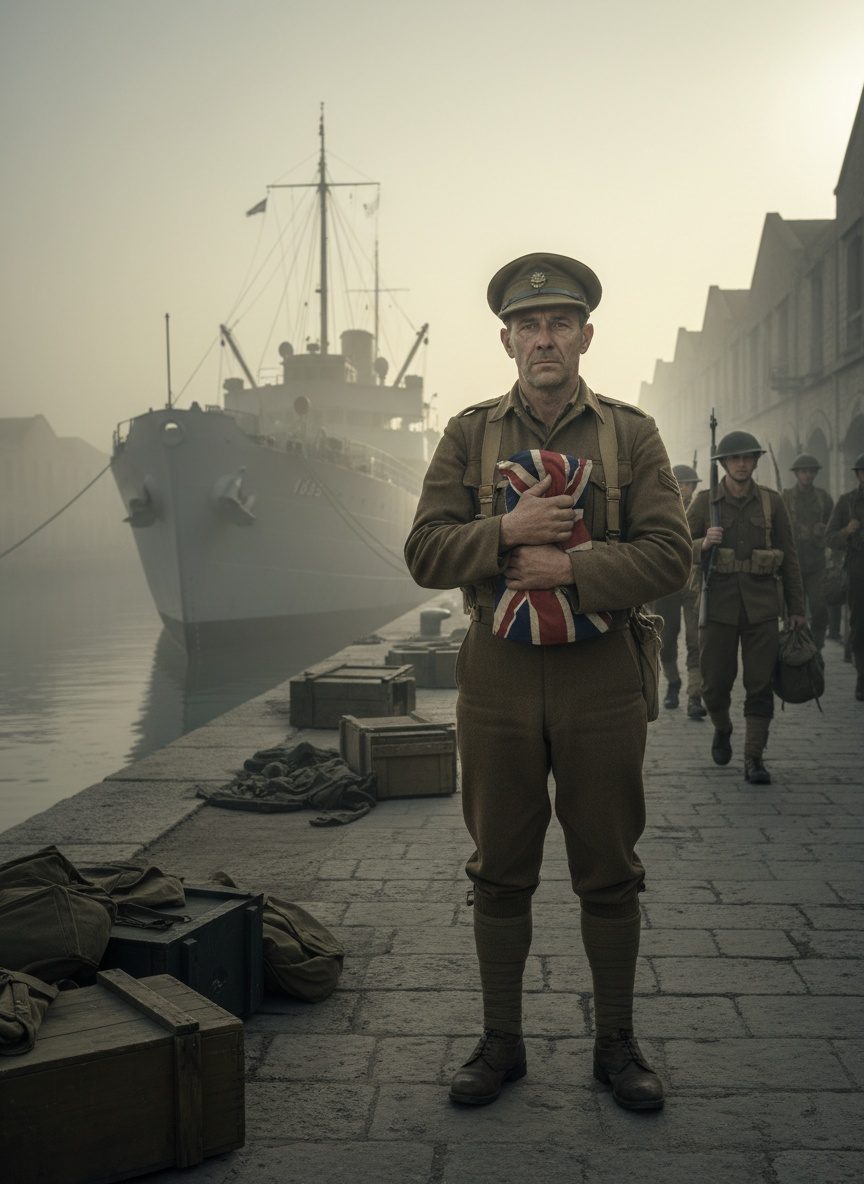
In the dead of night, a sergeant of the British Army found himself performing the most mundane of rituals for the last time. He folded the Union Jack carefully, with hands accustomed to the task. But the remarkable part? He handed it to no one. It was a silent departure, yet it spoke volumes.
The Twilight of Dominion
The British Mandate for Palestine was born from the embers of the First World War, a product of imperial ambition and wartime pragmatism. Instituted by the League of Nations, Britain had been tasked with shepherding a land of ancient dreams and contested claims. For three tumultuous decades, British soldiers and civil servants walked the delicate tightrope of administration in a territory fraught with conflicting national movements—the Zionist dream of a homeland and the Arab aspiration for independence. As the sun began to set on Britain's global empire in the aftermath of the Second World War, the mandate had become less a necklace of jewels and more a crown of thorns.
By 1948, the political situation in Palestine was spiraling into chaos. The United Nations' plan for partitioning the land into separate Jewish and Arab states—accepted by the Jewish leadership, rejected by the Arab—threatened to ignite a wider conflict. British forces, stretched thin and increasingly seen as oppressors by both sides, found themselves in the unenviable position of referees in a match without rules. The decision was made: Britain would withdraw, leaving the stage without a successor to take up the complicated script they had partially penned.
When the time came to depart, there was no fanfare. The routine tasks of packing and boarding took place under a bubbling tension that needed no embellishment with trumpets and speeches. In Haifa, the last significant British stronghold, weary soldiers watched the rising tide of violence and uncertainty. The Union Jack was lowered in quiet dignity—no governor on hand to pass the baton, no allies to salute the lowering flag, only the silent understanding that an era had stumbled to its end. The absence of ceremony was a testament to the complex legacy Britain left behind, etched in the lives of those who had served and lived under its rule.
The Soldiers' Silent Departure
In the final days of the mandate, as the troops prepared to leave, many of these soldiers were enveloped in a profound silence. It was not just an exit from a territory but a retreat from a vision of empire that had sustained Britain through the hardships of world wars. The soldiers were young—the average age not far from the early twenties—a fact that only underscored their vulnerability, not just to the risks of gunfire and bombings, but to the gnawing uncertainty of what future lay beyond the immediate task of departure. Those last days were etched with tension, yet amidst the chaos, there were moments of humanity that managed to shine through the dim haze of political and military maneuvering.
Haifa, a port city on the Mediterranean, had become the focal point of the final British evacuation. As Arab and Jewish forces maneuvered and clashed, the city's streets echoed with the complex dance of a population perched on the brink of transformation. British patrols wound their way through neighborhoods, carrying out their final duties, as if each step were an offering to the gods of stability they could no longer placate. A strange logic prevailed: the British had been drawn into the situation not by imperial design but by a series of promises and political necessities that had spiraled into an unmanageable epic.
The decision to leave without ceremony was both practical and symbolic. By exiting quietly, the British aimed to leave behind only what was absolutely necessary—no symbolic gestures, no grand declarations, just the solemn act of withdrawal. The reality on the ground was that both Arab and Jewish leaders had already begun making their own preparations for what was to come, rendering any kind of formalized handover redundant. The symbolism was powerful: while other territories of the empire were often ceremoniously transitioned, here was a land where peace had slipped through their fingers, and silence was perhaps the only honest acknowledgment of the chaos left behind.
An End Without a Beginning
The night of May 1948 marked more than just the end of British rule. It was a poignant moment, a stark crescendo in the long symphony of imperial history that needed no climax to be complete. The sergeant, stepping onto the vessel that would ferry him home, was not merely leaving a post but a deeply layered narrative of hope, conflict, and resignation. There was no one to hand the flag to because the future of Palestine was no longer a colonial enterprise—it was a nascent drama to be scripted by those who remained.
The British departure from Palestine was among the most extraordinary exits in the history of the empire, a quiet finale to a story of grand designs and unintended consequences. Eerily, it underscored the limits of imperial power in an age that increasingly demanded self-determination. Palestine had become a microcosm of the shifting global order—where empires found themselves increasingly out of step with the aspirations of the lands they governed. In surrendering the mandate with such muted finality, Britain acknowledged, perhaps unknowably, that the age of empire was entering its twilight.
As the ship drifted from the harbor, it left in its wake an unresolved tension between old imperial dreams and the nascent realities of a post-colonial world. The sergeant may have folded the flag in solitude, but the repercussions of that final act—and the era it concluded—continue to echo in the corridors of history. The silence might have marked an end, but the conversations born from that silence remain as vivid and vital as ever, reminding us that the stories left out of textbooks often tell the most profound truths of all.