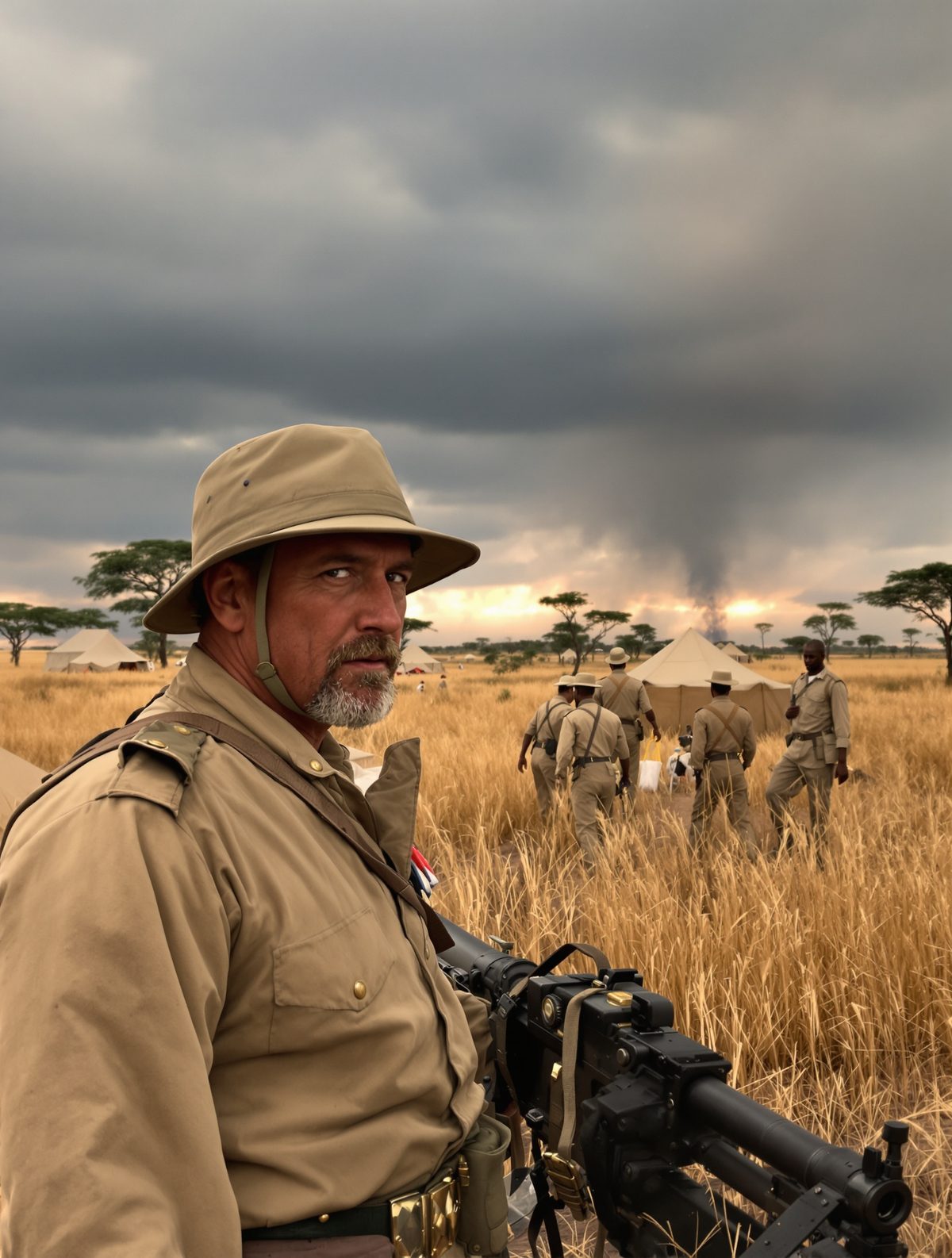
The sails were rotting. The fresh water barrels reeked of algae. And somewhere in the cramped hold of the Susan Constant, men were placing bets on which of their companions would be the first to die.
It was April 1607, and Captain Christopher Newport's three wooden ships had been crawling across the Atlantic for four grueling months. The 104 Englishmen aboard were about to make history—though not the glorious kind they'd imagined when they left London's docks. Within six months, disease and starvation would claim more than half their number. But against impossible odds, their muddy settlement on a Virginia marsh would become something extraordinary: England's first permanent foothold in the New World.
What they didn't know, as they glimpsed the Chesapeake Bay's tree-lined shores, was that they were sailing into a nightmare that would test every assumption about survival, leadership, and what it meant to be English in a land that cared nothing for their grand imperial dreams.
The Gentleman's Gamble
The Virginia Company's recruitment campaign had been masterful in its deception. Pamphlets circulated through London's taverns and coffee houses, promising easy riches and gentle climates. Gold lay scattered on Virginia's beaches, they claimed. The natives were friendly. A man could make his fortune in months, then return to England wealthy enough to buy his own estate.
The reality was that most of the 104 colonists had never held a tool more practical than a quill pen. Of the group, 48 were listed as "gentlemen"—men who considered manual labor beneath their station. There were goldsmiths and perfumers, but precious few carpenters or farmers. The Virginia Company had essentially loaded three ships with venture capitalists and sent them to build a civilization from scratch.
Captain Newport, a seasoned mariner who'd lost his right arm fighting the Spanish in the Caribbean, knew better than most what lay ahead. At 47, he'd spent decades navigating treacherous waters and hostile shores. But even he couldn't have imagined the perfect storm of disasters waiting in Virginia's tidal marshes.
The expedition carried sealed orders from the Virginia Company, not to be opened until landfall. When Newport finally broke the wax seals on May 14, 1607, he discovered something that would have shocked his passengers: the colony was to be governed not by a single leader, but by a council of seven men. Even more surprising was one name on the list—John Smith, a 27-year-old soldier who'd spent most of the voyage in chains, accused of plotting mutiny.
Paradise Lost in the Chesapeake
The site they chose for their settlement seemed promising enough. Jamestown Island offered deep water for mooring ships, thick forests for lumber, and what appeared to be fertile soil. What the colonists couldn't see were the microscopic killers lurking in their new paradise.
The island was a malarial swamp. Its brackish water teemed with typhoid bacteria. During summer months, the humid air would become a breeding ground for disease-carrying mosquitoes. The colonists had unknowingly chosen one of the most lethal spots along the entire Eastern seaboard.
But disease was only part of their problem. The Powhatan Confederacy, a sophisticated alliance of roughly 30 Algonquian-speaking tribes led by the formidable Chief Wahunsenacawh (known to the English as Chief Powhatan), controlled the region. This wasn't empty wilderness—it was somebody else's backyard, and that somebody commanded roughly 15,000 people across 8,000 square miles.
The initial encounters were tense but not openly hostile. Powhatan warriors appeared from the forest, observing these strange newcomers with their pale skin and thunderous weapons. The English, despite their superior firearms, were woefully outnumbered and completely dependent on native knowledge for survival.
Captain Newport, displaying the diplomatic skills that had served him well in previous voyages, managed to establish tentative trade relations. The Powhatans had corn, beans, and squash—crops that could mean the difference between life and death for the struggling colonists. In exchange, the English offered copper kettles, glass beads, and metal tools that the natives prized highly.
The Starving Time Begins
By August 1607, the death toll was staggering. Men were dying at a rate of nearly one per day. George Percy, one of the few literate colonists to survive, kept a grim diary: "Our men were destroyed with cruell diseases, as Swellings, Flixes, Burning Fevers, and by warres, and some departed suddenly, but for the most part they died of meere famine."
The colony's leadership was collapsing as quickly as its population. President Edward Wingfield was accused of hoarding food and deposed. His replacement, John Ratcliffe, proved equally ineffective. It was John Smith—the former prisoner—who emerged as the settlement's unlikely savior.
Smith instituted a brutal but necessary rule: "He that will not work shall not eat." This was revolutionary thinking in a society where gentlemen didn't soil their hands with labor. Smith forced aristocrats to dig wells, build fortifications, and clear fields alongside common laborers. Those who refused were cut off from the colony's dwindling food supplies.
But Smith's greatest talent lay in his dealings with the Powhatans. Unlike his fellow colonists, he made genuine efforts to understand native customs and language. His famous encounter with Chief Powhatan's daughter Pocahontas—though heavily mythologized by later generations—reflected a real ability to navigate the complex diplomatic landscape of Virginia's indigenous peoples.
Meanwhile, Captain Newport had sailed back to England with the Susan Constant, leaving the colonists with smaller vessels barely capable of coastal navigation. His mission was to report on the colony's progress and secure additional supplies and settlers. What he found in London was a Virginia Company board growing increasingly nervous about their investment.
Tobacco Changes Everything
The salvation of Jamestown came from an unexpected source: a plant the natives called "uppowoc." John Rolfe, who arrived with the Second Supply in 1608, experimented with cultivating tobacco using seeds smuggled from the Spanish Caribbean. The native Virginia tobacco was too harsh for European tastes, but Rolfe's hybrid varieties proved smooth enough to smoke and profitable enough to export.
By 1612, tobacco was bringing premium prices in London markets. The leaf that Europeans had initially dismissed as a curiosity became more valuable than silver. Suddenly, every available plot in Jamestown was being cleared for tobacco cultivation. Colonists were growing it in the streets, in the marketplace, even in the church cemetery.
This tobacco boom transformed Virginia from a charitable enterprise into a profit-driven machine. But it also created an insatiable demand for labor that would have devastating consequences for both indigenous peoples and, eventually, enslaved Africans brought against their will to work the plantations.
Captain Newport made multiple voyages to supply the growing colony, bringing additional settlers, tools, and livestock. His final voyage to Virginia in 1619 coincided with two arrivals that would reshape American history: the first representative assembly in the New World, and the first documented arrival of enslaved Africans in English North America.
The Captain's Legacy
Newport's role in founding Jamestown extended far beyond that initial voyage in 1607. Over the next decade, he made five round trips between England and Virginia, each time bringing supplies and settlers that kept the colony alive during its most vulnerable years. His ship, the Susan Constant, became as famous in its day as the Mayflower would later become.
But Newport's most lasting contribution may have been his insistence on maintaining diplomatic relations with the Powhatans during those crucial early years. While other English leaders advocated for military conquest, Newport understood that cooperation was the only path to survival. His approach bought the colonists precious time to establish themselves before inevitable conflicts erupted.
By the time Newport made his final voyage to Virginia in 1619, Jamestown had grown from 104 desperate souls clinging to a malarial swamp into a thriving settlement of more than 1,000 people. The transformation was remarkable, but it came at an enormous cost—not just to the English colonists, but to the indigenous peoples whose world was forever changed by those three ships limping into Chesapeake Bay.
Seeds of an Empire
Today, we tend to remember Jamestown as a quaint historical footnote, overshadowed by Plymouth Rock and the Mayflower Compact. But Captain Newport's 1607 expedition deserves recognition as one of the most consequential voyages in human history. Those 104 men who survived the Atlantic crossing didn't just establish England's first American colony—they planted the seeds of what would become the world's most powerful empire.
The lessons of Jamestown remain painfully relevant in our interconnected world. The colonists' initial arrogance—their assumption that superior technology and cultural confidence would guarantee success—led to near-total disaster. Only through grudging cooperation with indigenous peoples, brutal adaptation to local conditions, and the luck of finding a profitable export crop did the settlement survive its first decade.
Perhaps most importantly, Jamestown reminds us that the grand narratives of history are built on countless individual decisions made under extreme pressure. When Captain Newport's ships finally departed Virginia's shores for the last time, they left behind something unprecedented: a permanent English foothold in a hemisphere that Spain had considered its exclusive domain. The consequences of that achievement—for better and worse—continue to shape our world today.