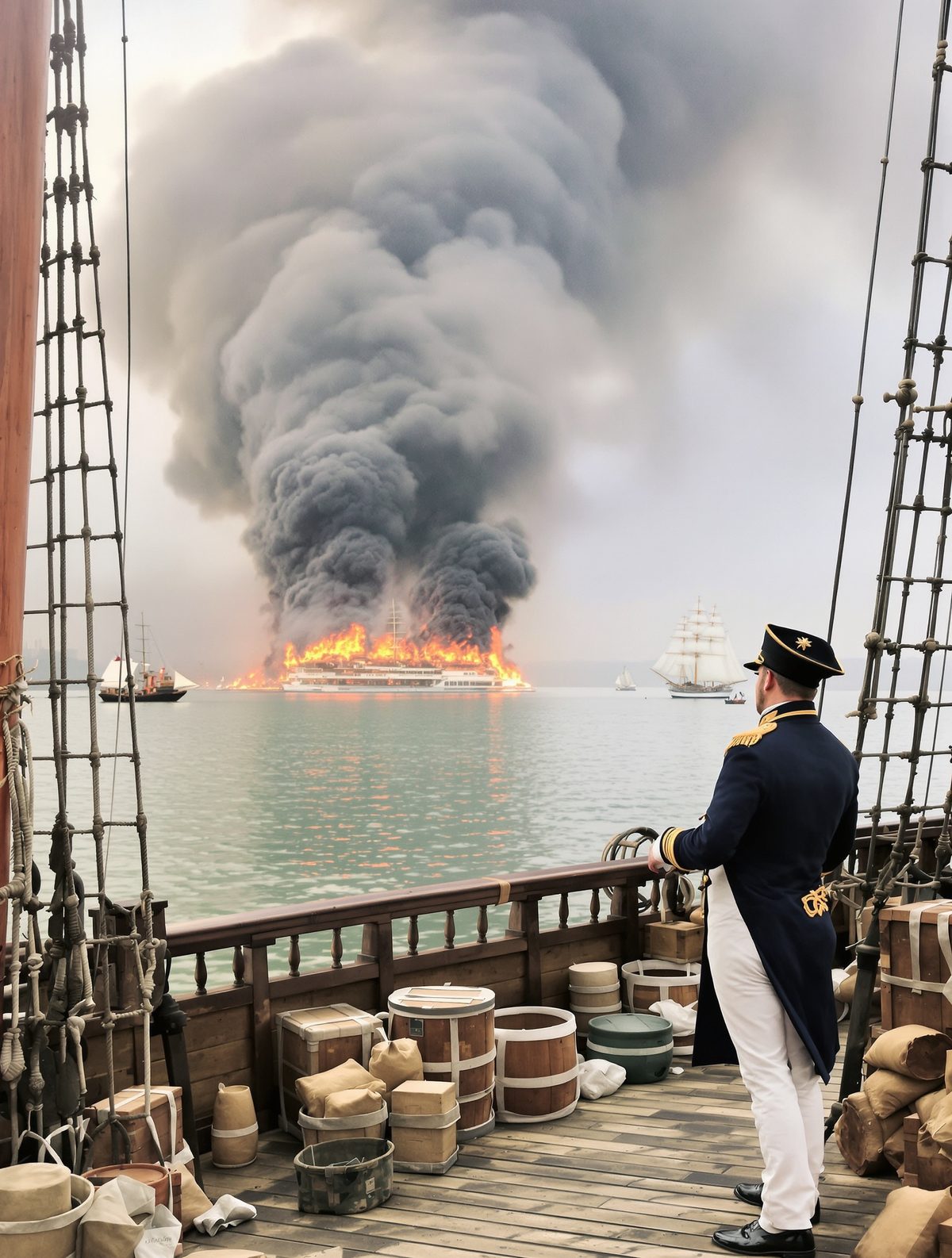
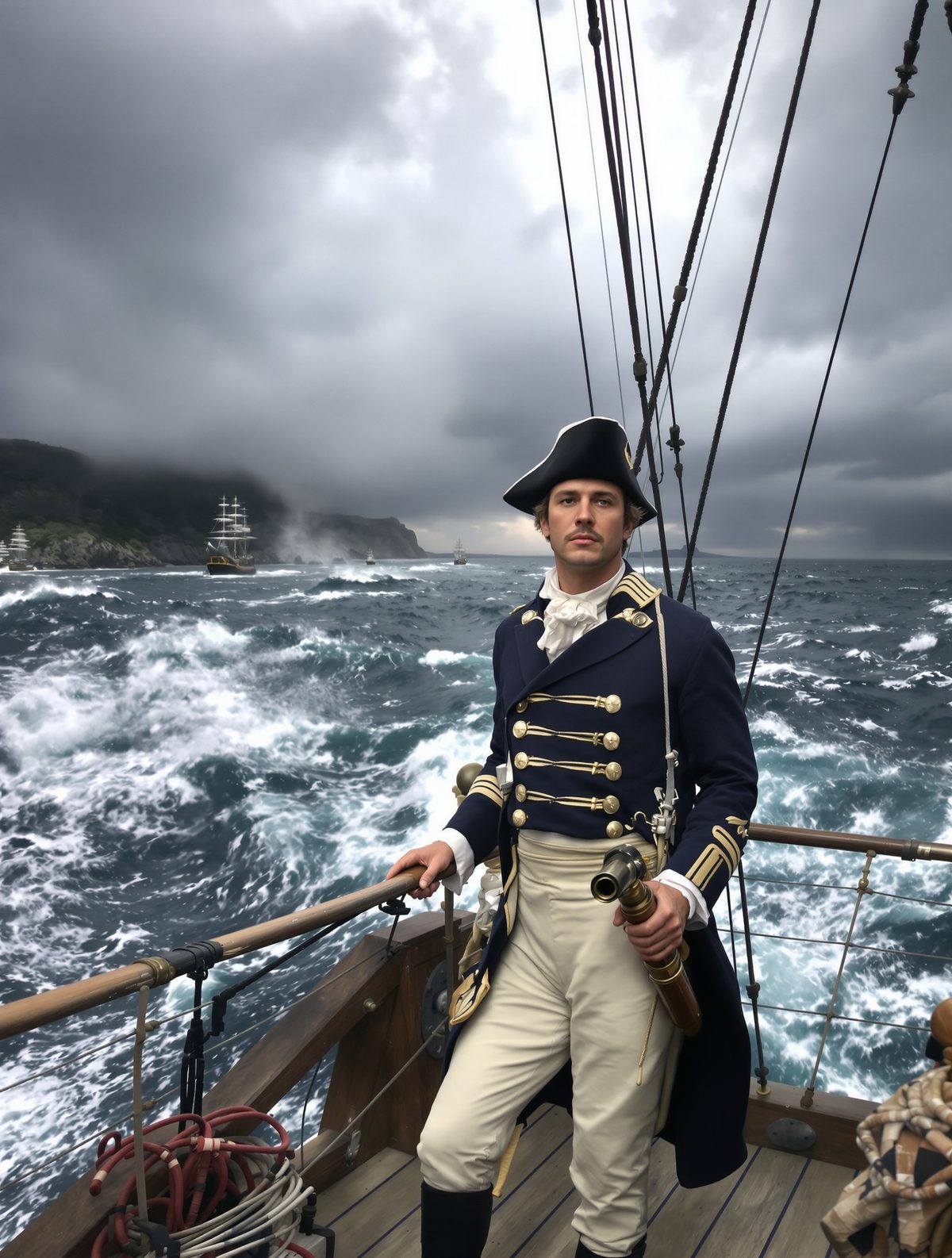
The morning mist clung to the waters off Brittany like a shroud, and through it emerged every British captain's nightmare: two French frigates, their tricolour flags snapping defiantly in the April breeze. Captain Edward Pellew squinted through his telescope from the quarterdeck of HMS Indefatigable, watching as the enemy ships maneuvered to trap him. By every rule of naval warfare, he should have turned and fled. Instead, he did something that would echo through the halls of the Admiralty for generations—he ordered his crew to sail straight between them.
The Hunter Becomes the Hunted
April 20th, 1796, had begun as a routine patrol for Pellew and his crew. The 44-gun Indefatigable was returning from a successful cruise, her holds heavy with prizes taken from French merchantmen. But success bred complacency, and Pellew had allowed his ship to stray closer to the French coast than prudence dictated.
When the lookout's cry of "Sail ho! Two points off the starboard bow!" rang out at dawn, Pellew initially assumed they were more merchant vessels ripe for capture. His assumption shattered when the morning light revealed not one but two French frigates: the 36-gun Virginie and the 40-gun Droits de l'Homme. Together, they mounted 76 guns against his 44—odds that would make any sensible captain retreat to fight another day.
But Edward Pellew was not any captain. At 39, he had already earned a reputation as one of the Royal Navy's most audacious frigate commanders. His motto, borrowed from his Cornish ancestors, was simple: "Strike hard, strike fast, strike first." Today, that philosophy would face its ultimate test.
The Mathematics of Madness
What Pellew saw that morning would have sent shivers down most spines. The two French ships had positioned themselves in a classic pincer movement, designed to catch enemy vessels between their combined firepower. The Virginie, commanded by Captain Bergeret, held the weather gauge to the north, while Captain Lacrosse's Droits de l'Homme blocked any escape to the south.
The mathematics were brutal. In a conventional engagement, Indefatigable would face approximately 1,500 pounds of iron shot per broadside from her enemies, while she could only reply with 600 pounds of her own. Her crew of 284 men would be fighting nearly 650 French sailors. Most damning of all, the French ships were fresh from port, their crews well-rested and their powder dry.
Pellew's first lieutenant, Edward Hamilton—later to become a legend himself—approached his captain with the obvious suggestion: "Sir, shall we come about and make for open water?" Pellew's response became the stuff of naval legend: "Mr. Hamilton, when did a British frigate ever run from a fair fight? Signal for battle stations."
Threading the Needle of Death
What happened next defied every principle in the naval tactics manual. Instead of attempting to engage one ship while avoiding the other, Pellew ordered Indefatigable to sail directly between his opponents. His reasoning was as brilliant as it was dangerous: by positioning his ship in the gap, he could prevent the French from concentrating their fire while forcing them to risk hitting each other.
At 7:30 AM, Indefatigable began her death-defying run between the enemy ships. The French captains, initially confused by this apparent suicide charge, hesitated just long enough for Pellew to gain the initiative. As his ship threaded the needle between Virginie and Droits de l'Homme, Pellew's gun crews unleashed devastating raking fire at both opponents simultaneously.
The British gunnery was magnificent. Pellew's crews had drilled relentlessly during their cruise, and their rate of fire was nearly double that of their French opponents. Each broadside sent 24-pound shot crashing through the enemy ships' hulls, while the deadly accuracy of British aim systematically dismounted French guns and cut down their crews.
But the French were far from helpless. Return fire from both ships raked Indefatigable's deck, sending deadly splinters flying like horizontal hail. The ship's wheel was shot away twice, forcing sailors to steer by emergency tackle deep in the bowels of the vessel. The mainmast took seventeen hits, swaying ominously with each French salvo.
The Tide Turns
By 9 AM, Pellew's audacious strategy began to bear fruit. The constant maneuvering required to avoid hitting each other had disrupted French gunnery, while Indefatigable's disciplined crews maintained their murderous rate of fire. Captain Bergeret aboard Virginie was mortally wounded by a British marksman in the rigging, his death sending shockwaves through his crew.
Pellew recognized the moment and pressed his advantage with characteristic ruthlessness. Ordering more sail, he positioned Indefatigable to rake Virginie from stern to bow—the most devastating attack in naval warfare. The British broadside carved through the French frigate's length, dismounting guns and cutting down entire gun crews. Within minutes, Virginie's tricolour came fluttering down in surrender.
But Droits de l'Homme fought on, Captain Lacrosse determined to salvage honor from disaster. His ship was larger and more heavily armed than the surrendered Virginie, and he still believed he could overpower the battered British frigate. For another hour, the two ships hammered each other in a brutal gun-to-gun duel that would be talked about in naval circles for decades.
Victory from the Jaws of Impossible Odds
The end came suddenly, as naval battles often do. A lucky British shot struck Droits de l'Homme's powder magazine, not exploding it but sending smoke and flame billowing through the ship. Believing his vessel was about to blow apart, Captain Lacrosse ordered his colors struck at 11:30 AM.
In four hours of hellish fighting, Captain Pellew had achieved the impossible: a single British frigate had defeated two French warships in fair combat. The butcher's bill told the story of the day's work—Indefatigable suffered 23 dead and 40 wounded, while the French losses exceeded 200 killed and wounded between both ships.
When news of the victory reached London, the Admiralty initially refused to believe it. Only when Pellew sailed into Portsmouth with his two prizes in tow did the full magnitude of his achievement sink in. King George III personally congratulated the captain, while the French newspapers struggled to explain how their navy had suffered such a humiliating defeat.
Legacy of Audacity
Pellew's victory off Brittany represents more than just exceptional seamanship—it embodies the spirit of calculated risk-taking that defines great leadership in any era. In a world where following procedure and avoiding failure often trumps bold action, Pellew's willingness to throw the rulebook overboard offers a powerful lesson.
The battle also reveals how superior training and discipline can overcome numerical disadvantage. Indefatigable's crews fired three broadsides for every two French salvos, their accuracy honed by months of relentless drill. In today's competitive landscape, whether in business, sports, or technology, the principles remain the same: preparation, precision, and the courage to seize the initiative can topple seemingly insurmountable odds.
Perhaps most importantly, Pellew's victory reminds us that the greatest triumphs often come not from playing it safe, but from those moments when we choose to sail straight between the guns. Sometimes, the most dangerous path is also the only path to victory.