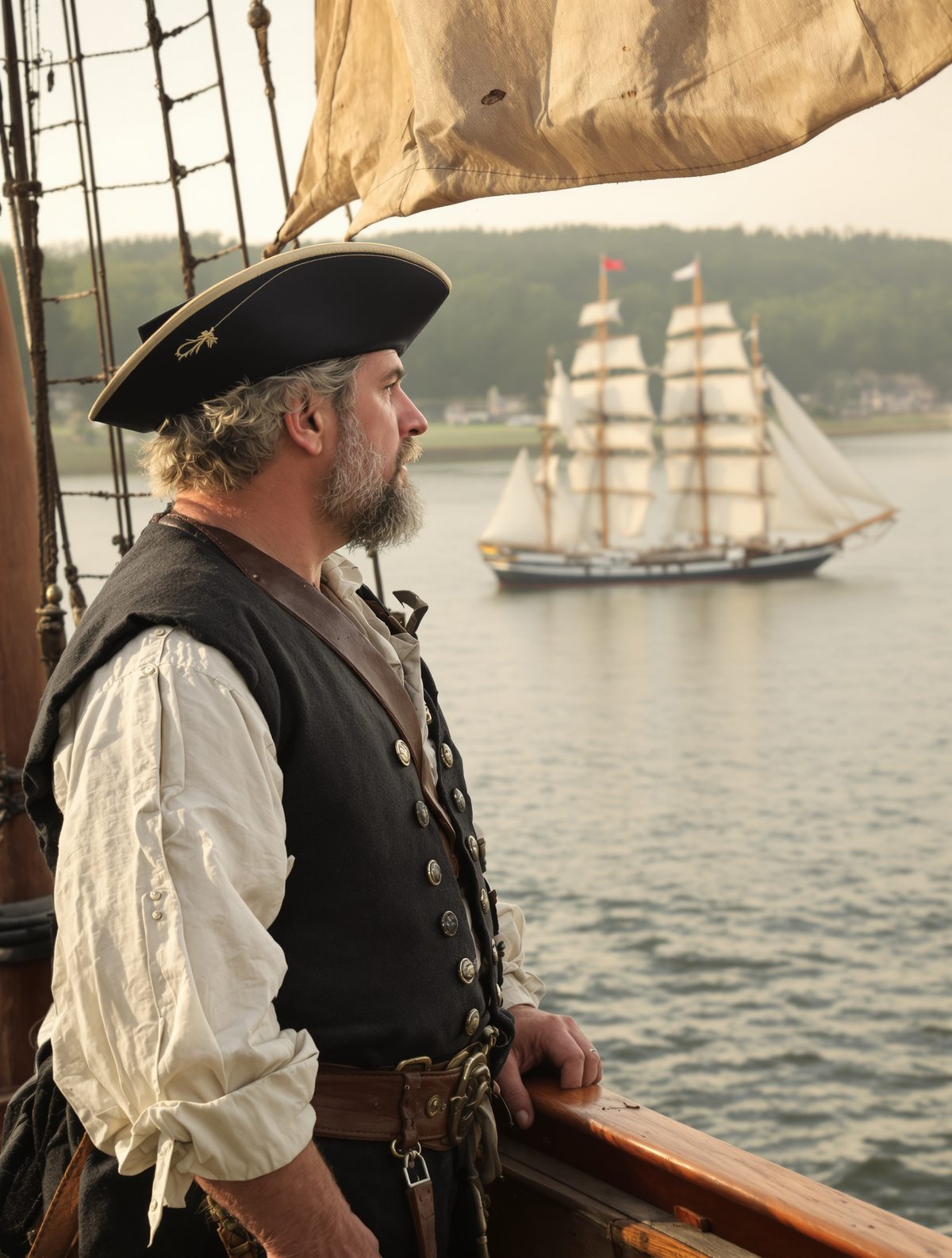
Through the acrid gunpowder smoke that choked Copenhagen's harbor on April 2, 1801, Captain Edward Riou squinted at the signal flags snapping from HMS Elephant. Signal 39 flew beneath the British ensign—"Leave off action and anchor." Admiral Nelson wanted the fleet to withdraw. But around Riou's frigate Amazon, Danish shot still screamed through the rigging and cannon balls sent geysers of seawater cascading across his quarterdeck. The enemy's guns had not fallen silent. Someone had to cover the retreat, or Nelson's battered ships would be torn apart as they tried to escape.
Riou turned to his signal officer with grim determination. "What will Nelson think of us?" he muttered, then gave the order that would seal his fate and save the British fleet. His frigates would stay. They would hold the line.
The Captain Who Chose the Hardest Road
Edward Riou was not supposed to die at Copenhagen. At 33, he was already a naval legend—the man who had navigated the wrecked HMS Guardian through 500 miles of Antarctic waters in 1789, saving hundreds of lives when everyone else thought the ship was doomed. The Admiralty had noticed. So had Nelson, who handpicked Riou to command the frigate squadron that would protect the fleet's vulnerable eastern flank during the assault on Copenhagen's formidable defenses.
The Danish capital bristled with more than 70 guns mounted on massive floating batteries and hulked warships, plus another 88 cannons in the shore fortifications. Crown Prince Frederick had turned Copenhagen into a floating fortress, determined to break the British naval blockade that was strangling neutral trade. When diplomatic negotiations collapsed in March 1801, the Royal Navy prepared for one of the most challenging battles in its history.
Nelson understood the mathematics of destruction all too well. His twelve ships-of-the-line would hammer the main Danish defensive line, but they'd be sitting ducks if Danish reinforcements swept down from the north or if the shore batteries caught them during withdrawal. That's where Riou came in. The frigate captain's job was to shield Nelson's blind side with HMS Amazon, Blanche, Alcmene, and Dart—fast, nimble ships that could dance between the shoals where larger vessels feared to venture.
Dancing with Death in the Shallows
When the battle erupted at 10 AM, Riou's frigates immediately found themselves in hell's antechamber. The Danish had positioned their strongest batteries—the Trekroner fortress and several powerful floating batteries—exactly where the British frigates needed to operate. Unlike Nelson's massive 74-gun ships that could absorb tremendous punishment, Riou's vessels carried only 32 to 38 guns each. They were greyhounds fighting bulldogs.
But Riou had learned something crucial during his Antarctic ordeal: sometimes survival meant doing the impossible. He maneuvered his small squadron into the shallow waters between Nelson's fleet and the Trekroner fortress, using the frigates' superior speed and maneuverability to avoid the heaviest fire while still engaging the Danish batteries. For nearly three hours, his ships absorbed a punishment that should have sunk them twice over.
The Danish gunners were no amateurs. These were the same naval forces that had given the British fits in the Caribbean and Mediterranean. Their floating batteries, essentially unsinkable gun platforms, poured a murderous crossfire into any British ship that came within range. HMS Agamemnon ran aground trying to avoid the worst of it. HMS Bellona and Russell followed, stuck fast on the Middle Ground shoal while Danish iron hammered their hulls.
Through it all, Riou's frigates kept moving, kept fighting, kept the Danish northern batteries from flanking Nelson's increasingly battered line of battle.
The Signal That Changed Everything
At 1:15 PM, everything changed. Admiral Sir Hyde Parker, watching the carnage from his flagship London safely positioned outside the battle zone, lost his nerve. The British fleet was taking horrific casualties—nearly 1,000 dead and wounded by this point. Three ships had run aground. The Danish showed no signs of weakening. Parker hoisted Signal 39: "Discontinue the action."
Nelson, famously, put his telescope to his blind eye and declared he couldn't see the signal. But Nelson's defiance created a deadly problem. Some British ships began to withdraw while others continued fighting. The formation fractured. Ships that had been protecting each other's flanks suddenly found themselves isolated, perfect targets for the still-blazing Danish batteries.
Riou saw the signal clearly. As a frigate captain, he couldn't ignore a direct order from the fleet commander the way Nelson could. But he also saw what retreat would mean: Nelson's ships would have to turn away from the Danish line and sail past the Trekroner fortress with their vulnerable sterns exposed to raking fire. Without the frigates to suppress those northern batteries, it would be a slaughter.
The mathematical brutality was inescapable. Danish gunners could pour shot the entire length of a retreating warship, potentially killing hundreds with a single well-aimed broadside. HMS Defiance was already trying to extract herself from the line and taking terrible punishment. Someone had to cover the withdrawal, and Riou's fast frigates were the only ships positioned to do it.
The Last Stand of HMS Amazon
"What will Nelson think of us?" Riou asked his officers as he ordered HMS Amazon to close with the Trekroner fortress. It was a rhetorical question. He knew Nelson would understand. The frigate captain who had saved 400 men in Antarctic waters wasn't going to abandon his comrades now.
What followed was one of the most gallant actions in naval history. Riou's four frigates positioned themselves between the retreating British ships and the Danish batteries, absorbing fire that would have devastated Nelson's larger but less maneuverable vessels. HMS Amazon closed to within pistol shot of the Danish guns—so close that musket fire from the fortress began sweeping her decks.
For forty-five minutes, the frigates held their impossible position. HMS Blanche lost her main topmast. HMS Dart took shot between wind and water that nearly sent her to the bottom. But they kept firing, kept drawing Danish attention away from the withdrawing ships of the line.
At 2:00 PM, a Danish cannonball from the Trekroner fortress cut Edward Riou nearly in half as he stood on his quarterdeck directing the action. His last words, according to witnesses, were "Come then, my boys! Let us die all together!" The man who had cheated death in Antarctic waters finally found an enemy he couldn't outmaneuver.
The Victory They Almost Lost
Riou's sacrifice wasn't in vain. His frigates' desperate rearguard action allowed Nelson to extract his battered fleet intact. By 3:30 PM, Danish resistance was finally crumbling—not from the power of British gunnery, but from sheer exhaustion and the psychological impact of seeing their enemies refuse to retreat even under direct orders.
Crown Prince Frederick agreed to a truce that evening. The Battle of Copenhagen was technically a British victory, breaking up the League of Armed Neutrality that had threatened British naval supremacy. But it was the narrowest of victories, won as much by individual acts of heroism as by tactical brilliance.
Nelson himself was devastated by Riou's death. "In poor dear Riou, the country has sustained an irreparable loss," he wrote to the Admiralty. The man who rarely showed sentiment in his official reports couldn't hide his grief at losing an officer he considered "a second himself."
The broader strategic implications were enormous. Had the British fleet been mauled during its withdrawal, the Royal Navy's aura of invincibility would have been shattered. French and Spanish naval commanders would have taken heart. The coalition forming against Napoleon might have collapsed before it truly began.
When Duty Demands the Ultimate Price
Edward Riou's story resonates today because it illuminates a truth that modern military leaders still grapple with: sometimes the mission requires sacrifices that seem to contradict direct orders. Riou faced an impossible choice between literal obedience and tactical necessity. He chose to stay because he understood that withdrawal without proper cover would doom his comrades.
In our era of precise communications and detailed contingency planning, it's easy to forget that 19th-century naval combat often came down to individual judgment calls made in the fog of war. Signal flags could be misread, tactical situations could change faster than new orders could be transmitted, and junior officers had to make life-or-death decisions with incomplete information.
Riou's legacy lives on in naval doctrine that emphasizes mission command—the idea that subordinate commanders must understand their superior's intent well enough to act independently when circumstances demand it. Sometimes the greatest loyalty requires apparent disobedience. Sometimes saving the fleet means sacrificing yourself.
The frigates that held the line at Copenhagen remind us that history's most crucial moments often depend on individuals willing to choose duty over survival, mission success over personal safety. In an age when heroism is often reduced to hashtags and soundbites, Edward Riou's story stands as a reminder that real courage is measured not in social media likes, but in the willingness to stand fast when everything depends on not backing down.