The waters of the English Channel shimmered under the pale light of a waning moon as the fierce winds made the waves dance with a haunting rhythm. Amidst this hypnotic sea stood the HMS Indefatigable, a sturdy frigate of the British Royal Navy, silhouetted against the dim horizon. It was the spring of 1796, a time when the world was cast into the tumultuous age of Napoleonic warfare. Captain Edward Pellew, a seasoned officer respected as much for his dauntless courage as his tactical acumen, had just delivered yet another glittering prize to his country's string of victories. Yet, within moments, this victory would transform into a crucible of moral courage unlike any faced by the captain and his crew.
A Blaze in the Dark
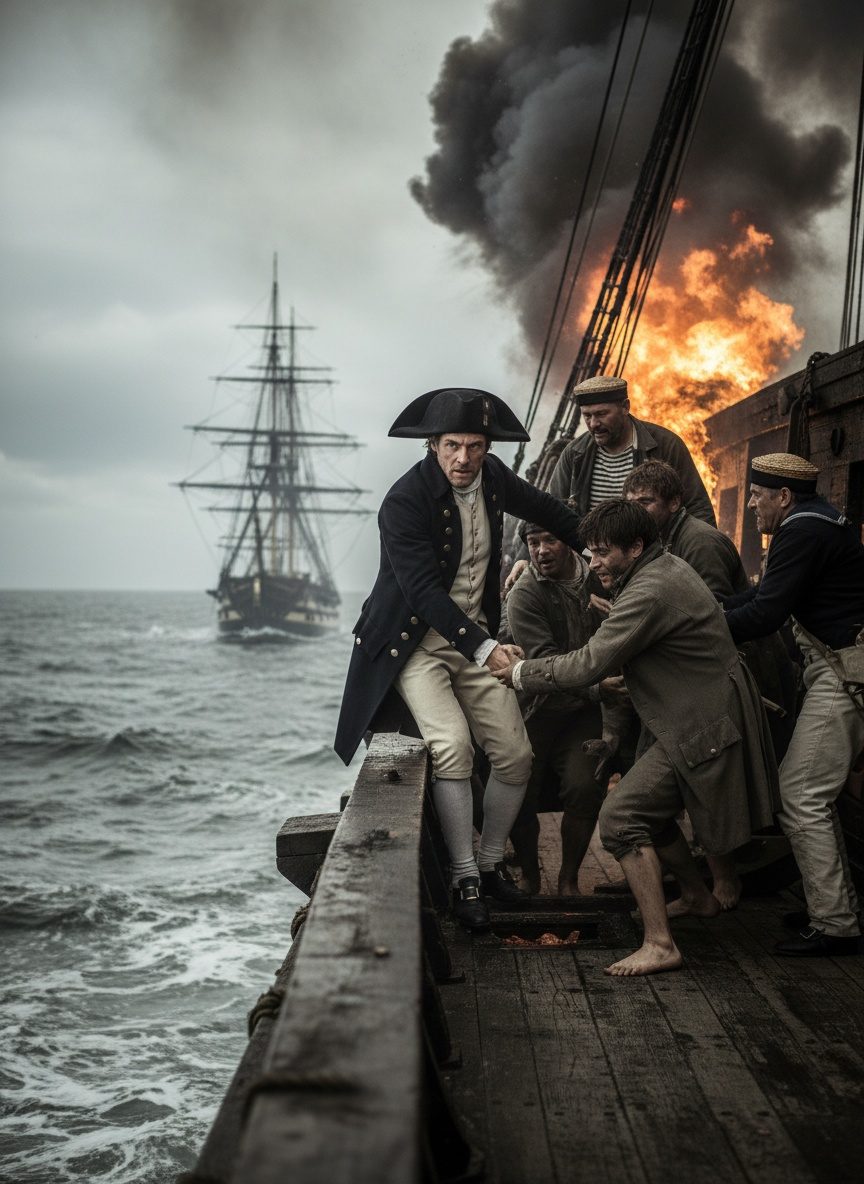
As the first light of dawn began to brush the sky with pastel hues, the joyous thrill of the recent capture was abruptly shattered. A billowing column of smoke, dense and foreboding, rose from the French corvette that had only just succumbed to British might. The ship's wooden frame, a graceful yet deadly instrument of war, had become a smoldering trap for the French sailors imprisoned within its hull — the spoils of war now on the brink of a fiery demise.
The flames that consumed the prize ship licked hungrily at the sails and rigging, threatening to engulf the entire structure. The prisoners, locked below deck, were confronted with a relentless enemy of flame and suffocation, their desperate cries muffled under layers of timber and the crackling roar of the fire. For Pellew, the calculus of war seemed to suggest a grim tautology: leave the prisoners to their fate or risk the safety of his crew in an attempt at rescue.
Yet Pellew was a man as principled as he was pragmatic. Wartime codes dictated that the enemy, once captured, were seen as akin to cargo—if peril overtook them, it was a cost of conflict. But Pellew's heart quivered at such brutality. An officer who understood honor as his unwavering North Star, the captain saw a different equation at play. With firm resolve, he issued an order that would etch his name into the annals of naval history: the Indefatigable would return to save the men trapped in the inferno.
Courage Beneath the Flames
As the Indefatigable drew alongside the burning vessel, her crew steeled themselves for the perilous task ahead. Buoyed by Pellew’s indomitable spirit, the men sprang into action. Smoke clouded their vision as the acrid smell of burning wood and tar filled the air. Guided by the hoarse instructions that cut through the din, the sailors maneuvered precariously close, the heat nearly unbearable even from the distance.
Yet it was Pellew himself who defied expectation and fearlessness anchored his limbs as he leaped from his own deck onto the corvette. The task of unlocking and opening the hatches was a grim one, the weight of humanity’s fraught dichotomies—not war nor peace, but life struggling against senseless death—weighing upon him. As the heavy doors swung open, a rush of acrid smoke mixed with a cooler, fresher air. One after another, French sailors clambered to freedom, limbs trembling against the stark reality of their narrowly avoided fate.
The air was thick with both smoke and relief, a cacophony of frenetic movement and whispered thanks emerging from the scorched vessel. Every man who had days or hours before been adversary, was now shepherded to safety. There was no thought of enmity, only survival. Every single soul was saved from certain death, an outcome rarely afforded in the theater of war.
Echoes of a Singular Bravery
The rescue completed, both ships now nestled safely upon the sea's undulating bosom, the sun had fully risen, casting long shadows that danced upon the tumultuous swells. Captain Pellew had accomplished more than a heroic rescue; he had given living testimony to the belief that certain principles stand inviolate, even amidst the thunderous chaos of war. The French sailors onboard, gratitude written across their ashen faces, bore witness to the magnanimity of a victory tempered with humanity, a stark departure from the savage finality that warfare so often metes.
In the months and years that followed, tales of Pellew's daring spread throughout both England and France, a testament to the unassailable link between bravery and morality. For some, the act represented the first flickers of what would later become modern humanitarian principles, infused into the brutal calculus of military engagement. For others, it was simply a story of a man who chose to do the right thing when all practical wisdom advised against it. To his crew, their captain’s actions fulfilled a higher law, one not written in any manual of military conduct but known instinctively in the hearts of those who choose courage over contempt.
Captain Edward Pellew's decision to save those French prisoners reminds us that in the theater of war, where courage is often defined by the cutlass and cannon, there is room for a different kind of heroism — one that demands we see our foes not as mere enemies, but as fellow travelers in the human condition. His tale is a beacon, illuminating the possibility of mercy prevailing even against the backdrop of relentless conflict. A legend left out of the textbooks, yet enduring in the whispers of waves that tell of courage that refused to be fettered by flames.