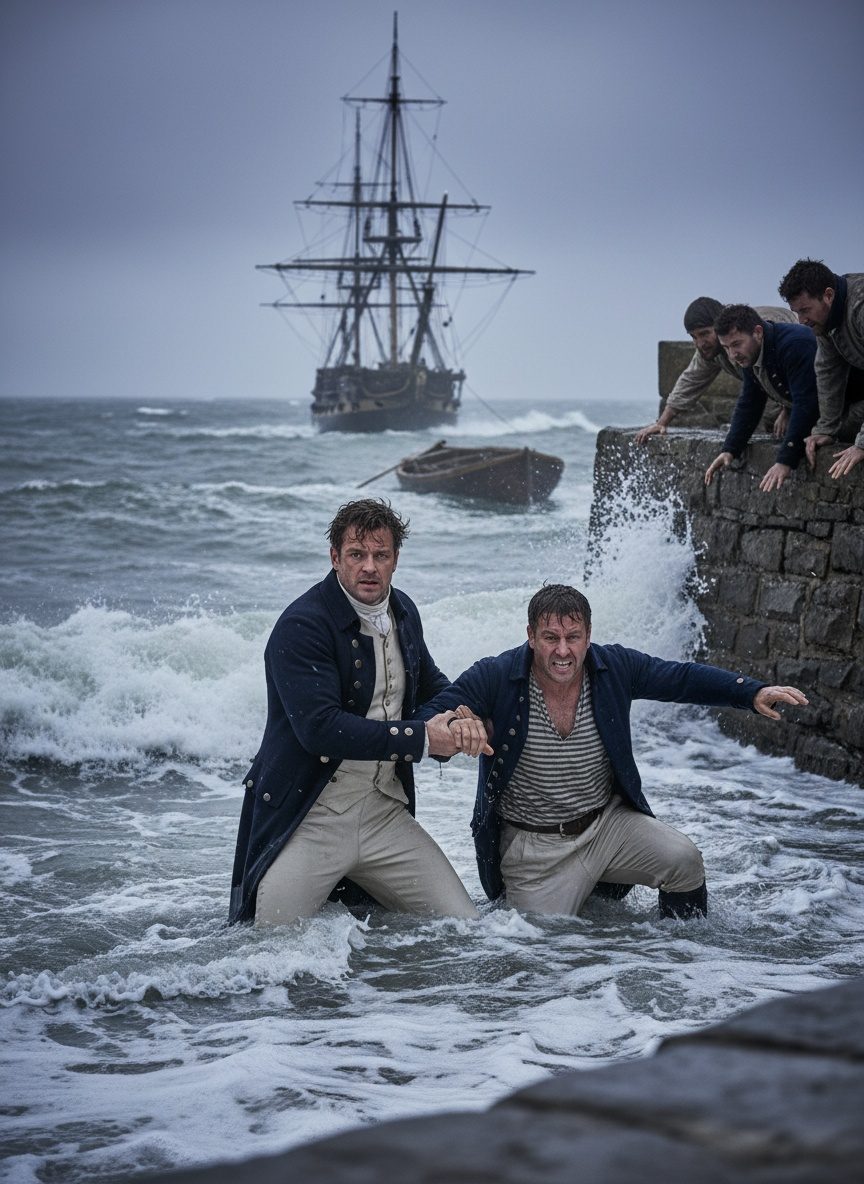
January 1796. The winds howled fiercely over the harbor waters, turning them into a churning cauldron of icy surf.
The Indefatigable’s Captain
Amongst the gales off the coast of Falmouth, HMS Indefatigable stood resolute. At her helm was Captain Edward Pellew, a man who epitomized the daring and determination of the Royal Navy during the Revolutionary Wars. His name was whispered with admiration across the maritime world, not merely for his strategic genius but for his almost mythical courage. The winter winds had forced his ship to anchor, and the crew prepared to brave the challenges that typically accompanied long winters at sea. Yet, nothing could have prepared them for the test that awaited just beyond the safe embrace of the frigate's decks.
It was a day like many others that winter, with HMS Indefatigable awaiting orders while lay anchored, its crew performing the necessary tasks to ensure their frigate remained in fighting spirit despite the harsh elements. Captain Pellew was known for his rigorous standards, but also for his unwavering care for his men. These high seas required a hardy constitution, as well as the acquired toughness that developed under masts and atop heaving decks. Experiences like these had etched Pellew into legend well before the January squalls had taken their toll.
The sea, with its capricious whims, demands respect, often reminding sailors of its dominion in brutal and unforgiving tones. For the men of the Indefatigable, the sight of the tumultuous waves was a daily reality, yet few could have predicted the crisis about to unfold amidst the towering spray and foam that fateful morning.
A diligent crew embracing their routines soon spotted a scene that sent a shiver down all spines regardless of their seafaring resilience. A longboat, crewed by fellow seamen, overturned amidst the biting surf as they attempted to navigate the treacherous waters surrounding the great battleship. Cold and chaos enveloped them in the blink of an eye — time was of the essence.
A Leap of Fortune
Pellew’s reaction came not as a surprise to anyone who knew him, only perhaps as a surprise to convention. Captains of ships were leaders—tactical minds expected to command and coordinate. Tradition dictated that the gallant actions came from those above deck, sent forth under dire circumstances. Yet, as the longboat capsized, Pellew cast aside the weight of his role, his title, and even his coat. He moved with an agility born of instinct, a man driven by necessity as much as it seemed instinct.
Without hesitation, Captain Pellew leapt from the safe vantage of the Indefatigable's deck into the swirling abyss below, a figure of singular resolve cutting through the pandemonium before him. The sheer shock of the frigid embrace should have been enough to silence any mortal leaping into such ruthless waters, but not Pellew. Perhaps there was something in his spirit that thrived alongside danger, turning resolve into action without regard for reward or recognition.
The sea was alive — fiercely so — as Pellew plunged beneath its ruthless grasp. Crew members shouted with urgency, their efforts redoubling to ensure the retrieval of those stranded amidst the whitecapped waves. The cold was biting, oppressive, a seemingly invincible barrier that attempted to claim any it ensnared. Yet determination seldom respects such boundaries, and Pellew was buoyed by a resolve unmatched by the elements around him.
One by one, men fought against the cold and the churn, steeled by Pellew's defiance of doom. His presence instilled a renewed vigor. Life preservers were cast forth from the frigate, ropes extended to willing hands as Pellew marshaled them towards salvation, catalyzing a symphony of cooperative survival. The courage to act had inspired the same in others, following him into the fray of fury and frost.
The Measure of Leadership
As the surf settled into a resigned gentleness, subdued by the dawn's emerging light, the deck of the Indefatigable bore witness to the breadth of Pellew's audacious deed. Not a single life was lost, each man accounted for, their gratitude puckered on each chapped cheek. Pellew had done what few men would consider, placing himself between the living and the perils that seemed poised to dine on souls that day.
News of the event scattered swiftly across Falmouth, more maritime legend than simple tale of bravery. Pellew’s name, already haloed by respect, became fabled among his peers, an exemplar not just of command but of quintessential naval excellence. His deeds echoed as ripples in the tapestry of time, shaping the perception of duty and honor across the seas he so nobly served.
Yet, perhaps most enduring is not the sea's own recount of captain against chaos, but what the longboat's rescue embodies about true leadership. For it is in the actions — daring beyond deference, generosity unbidden, and spirit observed — that true undiluted character reveals itself. Pellew's leap was not simply into the icy clutch of an English harbor; it was a leap into history, etching service and sacrifice into the fabric of the naval identity.
Captain Pellew's story is a manifest of valor wrapped in the brine and chill that charged Britain's maritime legacy. As Britannia's domain stretched across waves and nations, tales such as these served to convey not just might, but humanity, reminding us that the indomitable spirit of a single man can inspire much more than the sum of its parts.