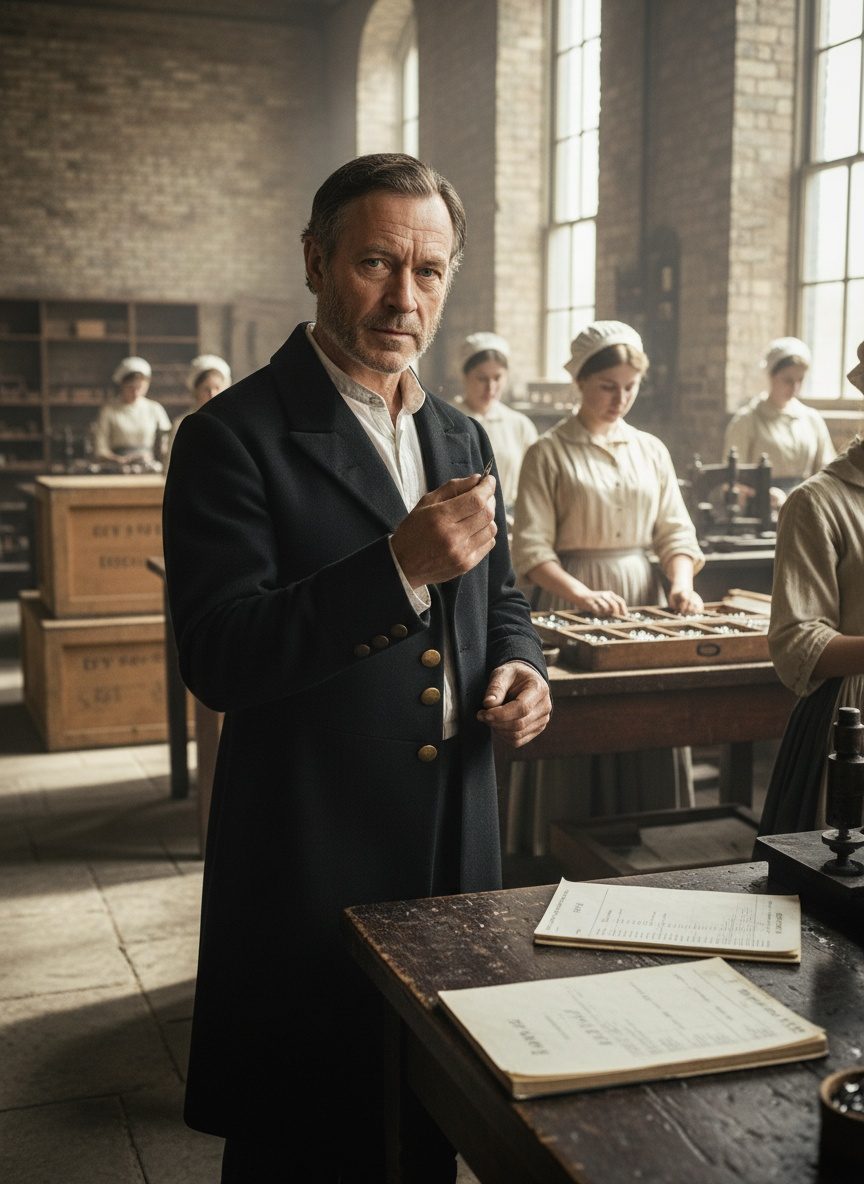
1844. The clatter of machinery reverberated through the smoky Birmingham air.
The Humble Beginnings of a Pen Meister
Josiah Mason's journey was as unlikely as it was inspiring. In the early 19th century, Birmingham was a burgeoning hub of industry, yet for a man like Mason—lacking formal education, influential connections, and financial capital—the path to prosperity seemed elusive. Born into modest circumstances in Kidderminster, Mason began his working life as a peddler, selling everyday wares across the English countryside. But beneath his simple exterior lay unbridled ambition and an ingenious mind eager to seize opportunity.
It was this dogged determination that propelled Mason from the humble trade of hawking goods to pioneering advancements in manufacturing. His relentless curiosity and innovative spirit soon directed him towards an unexpected frontier—the mass production of steel pen nibs.
The Pen That Conquered the Page
During the early 1800s, writing instruments underwent a revolutionary transformation. Quill pens, once the quintessential tool for writing, were wrought with inconvenience and inefficiency. Enter the steel pen nib—a durable, efficient alternative that quickly gained favor. However, the manufacturing process for these nibs was painstakingly slow, limiting their widespread adoption.
In 1828, Mason joined forces with the pioneering inventor James Perry, who had developed a method for mass-producing these nibs. Yet it was Mason's ingenious touch that truly unlocked their potential. He devised a streamlined manufacturing process that drastically reduced costs and increased production: punching, polishing, and packaging thousands of nibs in a fraction of the time it once took. With this breakthrough, Mason's factory in Birmingham soon found itself at the heart of a burgeoning global trade. By 1844, nine out of every ten steel nibs used throughout the British Empire were stamped with the mark of his relentless ingenuity.
The Industrial Symphony of Birmingham
Step into the bustling city of Birmingham during the Victorian era, and you would find yourself amidst a mechanical symphony of industry. Thick plumes of smoke danced from factory chimneys, while the rhythmic clanking of machinery filled the air. At the epicenter of this industrial crescendo stood Mason’s pen manufactory—a labyrinth of engineers and artisans working in concert to meet the insatiable demand for steel nibs across the globe.
To visit Mason's facility was to witness the epitome of Victorian industrial prowess: endless rows of punch presses hammered out nibs with mechanical precision, while skilled workers tended to their stations, ensuring that each nib met the exacting standards of quality that Mason himself insisted upon. In this microcosm of innovation, human ingenuity and mechanical efficiency coalesced, painting a vivid tableau of the era’s industrial might.
The Ink that Connected an Empire
In the quiet corners of the British Empire—from the bustling streets of London to the distant outposts of Calcutta—the humble pen nib transformed the written word. With Mason’s innovations, the flow of information and communication was democratised as never before. Ledgers, journals, and official decrees filled with precise script chronicled the narratives of commerce and governance, while private correspondence flourished across oceans and continents.
The pen, once relegated to a select literate few, ushered in an era where the average citizen could partake in the age-old act of writing. This empowerment catalysed educational reform, inspired literary exploration, and, in many ways, laid the paper foundations of an increasingly interconnected world. Mason had armed an empire not with swords or cannons but with the simple power of the pen.
The Legacy Written in Steel
The story of Josiah Mason echoes through the annals of history as an embodiment of industrious spirit and innovation. It is an oft-forgotten chapter of the Victorian era, nestled in the shadows of more resounding tales of conquest and power. Yet, the far-reaching impact of his contributions, comprised of unassuming yet revolutionary pen nibs, endures as an enduring testament to the transformative power of trade and commerce.
As we reflect on the profound implications of his work, Mason’s story serves as a compelling reminder of how a seemingly inconsequential invention can shape the course of cultures and societies. In the unlikeliest of places and driven by the unlikeliest of men, the monotonous cadence of machinery not only forged pen nibs but also inscribed the expansive story of the Victorian world—a timeless testament, etched in steel, to the empire he helped write into existence.