He was not an explorer by training. His life as a spy was never meant to be glamorous.
The Locked Lands of Tibet
In 1865, the very air of Tibet was inhospitable to outsiders. This was a world sealed off not by natural barriers of mountains and glaciers alone but by political edicts and cultural protectionism. The Great Game, that defining geopolitical chess match between the British and Russian empires, had made this fortress-like region of Asia both enigmatic and crucial. For Tibet, strict isolation was the dual blade of spiritual promotion and defensive stealth, one that put trespassers’ lives in peril, often terminating them swiftly upon discovery.
The British Empire, ever eager to see beyond the world's uncharted veil, turned its apprehensive gaze toward Tibets' hidden valleys and unknown towns, places where even whispers of British interests would not easily reach. Traditional explorers wouldn’t suffice. They needed someone inconspicuous, someone whose very identity could blend seamlessly with the landscape. Nain Singh, a former schoolteacher and resident of the Himalayan foothills, was the unlikely beacon of British hope.
The Schoolmaster in Disguise
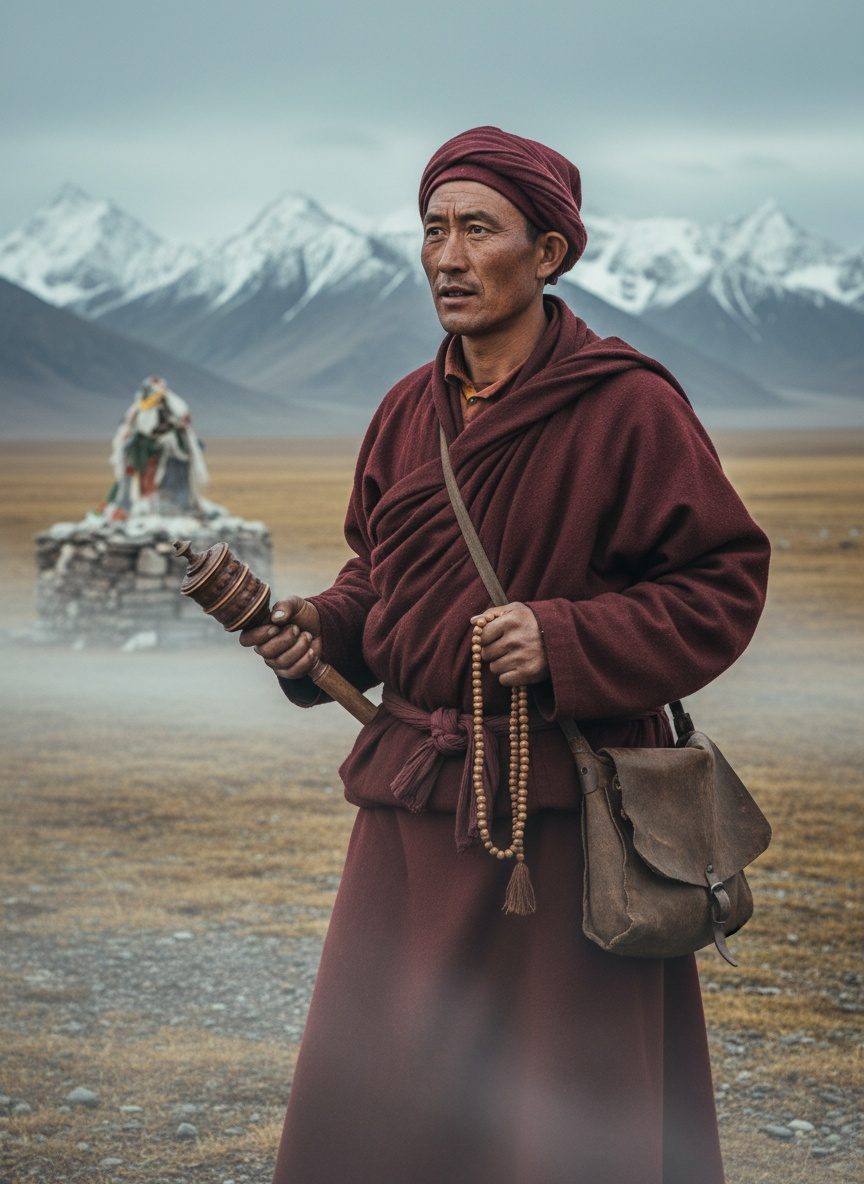
Singh’s entry into the British fold bore little resemblance to the tales of dashing spies and daring escapades. Educated in the hill town of Almora, Singh was a product of the expansive vision of Captain Thomas Montgomerie of the Royal Geographical Society. Discretion rather than daring was the order of the day. Melding into the milieu of a Tibetan monk required Singh to wield more than robes and a shaved scalp — it required intelligence as sharp as any blade and courage to face the unknown with calm resolve.
Singh’s secret arsenal was unconventional. Among his possessions were a Buddhist prayer wheel sewn with a hidden compass and a string of prayer beads, each bead representing a measured step. Not just relics of disguise, these tools were a clever use of native religious devices, allowing him to count his paces and calculate distances subtly as he moved through the terrain, creating vital maps previously only dreamt of in sketches and speculations.
Through Chains and Challenges
Despite his meticulous preparations, Singh's journey was anything but seamless. Crossing into Tibet, the risk of capture loomed omnipresent. In this land, where faith ruled and outsiders meant chaos, calamity befell him — he was captured, soon finding himself bound by chains and cast at the mercy of his captors. In interrogation, faced with the blunt finality of an executioner's blade, Singh’s calm façade became his greatest survival tool, persuading his captors of his harmless monastic mission.
Yet, it was his continued stoic perseverance that astonished. Even with chains cutting into his skin, he never truly halted his mission for the Empire. Released upon either the mercy or weariness of his captors, Singh resumed his journey with methodical doggedness. The landscapes unfurled, away from the bustling sanctuaries of Lhasa, into expansive desolate plateaus and winding riverbeds. It was within these hidden contours that Singh mapped over 1,200 secretive miles, a silent dedication to tasks no maps or instruments known in British circles could easily replicate or verify.
The Legend They Almost Never Told
Few outside the tight-knit community of cartographers and spies have heard of Nain Singh, the man who walked where no outsider was permitted to tread. His name rests obscurely in the folds of history, overshadowed by tales of adventuring gentlemen and military conquests. Yet, there lies an equivocal strength in his covert triumphs, one built upon cultural acuity, patience, and the understated mastery of walking unnoticed.
When Singh had finally completed his monumental task, his acquired maps became invaluable tools in mapping the previously undetermined landmass of Tibet. His contribution echoed quietly, yet profoundly, through the corridors of British power centers. A figure underestimated by his formal education, yet unmatched by any for his resilience and ingenuity, Singh remains a silent narrative of espionage, carved not in daring raids but in countless steps untold by textbooks.
The unwritten tales of Nain Singh resonate today as emblems of endurance and adaptation. They remind us of the unexpected forms rebellion and resistance can take and of the many unsung heroes who forge paths in the most unarmed and unassuming manners. Every step Singh took was a brushstroke against the canvas of a sealed world, capturing its shape in silence, painting a picture for those who dared not venture.