He was twenty-four years old. He had never abandoned a ship before, and he would not start now.
The Blaze of Honor
In the early months of 1801, the Mediterranean waters around Toulon shimmered under the fiery gaze of the midday sun. These waters were treacherous and unrelenting, much like the forces of the Napoleonic Wars that beleaguered them. Among the captains who braved their unpredictable temperament was Captain Israel Pellew, a figure known more for his indomitable spirit than for any lineage or advantage. That spirit was put to a harrowing test when HMS Lively, under his command, engaged and captured a French corvette in these very waters.
The corvette, a prize taken after a fierce but swift skirmish, was a testament to British naval superiority—a floating symbol of both fortune and peril. Yet, as fortune would have it, disaster struck with the ferocity of a squall. Reports reached Pellew that a fire had broken out on the newly captured ship. In an era when fire was the mortal enemy of all things wooden and tar-smelled, Pellew's crew knew well the risks posed by flame. The panic that ensued was the kind fit for mariners' nightmares. Smoke billowed from the captured vessel, a suffocating herald of doom that stood to consume the men aboard.
With a prize crew dispatched to the vessel, Pellew faced a decision forged in the crucible of command. He could command an evacuation, preserve his own life, and sail away, leaving the prize to the elements — or he could return, placing himself in mortal peril to attempt the near-impossible: to fight the flames and save those entrusted to his care. In a display that defied fear and embraced duty, Pellew chose the latter, choosing to fight not just the flames but a fate that seemed bent on claiming his men.
A Desperate Gamble
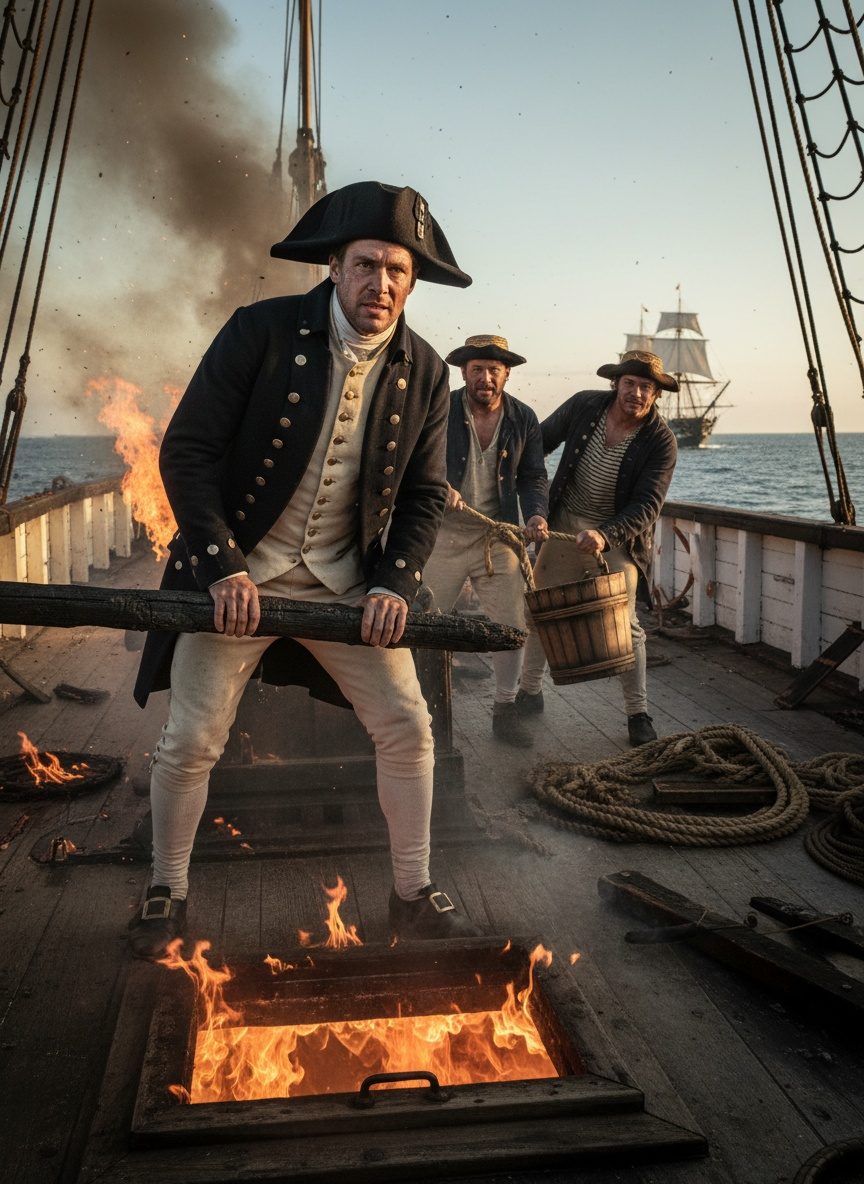
The sight of the Royal Navy captain scrambling back aboard the corvette seemed surreal, a vignette from a world where valiance coursed through veins like electricity. His men, galvanized by the sight of their captain risking all, surged back into action. Pellew, with hands that would blister and bleed, led the crew in a desperate, frantic fight against the inferno below decks. The flames roared as if with a malevolent joy, challenging each drop of water that splashed aggressively upon them.
In these moments, Pellew was more than a captain; he was a force of nature, embodied in the fiery hell of a ship on the cusp of destruction. His voice, commanding and unwavering, cut through the crackle and roar, directing efforts to combat the blaze. The struggle was elemental—a clash between heat and mettle, with sweat and smoke mingling in a dance of survival. Each bucket of water tossed upon the fire was a testament to the will of sailors determined not to abandon their own.
But as the contest endured, Pellew and his men achieved the unthinkable. The fire, quelled by their combined efforts and sheer determination, relented. Where once there was panic, now there existed an exhausted tranquility, an eerie calm bespeaking the raw edges of mortality brushed and beaten back. Pellew, surveying the blackened timbers and the tired but resolute faces of his crew, knew they had done more than win a battle—they had defied the twin adversaries of fate and flame.
The Legacy of Courage
News of Pellew's actions swept through the fleet with the same speed as a ship caught wind, inspiring awe and trepidation. Tales of his bravery spread, whispered in the hushed tones of those who knew that bravery was oft more quiet action than bold claim. Among the ranks of the Royal Navy, his story became a parable of honor and an enduring reminder of the leadership that turns peril into possibility.
Pellew returned home with every man, an accomplishment transcending any trophy or medal wrought in this world. His actions became a standard to be aspired to, an example of what the fabric of leadership might behold. It was not just that he had saved a ship; in returning to the inferno to rescue those men, he forged a narrative of indomitable courage, the kind that inspires others to peer into the abyss and choose to fight.
Reflecting on Captain Pellew's decision, it becomes evident that the fires faced in life are not always tangible elements. They are often the challenges that demand choices lighting the path of the brave. And it is through these choices, as exemplified by a young captain in the waters off Toulon, that the true nature of leadership is revealed—not in the absence of fear, but in the face of it.