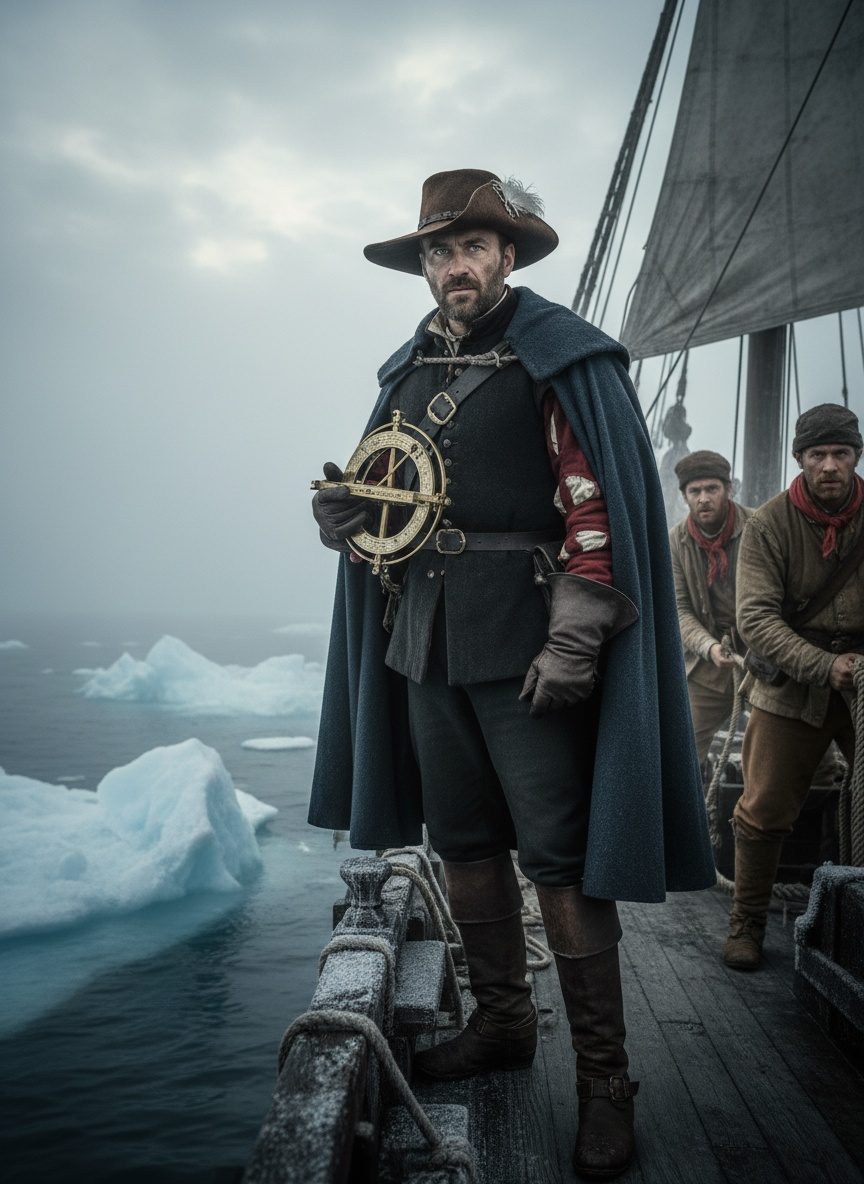
John Davis did not even know how cold ice could be. Yet he navigated his ship straight into it. This wasn't just a voyage; it was an audacious gamble against the might of nature and the unknown.
The Call of the Endless North
In an era where exploration meant endless possibilities, John Davis, a navigator from Devon, dared to sail north into uncharted territories. The year was 1585, and the English were hungry for new trade routes, particularly the fabled Northwest Passage to China. This passage held the promise of wealth and prestige for any captain brave enough to uncover its secrets. Davis, with his unwavering resolve and a fearless crew, embarked on his mission to penetrate the formidable Arctic. As he sailed, icy winds howled across the deck, and frostbite threatened the men’s extremities. It was a world wrapped in icy desolation, yet one teeming with potential riches for those willing to endure the journey's harsh trials.
For most sailors, the mere thought of the Arctic Circle was enough to send shivers down their spines. The region was a frozen mystery, a blank spot on the map where no Englishman had ventured so boldly before. But for Davis, the lure of discovery outweighed the paralyzing fear. His ships, with their hulls fortified to withstand the brutal cold and ice, became symbols of defiance against the elements. Despite the odds, he pressed forward, driven by the idea that this path could cement England’s position as a global power in trade.
Mapping the Unseen
As Davis navigated the fog-covered expanses of the Arctic, he did more than just brave the elements; he meticulously charted the unknown. In treacherous waters, where most saw only endless white and deadly icebergs, Davis saw opportunity. This voyage, though ultimately failing to find the Northwest Passage, was not in vain. Through his precise observations and detailed maps, he transformed the way seafarers understood these alien waters.
Despite the failure to find a trading route to China, Davis's maps laid the groundwork for future exploration. Charts once filled with the speculation of mythology became lined with islands, shorelines, and navigable passages. By documenting these icy seas, Davis provided a new understanding of the geographical world. His work set the stage for generations of navigators who followed in his wake, using his insights to venture safely into Arctic waters. Among his most significant contributions was the depiction of the eastern coast of Greenland and the discovery of what later became known as the Davis Strait, a testament to his achievements in mapping the unseen.
The Emotional Voyage
Back on board, the freezing temperatures tested the mettle of Davis’s crew. For these men, life was a relentless struggle against the elements, with fingers numb and breath visible in the cold air. Each creak of the wooden hull as ice bore down upon it became a hymn of endurance. These resilient sailors, recruited from the heartlands of England, were unfamiliar with such conditions. Yet, they stood steadfast against walls of ice, guided by Davis's unwavering leadership.
The psychological strain was as fierce as the physical. Men who had once known the temperate English shore were now facing the raw, inhospitable grandeur of the north. The rigging, usually a sailor's trusted companion, became a crystalline mass, frozen and unwieldy. It was in these dire circumstances that the true character of the voyage was revealed. Courage underpinned with profound fear, seafaring lore clashing with harsh realities—these were the moments that would define the expedition.
The Endurance of a Legacy
John Davis returned from his third and final voyage in 1587 without the prized Northwest Passage, but not without making indelible contributions to the era’s cartographic knowledge. His explorations reminded the Elizabethan England of the power of persistence and the importance of daring to push beyond known boundaries. Despite the ice and storms, his maps became guiding beacons in the pursuit of trade, exploration, and empire-building.
In an age of budding imperial ambition, Davis’s journeys underscored the importance of geographical knowledge and the spirit of exploration. His story does more than recount a voyage; it captures the courage to venture into the unknown, the tenacity to challenge the forces of nature, and the vision to expand one's understanding of the world. As history recalls his efforts, it becomes evident that Davis’s legacy lies not in the passage he sought but in the charts he left behind—blueprints that rewired Britain’s approach to navigation and exploration. As the ice cracked against his hull, each line drawn on his map represented the audacity of an age that dared to dream beyond its borders.