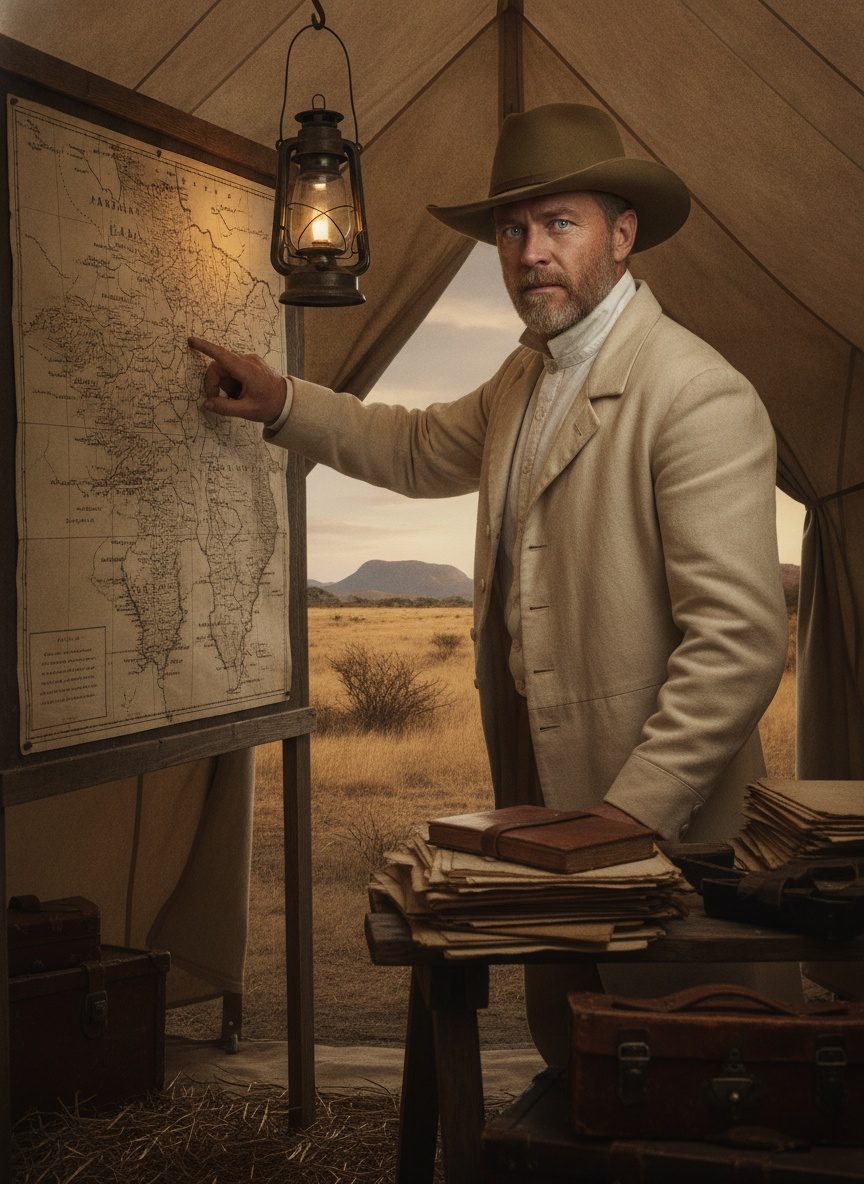
June 29, 1890. The African savanna stretched endlessly towards the horizon, shimmering under the relentless sun.
The Gamble: Betting an Empire on a Telegram
In the twilight of the 19th century, a slender wire stretched across continents carried the hopes of an empire-hungry visionary. Cecil Rhodes, equipped with nothing more than a royal charter, dared to dream of an expanse stretching through the heart of Africa — the fabled land of Mashonaland. The geopolitical chessboard was filled with pieces in move; the Portuguese and the Boers had their eyes set firmly on the same prize, eager to imprint their own influence on this rich territory.
Rhodes, however, was not easily deterred. He bore an almost fanatical belief in the imperial destiny of the British Empire, and in his gambit, he relied not on the force of arms but the sheer force of conviction and a thin, crackling telegram line. This modern marvel of communication was his sole connection to the intrepid band of 200 pioneers he had dispatched to stake a claim on Britain's behalf. They were not soldiers but settlers, adventurers lured by the promise of land and opportunity. Armed with surveying equipment rather than rifles, they represented Rhodes' boldest venture yet: to seize Mashonaland without a single shot fired.
As Rhodes stood by, perhaps in the bustling offices of the British South Africa Company, waiting for word of their success, the silence must have been profound. The line upon which he depended to spread British influence lay silent, the lifeline to his dreams of empire stretching thin and vulnerable over the vast, unpredictable landscape of colonial Africa. He gambled everything on this treacherous whisper of technology, hoping the message would carry his ambitions past the claws of opposition and into history.
Marching North: The Path to Fort Salisbury
The journey northward that these 200 men embarked upon was fraught with uncertainty, tempered only by the prospect of what lay at the end. Not only was the boon of a new land at stake, but also the very credibility and future of Rhodes' vision. They were to confront terrains unseen and cross lands unmapped, driven by directives that were as much a test of faith as of endurance.
The British enterprise had already made its mark across Africa's southern tracts by then, but Mashonaland represented the tantalizing verge of new imperial territory. It was a place legendary in its speculated wealth, yet shrouded in mystery. Administering such ventures with no ready military support, Rhodes’ settlers would rely entirely on their spirit and the persuasive power of British determination.
Under Rhodes' directives, every step they took was towards creating a new seat of power, a fortified presence amid a volatile frontier. As if guided by destiny, the journey culminated in the formation of Fort Salisbury, a place that symbolized not merely a physical outpost but the catalyst of an emerging story of conquest. It swiftly became a beacon of British Imperial might, defying the immediate ambitions of both Portuguese and Boer rivals.
The flag that was planted at Fort Salisbury was more than cloth: it was the pedigree of a relentless empire anchored in one man's unfaltering navigation through a geopolitical storm. The settlers' successful transmission of the Morse signal declaring success must have filled Rhodes with an ecstatic vindication, reverberating louder than cannon fire across the imperial corridors of power in London.
A Transformative Moment: The Dawn of Rhodesia
With the claim on Mashonaland secured virtually overnight, the world witnessed the birth of what would come to be known as Rhodesia. It was a stark testament to Rhodes’ vision, one that intertwined the grand imperial narrative with personal tenacity and strategic acumen. Laying down roads from a charter instead of concrete, Rhodes’ influence expanded not just in geographical terms but through the story that emerged from this daring gamble.
Yet, this monumental feat signified more than just the assertion of British dominance. It highlighted the volatile nature of colonial expansion, driven by individual ambitions set against the broader imperial objectives. The Cantonese whispers of dissent, long before the telegraph marked them as incomplete narratives, resonated with the indigenous peoples whose histories were forever changed by this act of imperial claiming.
In the centuries preceding and following, Mashonaland and the broader territories of Rhodesia bore the marks of that audacious gamble. It set the stage for the complex drama of colonial and post-colonial evolution, adjusting constantly under the weight of its origins amidst diplomatic and cultural travails. The land, once captured on the wire of a single telegram, unfolded into a reality at once emblazoned with emblazoned legacy and beset with challenges wrought by imposed boundaries.
The story of Cecil Rhodes' telegram in 1890 continues to echo through time, a compelling reminder of how individuals dared to sculpt the world map based solely on inked dispatches and steadfast dreams. It invites us to reflect on the intricate weave of ambition and consequence, the unseen forces of determination that allow a flag to tether historical tides in its shadow.