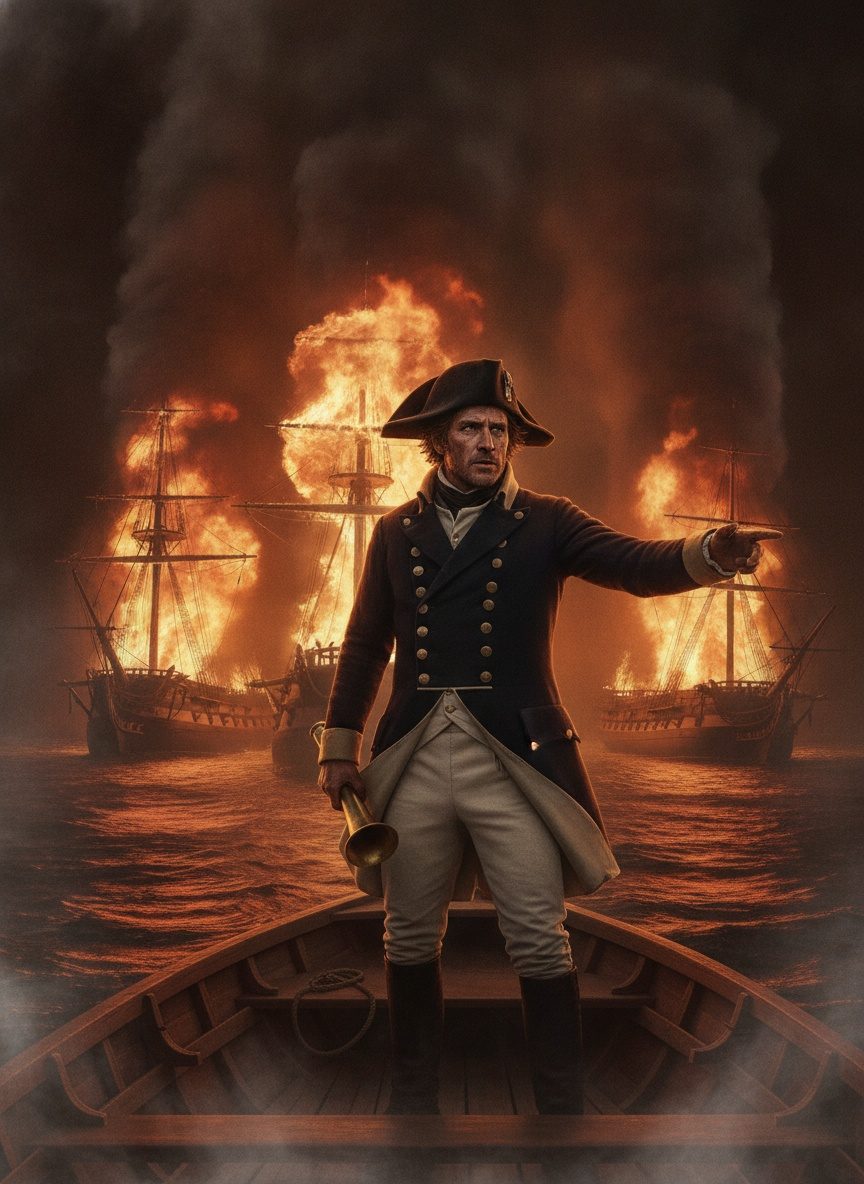
The night was alive with flames, a fiery tableau painted against the backdrop of the French coastline. Lord Cochrane stood unwavering on the deck, the acrid smoke coiling around him like a python. The incandescent glow of his vanguard, the fireship, cast a flickering light across the chaotic sea. Exhilaration mixed with desperation as he orchestrated the audacious attack against Napoleon's proudest fleet at Aix Roads in April 1809.
Beneath the tumultuous overlay of clouds, the French ships rested, seemingly invincible in their rowed alignment, each a fortress in its own right. The coastal waters shimmered in the moonlight, each wave a crystalline reflection of the heavens above. Yet, it was not the stars that would illuminate this night but the inferno set loose by one daring man.
Left with his superiors' skepticism, Lord Cochrane understood the stakes. The British Admiralty, entrenched in tradition, had underestimated the potential of fireships. Cochrane, however, saw them as the key to Britain's naval supremacy. His task was insurmountable, his resources meager; yet, he harbored an unshakeable belief in the power of psychological warfare. He knew that the sight of ships ablaze, hurtling toward them, would shatter French morale.
As Lord Cochrane signaled the charge, the air filled with adrenaline. The fireships, laden with flammable material, drew closer to the enemy. In that breathless moment, time seemed to stretch, the French sailors barely making sense of the incandescent fleet rushing toward them. The fireships advanced inexorably, their trajectory a flaming arc etched against the night sky.
The French, gripped by panic, scrambled chaotically. Officers barked orders lost to the sea's roar, men scrambled to cut anchor cables in a desperate attempt to evade the advancing inferno. Flames licked the heavens, a harbinger of their imminent destruction. The line which had moments before been so orderly disintegrated into chaos.
Four mighty ships of the line, symbols of Napoleonic power, found themselves cast upon the rocky shallows. Masts splintered like matchsticks; the hulls groaned under the sea's unyielding embrace. The air crackled with the pungent mix of salt and scorched timbers. It was as though the sea itself conspired with Lord Cochrane, reshaping the destiny of empires with every fiery wave.
And amidst it all, Lord Cochrane's audacity shone like a beacon across the waters, a striking testament to individual initiative defeating bureaucratic inertia. It was not sheer firepower but rather the element of surprise and psychological dominance that had ruptured Napoleon's naval stronghold.
As the dawn crested on the battered remnants of the French fleet, the British watched from afar, astonished by the extent of Cochrane's triumph. Napoleon's admirals were left with the bitter truth that innovation and audacity had unraveled their formidable alliance. The flames might have died down, but their impact reverberated through the corridors of power.
This remarkable exploit was a display of inventive warfare, reshaping the philosophies of naval engagements in one dramatic sweep. The echo of Cochrane's triumph at Aix Roads underscored a profound truth: empires might rise through grand frameworks of strategies, but sometimes they topple through the strokes of a singular, unyielding vision.
In the subsequent months, as whispers of Cochrane's daring reached far beyond the naval charts, a shift in battlefield tactics began to emerge. The legend of the fiery assault ingrained itself in maritime lore, a tale not penned tightly enough in history's textbooks but alive in the spirits of those who dared challenge convention.
As one reflects upon the fiery silhouettes dancing against the April sky of 1809, a singular lesson endures: innovation is the progeny of necessity, courage, and foresight. It reminds us that sometimes it takes just one bold mind to rewrite the narrative against insurmountable odds, a testament immortalized by a night ablaze at Aix Roads.