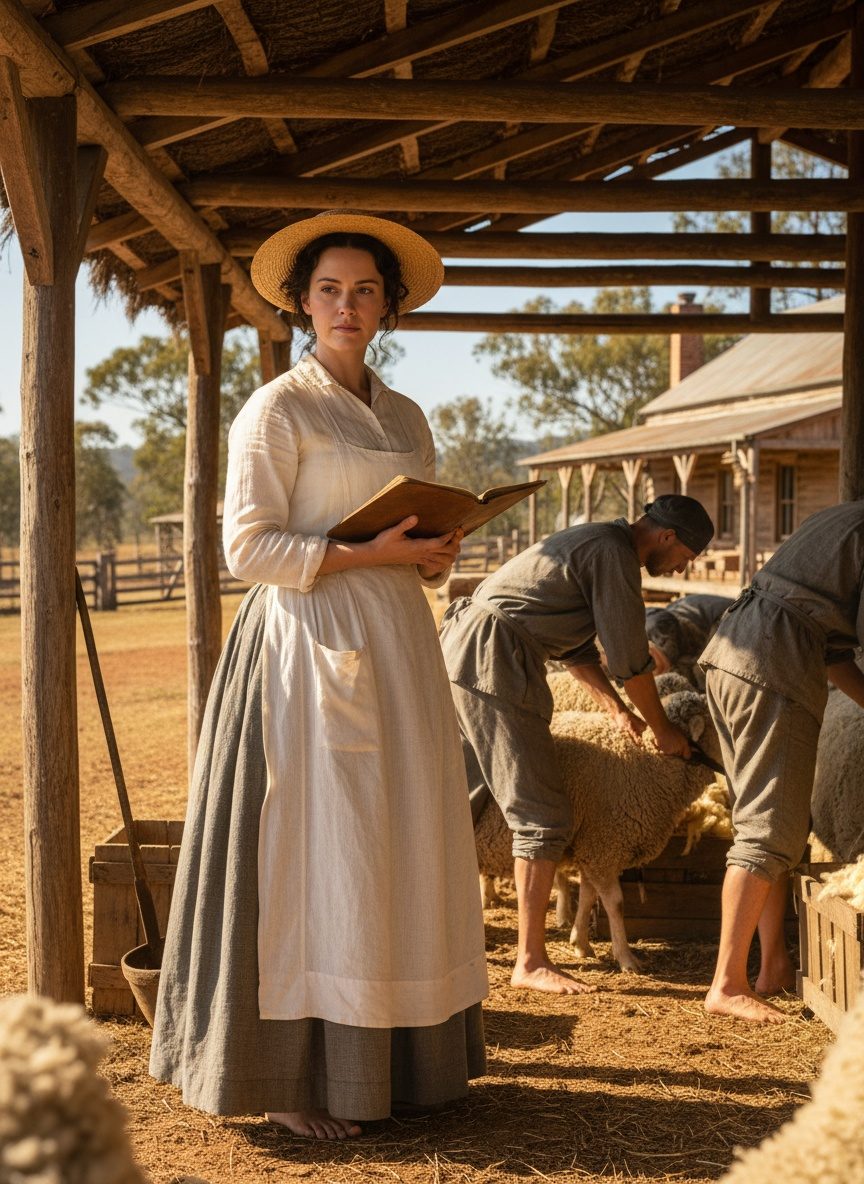
She was a convict's wife who had never planned to run a farm. Yet Elizabeth Macarthur became the unlikely architect of an industry that would reshape Australia. In the rugged landscape of Sydney in 1805, she transformed adversity into opportunity, herding convict laborers and nurturing a flock of merino sheep whose wool would soon warm the wealthiest homes in London.
The Unexpected Shepherdess
Elizabeth Macarthur had no formal training in wool production or managing sprawling colonial estates. Born in 1766, she grew up in a genteel environment in Devon, England, far removed from farm fields. Her improbable journey to shepherdess began when her husband, John Macarthur, was exiled back to England in disgrace after a series of disputes with colonial authorities. Left to manage a fledgling estate on the outskirts of Sydney with no money and no support, Elizabeth faced devastation.
The farm was filled with convicts whose skills and motivation were questionable at best. Yet Elizabeth possessed a keen intellect and a rare resilience. She saw the potential in their tireless hands, just waiting to be directed. Her leadership turned misfortune to advantage, transforming her unlikely workforce into a dedicated team. With their help, she expanded the farm's operations, focusing on the small flock of merino sheep her husband had imported before his exile.
Spinning a New Future
Merino sheep were not just any sheep; they were the prized possessions of Spain, guarded jealously for the superior quality of their wool. The 18th-century world craved merino wool — a fabric prized for its fineness and softness. Elizabeth understood that quality would be her trump card in transforming the ordinary into extraordinary. Despite her lack of formal training, she threw herself into the pursuit of excellence, focusing on the nurturing and shearing of the flock with meticulous care.
The challenge was immense. Australia's climate was harsh, the summers blistering, and the winters biting. But Elizabeth improvised. She learned through trial and error — how to feed the sheep, treat diseases, and shear the precious fleece carefully. No guidebooks existed, and communication with expert shepherds from the homeland was unreliable and slow. Her methods were unorthodox, combining innate wisdom with the practical know-how gathered from the work done by the convicts. Her biggest resource was her unyielding determination.
Convicts, Fleeces, and Fortune
Shearing time on the Macarthur estate became a vibrant scene of organized chaos. Convicts, each contributing whatever skills they possessed, worked efficiently under her direction. Elizabeth managed to keep them motivated with fairness and a remarkable tenacity that earned their respect. The wool shorn was carefully inspected, classified by quality, and stored meticulously.
In 1807, a bale of Macarthur wool found its way to London. This shipment of wool was unparalleled in quality, and the reaction was immediate. British manufacturers, hungry for raw materials due to disruptions across Europe, were quick to recognize the quality of Elizabeth's produce. The English market was abuzz with this revelation; the Macarthur wool was unmatched. Orders poured in, and her success ignited what would become Australia's wool industry.
An Unlikely Revolution
By managing to export such fine-quality wool across oceans, Elizabeth not only supported her family but laid the foundation for an entire industry. Her triumph was not just the wool itself, but the demonstration of what could be achieved with sheer determination and pragmatism. She proved that an untrained woman, with an undesirable batch of laborers, could transcend her circumstances, creating not just a successful farm but sparking a crucial segment of the Australian economy.
The story of Elizabeth Macarthur and her sheep is one of relentless optimism and tenacity in an era that demanded women remain in the shadows. Her remarkable foresight in cultivating merino wool changed Australia's economic landscape. When looking at the wealth generated by the wool industry today, one must reflect on how it all began — with a woman alone, a flock of sheep, and a sheer commitment to excellence. Through Elizabeth's vision and courage, she did more than manage a farm; she sheared the fleece that fed a nation.