The roar of the Dakota's engines was thunderous, dousing any chance of a silent entry. As the metal belly yawned open, the only sound louder than the aircraft’s fury was the howl of the wind rushing through the open hatch. Paratroopers prepared themselves with calculated movements, adjusting straps and double-checking their gear before the final jump signal. Below them, unaware of what was soon to descend, lay a patchwork of fields and forests, crisscrossed with nameless roads — or sometimes, no roads at all.
The Lighter Cavalry
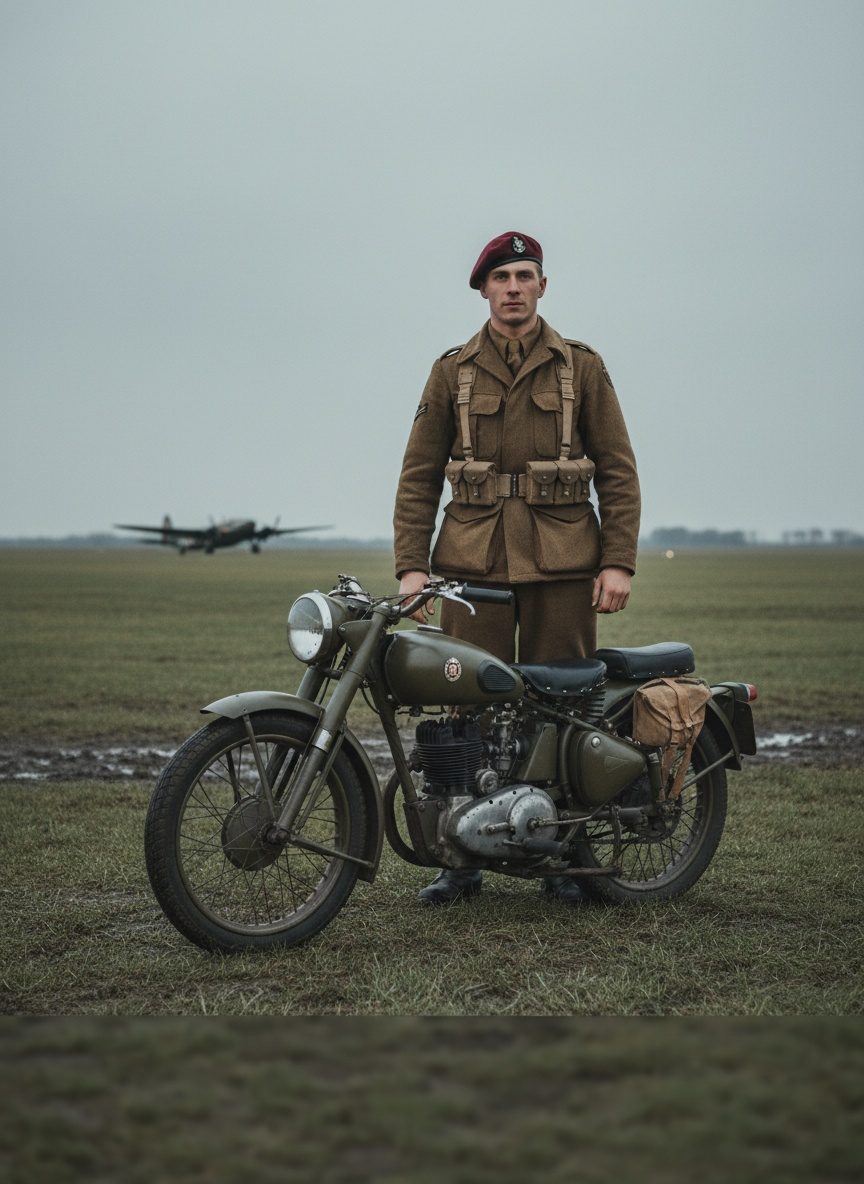
In World War II, battles were not solely won by the weight of artillery or the thunder of tanks; they were often decided by the nimbleness and adaptability of the forces on the ground. For the British paratroopers, these qualities were crucial. Yet, dropping into hostile terrain posed a different challenge: mobility after landing. The Royal Enfield WD/RE, affectionately nicknamed the Flying Flea, was designed specifically to address this Achilles’ heel. Weighing a mere 60kg, lighter than some of the men who would ride it, the Flying Flea was the airborne transport of choice for these skyborne warriors. Paradoxically solid and fragile, it had no intention of leading charges but promised speed and convenience where none was thought possible.
A Skyward Gamble
Conceived to be compact enough to accompany paratroopers into battle, the Flying Flea was the brainchild of British ingenuity under duress. It was engineered with versatility in mind; its lightweight frame meant it could be parachuted alongside soldiers or packed into gliders, providing them with quick transit out of drop zones. Imagine the spectacle, as much astonishing as absurd, of these tiny motorcycles being pushed out of aircraft with naught but a parachute for shelter — an aerial ballet fraught with inherent risks. More than just a practical tool, it was a morale booster, a symbol of strategic outmaneuvering, intended to catch the enemy flat-footed by manifesting mobility where tracking wheels had been counted impossible.
Windswept Allies
While the Flying Flea didn’t roar with daunting power, its hum was a promise of reliable efficiency. After their airborne descent, paratroopers would unbundle the motorcycles as swiftly as they had leaped from the sky, revving the engines not with the intent to intimidate but to bridge the vast sprawls of hostile territory with haste. It was a logistical miracle; roads were seldom near attack points, resources limited, time stretched thin — yet here was a mechanical steed, ready to slice through the landscape. For the troops, these compact mounts symbolized not just mobility, but also a feeling of camaraderie — their silent partners from the skies, devoted in function even in the depths of warfare’s chaos.
A Warped Reflection
The Royal Enfield WD/RE stands emblematic of the desperate adaptability wars often mandate. It was a product of a conflict that blurred boundaries between the imaginable and the executed, a relic of necessity meeting innovation. Though not as heralded as their larger mechanical siblings, the Fleas played a critical role in embedding British paratroopers behind enemy lines, a silent yet roaring advance forgetful history often overlooks. Their part wasn't scripted in glorious testimonies or grand battlefield maneuvers, but in the quieter, relentless spirit of ingenuity that shaped tactical operations — each rev a reminder that wars are waged, above all, through hidden stories and obscure marvels.
What Fell, Now Rises
Today, as the world peels back the layers of military history, tales like that of the Flying Flea remind us of the countless peripheries that rarely see light in textbooks. It's a narrative of unheralded invention, human adaptability, and the steady hum of progress darting alongside the thunderous clamor of battle. When we muse about warfare’s transformations, we remember the artillery and the infantry, the tanks and the bombers, but perhaps it is time we give thanks to those intrepid souls who flew softly on machines weighing less than their ambition. Each Flying Flea was a whisper through the winds of war, a testament to the outlandish dreams quietly breathing life into the heart of chaos.