In the sweltering heat of an Indian summer, as monsoon clouds gathered ominously in the sky, a battle was about to unfold that would alter the course of global history. Yet, this battle would not begin with the thunder of cannons or the clash of swords. Instead, it was waged with ink on paper, sealed with deceit, and shrouded in the shadows of a daring subterfuge. Welcome to the prelude of the Battle of Plassey in 1757, where Robert Clive's audacious mind tricked a powerful Nawab with nothing more than forged letters and a silver tongue. This is the story they left out of the textbooks.
The Looming Battle: A Colossal Gamble
By 1757, the British East India Company's foothold in India was precarious, balancing on a knife's edge. Their trading ambitions were insulted by Siraj-ud-Daulah, the young and volatile Nawab of Bengal, who had already sacked the British fortifications at Calcutta. Robert Clive, a man of towering ambition and extraordinary nerve, faced not only a resurgent Nawab but an army of fifty thousand strong. In stark contrast, Clive's own force numbered a paltry three thousand men. Outmanned and outgunned, Clive stood at the precipice of disaster. But where others might have seen an insurmountable challenge, Clive saw an opportunity for strategic cunning.
The Ingenious Deception: Conspiring with Words
On the eve of what would later be known as the Battle of Plassey, Clive needed to sow discord amongst the ranks of the Nawab. His plan was straightforward yet bold: isolate Siraj-ud-Daulah from his key allies by casting doubt upon their loyalty. His first step was to secretly align with Mir Jafar, Siraj's own commander-in-chief, who nursed ambitions of power himself. Promising Mir Jafar the throne of Bengal in return for his support, Clive began to weave his intricate web of betrayal.
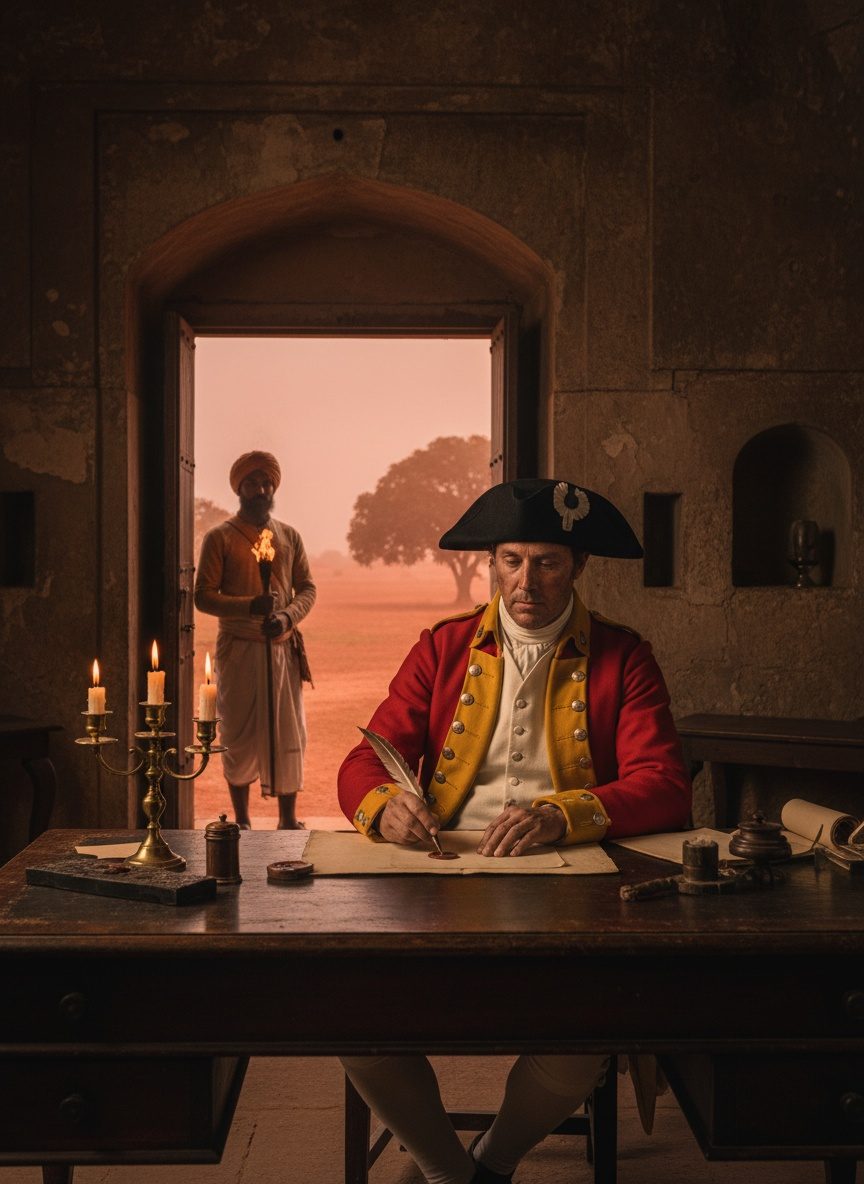
But Clive’s artistry lay not just in forming this conspiracy but in ensuring its success through artifice. He orchestrated a series of forged letters — each penned with meticulous care — supposedly from Mir Jafar to the British. These documents, laden with false promises of neutrality, were deliberately 'intercepted' by Siraj-ud-Daulah's spies, kindling the flames of paranoia and suspicion within the Nawab's court.
The Turning Tides: Strategy, Suspicion, and Subversion
Clive knew well the value of psychological warfare, understanding that even the mightiest of armies could falter if their leaders were gripped by doubt. Each letter served its purpose, subtly eroding Siraj-ud-Daulah's trust in his commanders. Seeding suspicion in the mind of the Nawab, Clive planted within his adversary a corrosive uncertainty that spread through his camp like a silent plague.
Meanwhile, Clive’s propaganda also extended to the populace. With traders, landowners, and local leaders swayed by promises of peace and prosperity under reestablished British favor, Clive skillfully undermined the local support that the Nawab desperately relied upon. The very land that Siraj sought to protect began to betray him.
The Battle that Never Was: Of Muskets and Mind Games
June 23, 1757, dawned hot and humid as Clive’s men took their positions on the battlefield by the riverbank, their hearts pounding not with fear of defeat, but with the anticipation of a bloodless victory. Across the field, the Nawab's forces, though vast and formidable, teetered on the brink of discord. As cannons roared and musket balls flew, Clive sent a signal for Mir Jafar to hold his men steady, watching from a safe distance. Analyzing the indecision in the Nawab's eyes, Clive understood that the battle was as good as won before the dust settled or a single man fell.
That day, as the rains swept across the fields of Plassey, it was not the weapons of war but the whispered promises and clandestine deals that decided the fate of Bengal. When Mir Jafar and his loyalists defected at the critical moment, the Nawab's army crumbled, fleeing in disarray. Siraj-ud-Daulah was later captured and executed, paving the way for Mir Jafar’s ascendancy and the firm establishment of British dominance in India.
The Aftermath: Unseen Ripples of a Forged Quill
Clive's triumph at Plassey rewrote the fabric of history in strokes of both brilliance and subterfuge. What appeared to be a straightforward military conquest was, at its core, a masterclass in manipulation and strategic deception. This victory marked the dawn of British colonial rule in India, setting a template for imperial expansion that would span continents.
In the retelling of history, the machinations behind these pivotal moments are often overshadowed by the battles themselves. Yet, stories like Clive’s remind us of the indelible impact of those wielding not just the sword, but the pen. The fabricated letters at Plassey set in motion a sprawling empire's ascent, grounded in the notion of perception as reality.
As we reflect on these events, we are prompted to consider the real power of information, persuasion, and strategic foresight in shaping our world. Clive's victory underscores a timeless truth—wherever there is conflict, the battle for hearts and minds is as crucial as the clash of arms.