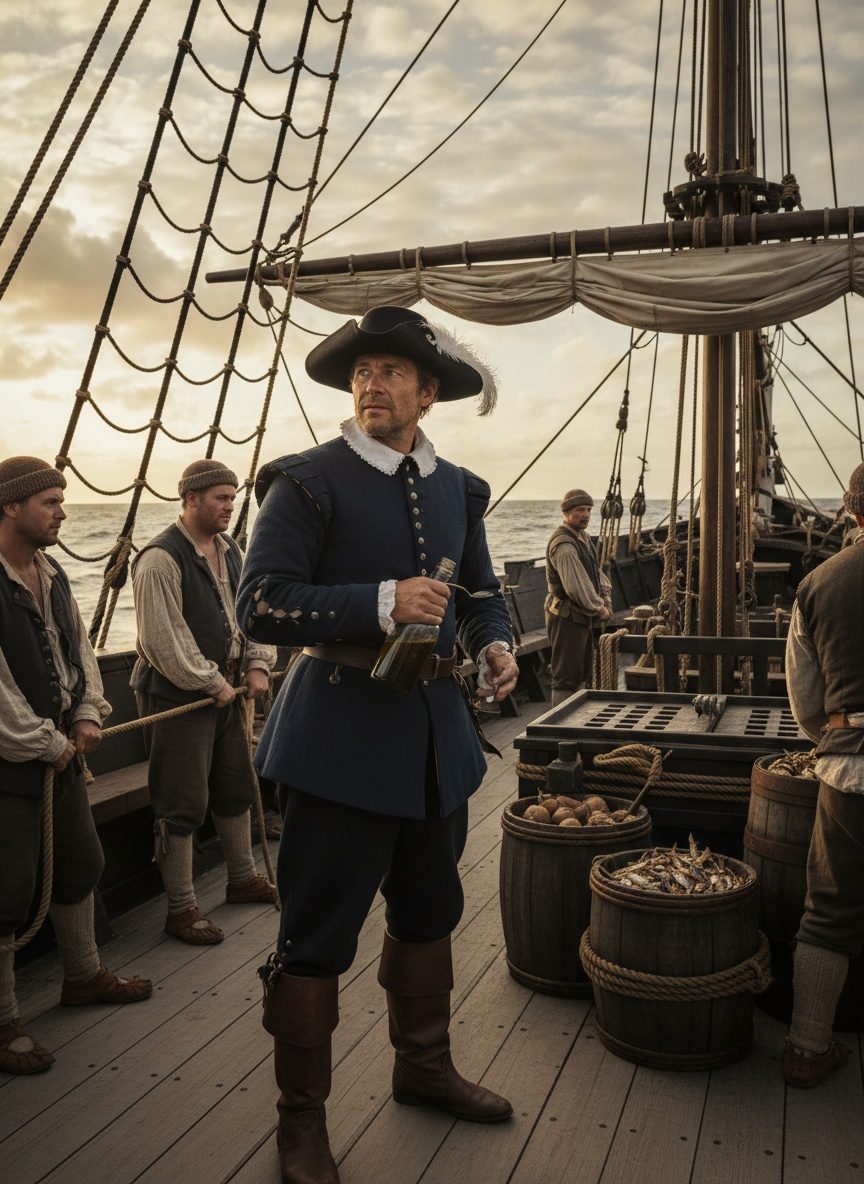
Picture the vast, unforgiving seas of the early 17th century, where the horizon was limitless but perilously unpredictable. The year is 1601, and amidst the rolling waves and biting wind, Captain James Lancaster stands resolute at the helm of the redoubtable *Red Dragon*. The East Indies were his destination, a realm promising untold riches in spices. But his most precious cargo wasn’t cloves or pepper; it was the humble lemon.
The Voyage of Risks
The waters of the East were no sanctuary—they were a crucible for the crews of the four ships dispatching from England. Lancaster, seasoned and intrepid, commanded the fleet comprising the *Red Dragon*, *Ascension*, *Hector*, and *Susan*. As the sails unfurled on this audacious enterprise, peril was never far from mind. The trade routes were contested, and the logistics formidable, but one danger loomed largest: scurvy.
Scurvy, a scourge on any sailor of the age, could decimate a crew long before enemy cannons. Known for stripping gums and joints of their vigor and eventually life, it was a nemesis that the seamen arduously battled. Curiously, Lancaster had a theory. Not from charts or compasses, but from the humble lemon—an idea whose simplicity was undercut only by its potential genius.
A Taste of Survival
From the outset, he instigated an unusual practice: each dawn, under the rising sun, his men were given three spoonfuls of lemon juice. While it seemed an innocuous ritual, the dire state of the crews upon their return dictated otherwise. The sailors of *Red Dragon* were remarkably hale; sickness had avoided them. Their counterparts on the *Ascension*, *Hector*, and *Susan* were not so fortunate.
As Lancaster guided his ship through dangerous waters, the disparity between his sailors’ vigor and the ailing crews of the other ships underscored a bittersweet triumph. The tropical sun bore witness to a discovery that could alter the fate of the seafaring world. Yet, in those days when ships were the lifeline of empires, this revelation was swept downstream by tidal waves of change.
A Remedy Ignored
Despite the astonishing results upon their return to England, Lancaster’s lemon juice regimen was largely overlooked by his contemporaries. The information was sparse, resting quietly among other forgotten anecdotes of the sea. The pace of change was slow, and citrus’s lifesaving properties would not be fully implemented by the Royal Navy until nearly two centuries later.
In fact, it wouldn’t be until the mid-18th century when James Lind, a Scottish physician, conducted one of the first controlled clinical trials, eventually convincing the British Admiralty to reconsider Lancaster’s legacy. Until then, sailors continued to succumb unnecessarily to scurvy despite the solution having been navigated through treacherous seas long before.
A Problem of Evidence
What held back this citrus secret? Perhaps it was a lack of scientific methodology, as bartizaned citadels of skepticism overshadowed the anecdotal evidence Lancaster presented. The age was defined by innovations, but also by entrenched beliefs, and the idea of a liquid cure-all was understandably met with doubt by those steeped in tradition.
Another possible barrier was the seasonality and perishability of citrus fruits when stored on long voyages. Without the means to preserve these fruits over extended periods or the understanding of vitamin C, Lancaster’s cure may have seemed impractical to execute regularly. In addition, the larger political and commercial interests of the time may have directed attention elsewhere, overshadowing what was not an immediate trade good.
The Legacy of a Forgotten Cure
As modern science and history align, the foresight and intuition of Captain James Lancaster deserve new admiration. His insight into diet and health contributed bravely, albeit silently, to the wellbeing of sailors long after his own journey to the East. He captured the winds of revelation, though its full sails only unfurled with time.
The orange glow of a sunset over the sea mirrors our rediscovery of this invaluable lesson Lancaster taught in quiet humility. His understanding of the preventative power of vitamin C was monumental, influencing maritime health standards that would later support the expansion of the British Empire and global exploration.
Today, as we harness the enormous potential of nutrition and biochemistry, we identify with Lancaster's principle—small interventions can lead to significant outcomes. The narrative of such historical episodes acts to educate and incentivize, reminding us that innovation often begins with those who dared to chart their own courses.