The Napoleonic Wars were defined by grand armies and epic battles. Yet, one British frigate wreaked havoc in ways entire fleets could not.
A Lone Frigate Against an Empire
In the spring of 1807, while grand campaigns unfolded across Europe, a unique maritime undertaking began along the French Mediterranean coast. The audacity of Captain Thomas Cochrane allowed the HMS Imperieuse, a mere frigate, to cast a daunting shadow over Napoleon's forces. Cochrane, famed for his cunning and maritime acumen, seized the opportunity to employ deception tactics that left French commanders scrambling. As his ship cut through the waves, Cochrane set his sights on a stretch of coastline spanning six hundred miles—a seemingly impossible task for a single ship and a crew of 280.
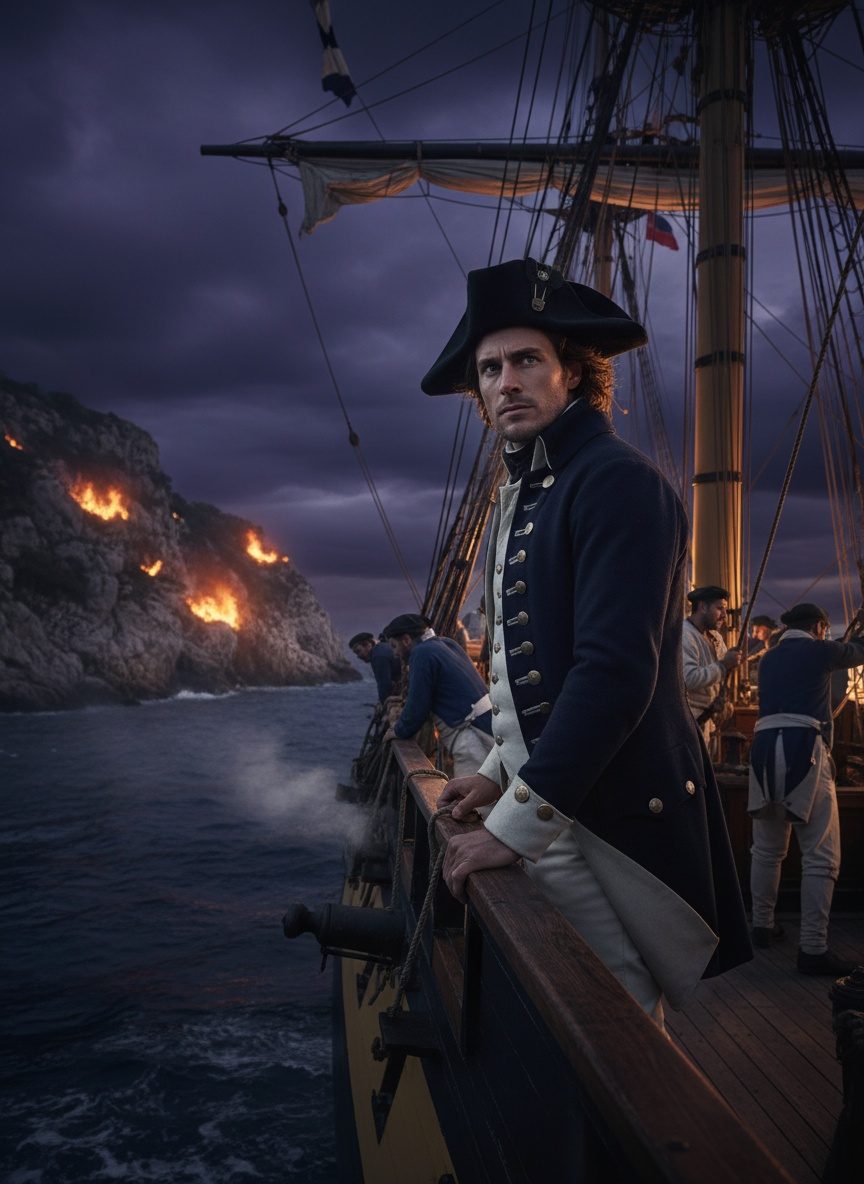
Under a sky often darkened by the foreboding conditions of war, the HMS Imperieuse began its campaign of subterfuge. Cochrane's crew lit fake signal fires along the cliffs, a masterstroke of psychological warfare. The aim was to convince the French garrisons that an invasion force far larger than a mere frigate loomed just beyond the horizon. His pirates of the realm executed these ruses with precision, their wily maneuvers undermining the confidence of French coastal defenses. These efforts sowed chaos, and the mere sight of fire in the distance sent shivers through the ranks of Napoleon’s soldiers.
Panic Among the French Ranks
The effect of Cochrane’s deceptions was immediate and palpable. As reports of rogue signal fires spread like wildfire through Napoleon’s forces, a landscape of paranoia emerged from Toulon to the rocky coves of the French Riviera. Troops were mobilized en masse, dragged out from the tranquility of their barracks to confront a phantom enemy. Thousands of men abandoned their posts to fortify inland positions against a nonexistent threat, many marching for days on end without confronting a single British invader. Like a grand marionette master, Cochrane had pulled the strings and watched as panic rippled through the enemy ranks, a testament to his naval prowess.
Yet the chaos extended beyond the troops’ movements. Local inhabitants were caught in this confusing specter of war. The resulting anxiety disrupted daily life, with communities along the coast witnessing the curious sight of soldiers, usually bound for frontlines, now scuttling in defense of home shores. Cochrane, with each blaze set against the skyline, demonstrated that the theater of war extended into the psychological realm, a concept underappreciated in the grand histories of the era.
Maritime Maverick: The Genius of Cochrane
Thomas Cochrane's endeavors were far from born of frivolous theatrics. His reputation as a maritime maverick was steeped in years of navigation and combat experience. Cochrane's tactical genius lay not only in his daring but also in leveraging every aspect of warfare available to him—a philosophy resonating in each strategic decision. With the HMS Imperieuse as an extension of his will, Cochrane choreographed a naval ballet that melded deception, surprise, and audacity.
To understand why a single frigate could accomplish what fleets could not, one must delve into Cochrane’s mind. He saw the world not just as it was but as it could be manipulated. His assignments rarely came with direct commands, mirroring his affinity for the limitless possibilities of guerrilla warfare. Cochrane did not just want to defeat his enemies; he sought to outthink them. His tactics of illusion and diversification diverted attention away from the tangible threat—a harbor brimming with British might waiting to strike—and left Napoleon’s forces churning in a froth of uncertainty.
A Lasting Impact on Military Strategy
While the signal fires may have long since extinguished and the chaos quieted, the lasting impact of Cochrane’s exploits can still be seen in military strategy today. Napoleon, famed for his military intuition, was reportedly furious that his defenses had been so thoroughly embarrassed by a single ship, a circumstance which only served to enhance Cochrane’s legendary status. The campaign of the Imperieuse stands as a testament to the power of psychological warfare—a force that, even in the presence of overwhelming power, can shape the tides of history.
In an era dominated by grand strategy and colossal forces, the story of Cochrane and the HMS Imperieuse echoes as a reminder of the potency of unconventional warfare. It compels us to consider how perception, manipulation, and craftiness can rewrite the chapters of history. The tale stands not only as a narrative of military genius but as a beacon for the strategic minds of today, inspiring those who dare to challenge the norms to chart their courses across the tumultuous seas of possibility.