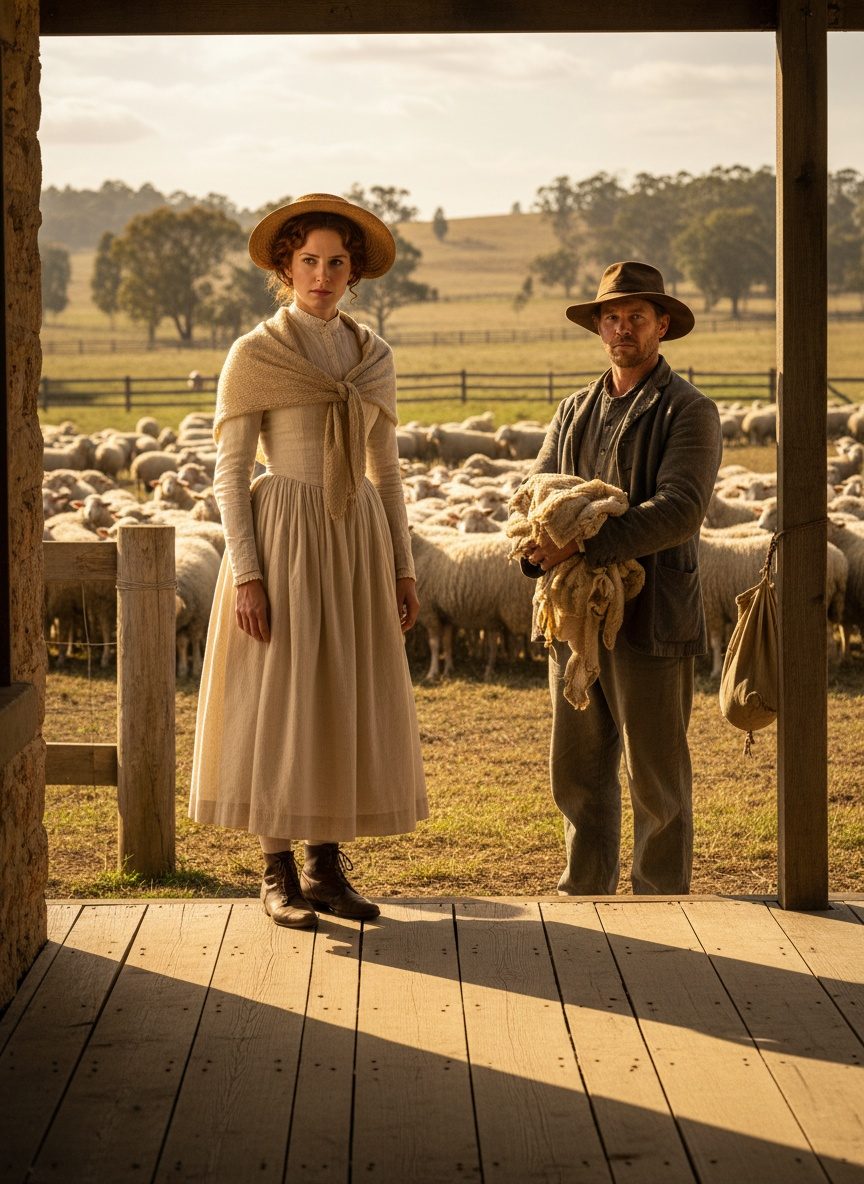
She was a woman of no particular renown. Yet for eight solitary years, Elizabeth Macarthur orchestrated the transformation of a ruin into the roots of a nation's prosperity.
The Unexpected Architect
Lizzy Macarthur, as those around her called her, was not just any colonial settler's wife; she was the silent architect behind one of Australia's most enduring industries. Born in England to a family with no prior immersion in livestock, she seemed an unlikely candidate to fuel agricultural transformation in the far-flung penal colony of New South Wales. Her genteel personality belied the steel-willed determination that would later define her legacy. For when her husband, John Macarthur, embroiled himself in political entanglements and sailed back to England, Elizabeth stepped into an unforeseen role — the custodian of Camden Park.
John was away from 1809 until 1817, leaving Elizabeth, quite literally, to mind the farm. With Camden Park in dire straits, it was Elizabeth who supervised the sheep's pasturing, oversaw their shearing, and ensured that wool of unparalleled quality made its way to the docks. It was a task of Herculean proportions, one that few back in England imagined possible, much less for a woman.
A Ruined Farm and Convict Hands
The vast acres of Camden Park were, at the time, more wilderness than farmland — an abundant scrubland echoing the harshness of their new world. Yet Elizabeth, with her acute intellect and strategic foresight, envisioned it as a haven for merino sheep. Even as irony wove stories of her husband's rancorous confrontations with governors, Elizabeth quietly struck a symbiotic partnership with the very backbone of the colony — her convict workforce.
Surrounded by convicts, with calloused hands familiar only with shackles, Elizabeth saw not mere penal laborers, but potential stewards of the land. Establishing a rapport with the men who had been sent to serve a sentence rather than wield a plough, she transformed them into skilled agricultural workers. She gifted them the torch of trust, demanding excellence in return — a gamble that paid off richly as the wool produced on her lands grew in the esteem of international wares.
The pastoral transformation defied expectations, as convicts who had once gazed listlessly at freedom through bars cultivated one of the richest wool-producing farms under Elizabeth’s stewardship. Each fleece she prepared was a testament not only to the perseverance of one woman’s vision but also to the capacity for redemption embedded within human hearts — even those marked by transgression.
The Looms of a Nation
Elizabeth Macarthur’s achievements were not solely confined to Australia’s rugged terrains. Across oceans, the fruits of her labor reached English markets at a time when industrial looms craved more wool, more fiber from colonies beyond known geographies. Little did those genteel urbanites know that the sensational strands now woven into fabrics had been shepherded by a woman battling isolation and uncertainty.
In a world largely determined by male voices, the presence of Merino wool of such fine quality on the European market raised eyebrows and bedazzled the trade elite. The rise of the Australian wool industry, albeit quietly midwifed by Elizabeth, catalyzed a change in how colonies perceived their economic potential and worth. The wool economy burgeoned into a cornerstone of Australia's territorial identity and mercantile prowess.
Elizabeth’s correspondence home reveals an innate business wisdom and striking diplomacy. Unbeknownst to many, she managed not only Camden's practicalities but penned astute missives lobbying for levies, advocating for local goodwill, and, occasionally, sneaking in notes on social conventions she missed dearly.
The Quiet Revolution
Elizabeth Macarthur remains an enigmatic cornerstone of colonial Australia’s narrative. Perhaps her greatest gift lay not in the wool or the wealth that transformed her adoptive nation, but in the paradigm she instilled. Her efforts recalibrated perceptions of achievement and resilience, particularly in a period marred by rigid gender expectations and settler strife.
The tale of Elizabeth and her convict compatriots at Camden Park is one of indomitable will and unexpected partnerships. It reminds us that history often forgets its quiet champions, those whose whispers and labor rewrite legacies from shadows. Elizabeth Macarthur's life demands from us a consideration of history's unsung architects — and in turn, our own potential to forge moments of lasting change from the unlikeliest of circumstances.