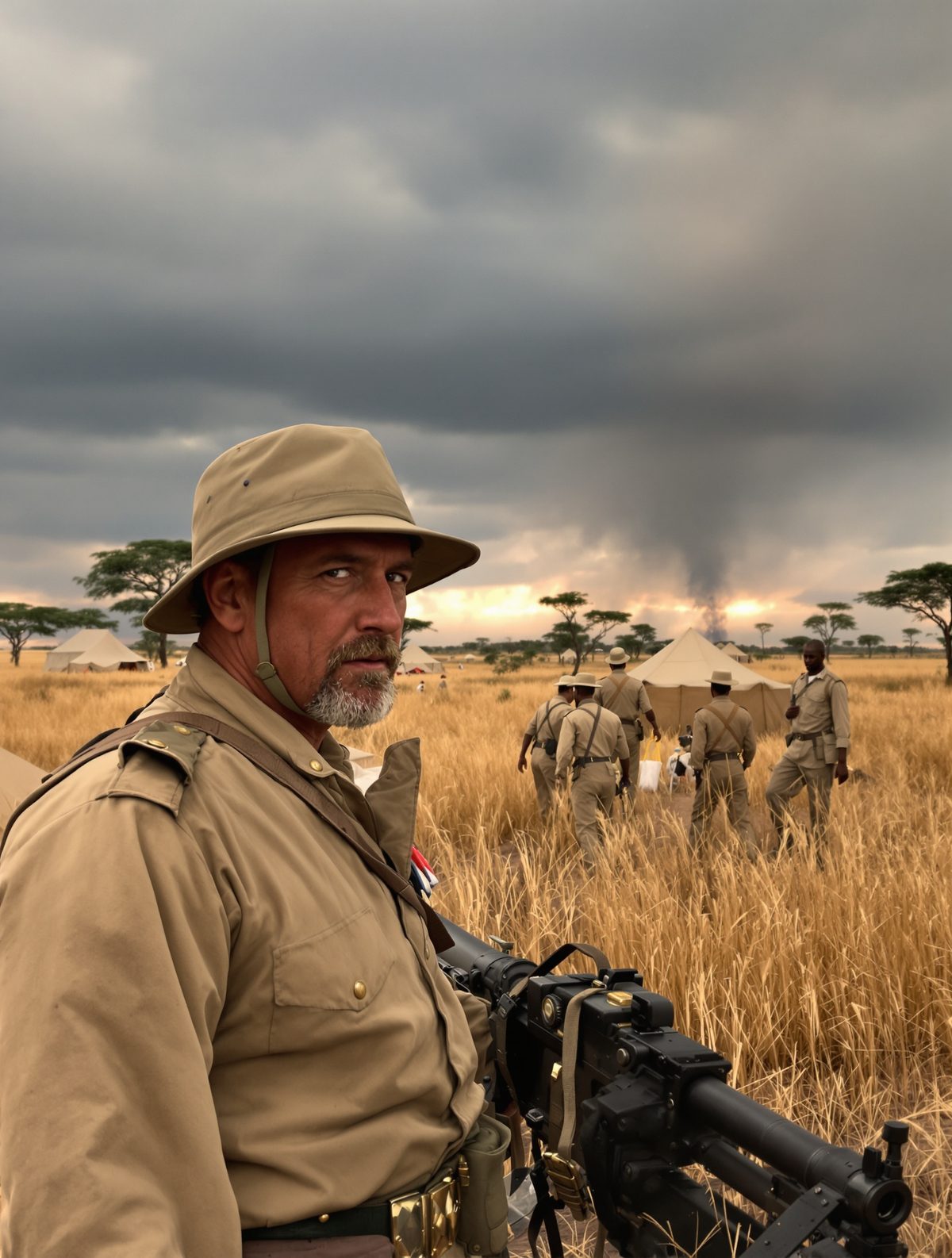
The stench of death hung over the British camp like a shroud. In the scorching heat of July 1857, Colonel Henry Havelock watched another soldier collapse into the dust, his body wracked by dysentery. Around him, what remained of his relief force lay scattered under makeshift shelters—men who had once marched proudly through the gates of empire now reduced to skeletal figures barely able to lift their rifles. Half his force was either dead or dying from cholera and dysentery. The other half could barely stand.
But 126 miles away, in the besieged British Residency at Lucknow, 200 British women and children were facing their own death sentence. Their supplies were nearly gone. Their defenses were crumbling. They had perhaps days to live.
Havelock's aide approached hesitantly with the morning reports. More deaths. More men unfit for duty. Any reasonable commander would have waited for reinforcements, for better conditions, for his men to recover. But reasonable commanders don't make history. As the first rays of dawn cut through the Indian heat, Havelock gave an order that would echo through the annals of military legend: "We march at dawn."
The Impossible General
Henry Havelock was 62 years old—ancient by Victorian military standards. He should have been enjoying retirement in some English country house, not leading desperate rescue missions through rebel-held territory. But this white-haired Baptist teetotaler had spent four decades fighting across the empire, from Afghanistan to Burma, earning a reputation as one of Britain's most tenacious commanders.
What made Havelock truly extraordinary wasn't his tactical brilliance—though he had that in spades—but his ability to inspire dying men to perform miracles. His soldiers called him "Old Fighting Cock," and they would follow him into hell itself. In July 1857, that's exactly what he was asking them to do.
The Indian Mutiny had erupted three months earlier when sepoy soldiers turned their rifles on their British officers. What began as a military revolt had exploded into a subcontinental uprising. Cawnpore had fallen after a horrific massacre. Delhi was in rebel hands. The entire edifice of British rule in India seemed to be crumbling like sand.
But Havelock wasn't thinking about empire or politics as he studied his maps by candlelight. He was thinking about Lucknow, where British families huddled in cellars while rebel cannons pounded their defenses to rubble. Every day he delayed meant more innocent deaths.
An Army of Walking Dead
The force Havelock commanded barely deserved the name "army." Of his original 2,500 men, cholera and dysentery had claimed nearly a thousand lives. The survivors were a pitiful sight—hollow-eyed scarecrows in tattered red uniforms, many unable to march more than a few miles without collapsing.
Captain Maude, one of Havelock's officers, wrote in his diary: "The men drop like flies in the heat. We bury a dozen each morning and pick up twice as many who cannot continue. Yet still the Old Man insists we can reach Lucknow. God help us all."
The medical officers had pleaded with Havelock to halt the march. Dr. Home reported that 40% of the remaining force was unfit for active duty. Men were literally defecating blood as they marched. Some collapsed mid-step and never rose again. The smart money said this wasn't a relief force—it was a funeral procession.
But Havelock had received intelligence that chilled him to the bone. Lucknow's defenders were down to their last barrels of water and handfuls of grain. The women had torn up their petticoats to make bandages. Children were crying for food that didn't exist. If his army didn't reach them within days, there would be nothing left to rescue but corpses.
The March That Defied Death
What happened next violated every principle of military medicine and common sense. Starting at 3 AM on July 25th, 1857, Havelock's disease-ravaged column began a forced march that would cover 126 miles in just eight days—through territory crawling with hostile rebels, in temperatures that regularly exceeded 110°F.
The men marched in the pre-dawn darkness to avoid the worst heat, but even at night the temperature rarely dropped below 90°F. They moved in a long, straggling line—the healthy supporting the sick, officers carrying soldiers' packs, everyone driven forward by sheer force of will.
On the second day, they encountered a rebel force at Unao. Any sane commander would have avoided battle—his men could barely walk, let alone fight. Instead, Havelock ordered an immediate attack. His skeletal soldiers charged with bayonets fixed, roaring like demons. The rebels, expecting to face a broken army, fled in terror before these walking dead who fought like devils.
The most remarkable aspect wasn't the speed—though averaging nearly 16 miles per day with dying men was extraordinary—but the fact that morale actually improved as the march continued. Sergeant Wheeler noted: "Strange to say, the lads seem to grow stronger with each mile. Perhaps knowing we're racing death itself gives them strength they never knew they had."
Miracles and Willpower
By the fifth day, something impossible was happening. Men who had been carried on stretchers were walking again. Soldiers who couldn't keep down food were somehow finding strength to continue. It was as if the urgency of their mission was burning away the disease that had been killing them.
The secret lay in Havelock's leadership. Each morning, he would ride among the men—not on a horse, for he had given his mount to a sick soldier—but on foot, his white hair gleaming in the dawn light. He knew every man's name, asked about their families back home, and reminded them constantly of the children waiting in Lucknow.
"We are not just soldiers today," he told them. "We are angels of deliverance for innocents who have no one else. Every step you take saves a life. Every mile you march brings hope to the hopeless."
The rebels, meanwhile, were growing increasingly demoralized. Reports reached their commanders of a ghost army that couldn't be stopped—men who should have been dead days ago but kept appearing on battlefields like specters of vengeance. Some rebel units simply melted away rather than face these "undead" British soldiers.
The Gates of Hell Open
On August 2nd, 1857—eight days after beginning their impossible march—Havelock's dying army crested the final hill before Lucknow. What they saw below made hardened veterans weep. The British Residency was a smoking ruin. Rebel cannons had reduced entire buildings to rubble. Bodies lay scattered in the courtyards.
For a heart-stopping moment, it seemed they had arrived too late. Then, from the shattered windows of the main building, came a sound that none of them would ever forget: the weak but unmistakable notes of "God Save the Queen" played on a bugle by the surviving defenders.
The final assault was less a battle than an explosion of fury. Havelock's men—who hours earlier could barely stand—charged down the hill with terrifying ferocity. Eight days of forced marching, of watching comrades die, of racing against time itself, erupted in a hurricane of violence that swept the rebels aside like leaves.
When the shooting stopped and the smoke cleared, 200 British women and children emerged from their underground shelters—alive, rescued, saved by an army that should have been in hospitals or graves. The relief of Lucknow became legend, but the legend never captured the full miracle of what Havelock's men accomplished.
When Character Conquers Everything
Today, when we face our own seemingly impossible challenges, Havelock's march offers a profound lesson about human potential. Those dying soldiers didn't suddenly develop superhuman strength or immunity to disease. What they found was something far more powerful: a purpose greater than their own suffering.
In our age of advanced medicine and technology, it's easy to forget that the most potent force in human affairs isn't knowledge or equipment—it's character under pressure. Havelock's men discovered that when you're fighting for something truly worthy, the human spirit can transcend almost any physical limitation.
The march to Lucknow reminds us that our greatest victories often come not when we're strong and ready, but when we're broken and desperate yet choose to continue anyway. Sometimes the impossible becomes possible not through careful planning or perfect conditions, but through simple, stubborn refusal to quit when others depend on us.
History doesn't remember the reasonable commanders who waited for better conditions. It remembers the ones who marched at dawn when dawn was the only option left.