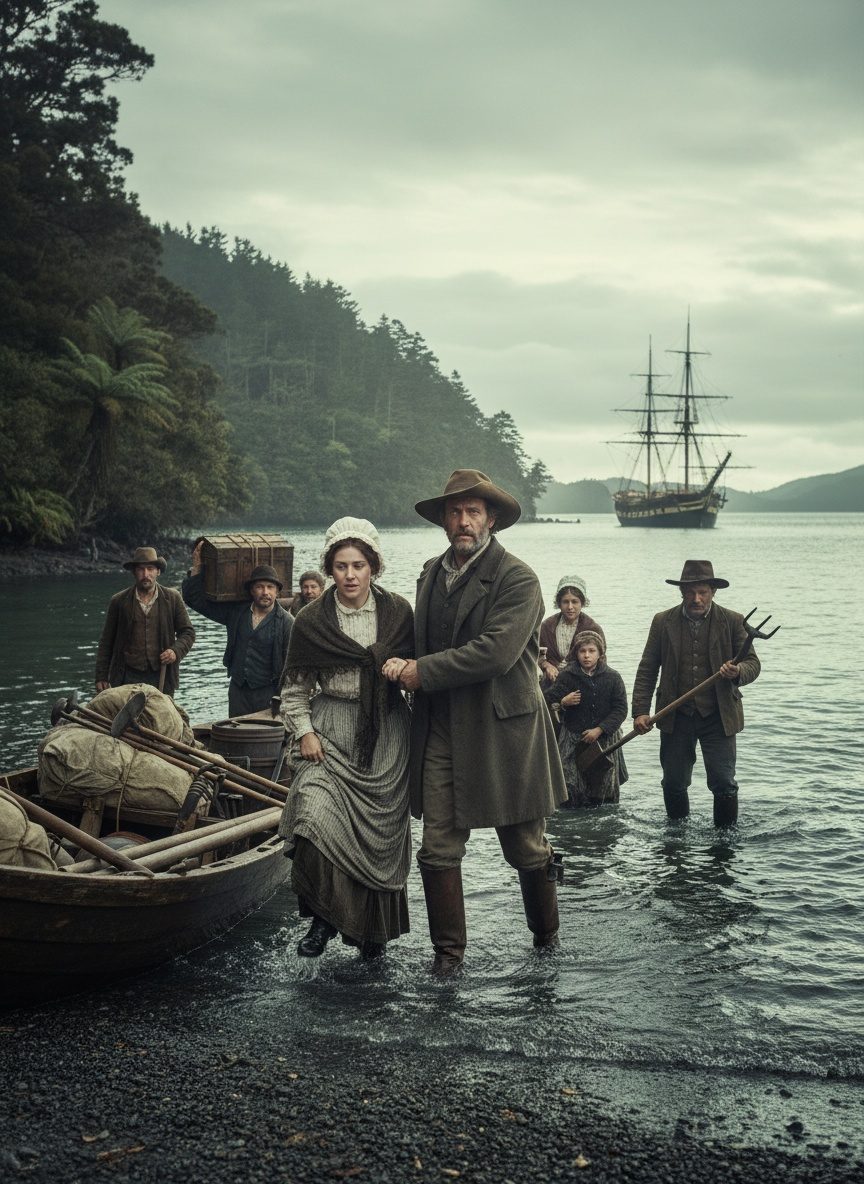
The surf roared as Edward Jerningham Wakefield stepped onto the wet sands of Petone Beach, the salt spray chilling his face as he surveyed the untouched horizon. Around him, men and women, haggard from their long journey at sea, dragged heavy crates through the surf to the shore. Their breath hung in the cool air as they labored. A mix of thrilling anticipation and bone-deep fatigue reflected in their eyes—for there, beyond the beach, lay the unyielding wilderness that would either be transformed into a new home or swallow them whole.
The Dreaming Letter
Before the settlers set foot on New Zealand soil, Edward Gibbon Wakefield—a man of grand ideas and a knack for persuasion—had ensured that these pioneers invested in their own dreams of prosperity. Through a series of letters, inflamed with idealism and ambition, Wakefield painted a vivid picture of an "England in the Pacific". Fertile lands, mild climates, and opportunities as far-reaching as their imaginations: these were the promises sealed in ink and wax that carried the settlers across the hemisphere. Wakefield envisioned more than a colony; he proposed a class-stratified society that mirrored the English countryside with its ordered charm and dignity.
Yet, when the settlers landed, they found no quaint villages or productive pastures. Instead, they were met by the impenetrable bush and mystifying wilderness. Many felt betrayed by the absence of the civilized landscapes Wakefield had described, their longing for familiar comforts juxtaposed against the seemingly unconquerable landnscape.
Forging Civilisation
The settlers faced their new reality with resolute determination. The familiar sounds of English life—the clang of iron against wood, the soft bleating of livestock—were replaced by the whispers of native flora, rustling with the breeze. Still, each strike of an axe and each furrow plowed into stubborn soil was a declaration of their will to survive and make Wakefield’s vision tangible.
Days turned into weeks, and soon rudimentary structures sprouted along the wild coastline. Life began to divide into a new rhythm dictated by elemental forces and the struggle for survival. They raised homes with little more than timber and tenacity, transforming the untamed wilderness into a semblance of English order. Community life bled into one of collaboration and resilience—neighbors helping neighbors, fusing camaraderie from the crucible of shared necessity.
Challenges and Unity
Despite the tangible strides made, the journey was fraught with challenges. The weather often turned treacherous; rainstorms cast sprawling camps into mud-filled quagmires, and unwanted pests threatened fledgling crops. Compounding their plight was the tension with the indigenous Māori population, who viewed the newcomers with both curiosity and suspicion. Cultural and language barriers presented an obstacle, as did the contesting claims to land.
The settlers, invigorated by grit and ingenuity, eventually sought understanding with their Māori counterparts. While initial relations oscillated between amiable and confrontational, valuable exchanges persisted, including trade of food and knowledge. Together, they sometimes found common ground—a sowing not of seeds, but of a fragile peace.
The City That Emerged
Year by year, Petone's scattered assortment of huts and provisional structures matured. Streets were planned and laid out; shops and businesses inevitably sprouted; the thrum of hammers gave way to the hum of wheels and trade. The fledgling community evolved into Wellington, now a bustling city that stands as a testament to the determination and dreams shaped by these early settlers. From the bones of Wakefield’s letters, a living, breathing canvas was painted that defied both nature and expectation, becoming one of the great colonial cities on Earth.
This episode in New Zealand’s history extends beyond its narrative of colonization; it demonstrates the potency of human tenacity and transformative power of belief. It reflects both the allure and peril of idealism and ignorance intersecting in unfamiliar realms. The settlers’ story is a reminder of history’s weight in shaping modern identity and the landscape we inhabit, whispering that even unyielding terrain can yield under hands committed to turning dreams into reality beyond textbooks’ reach.