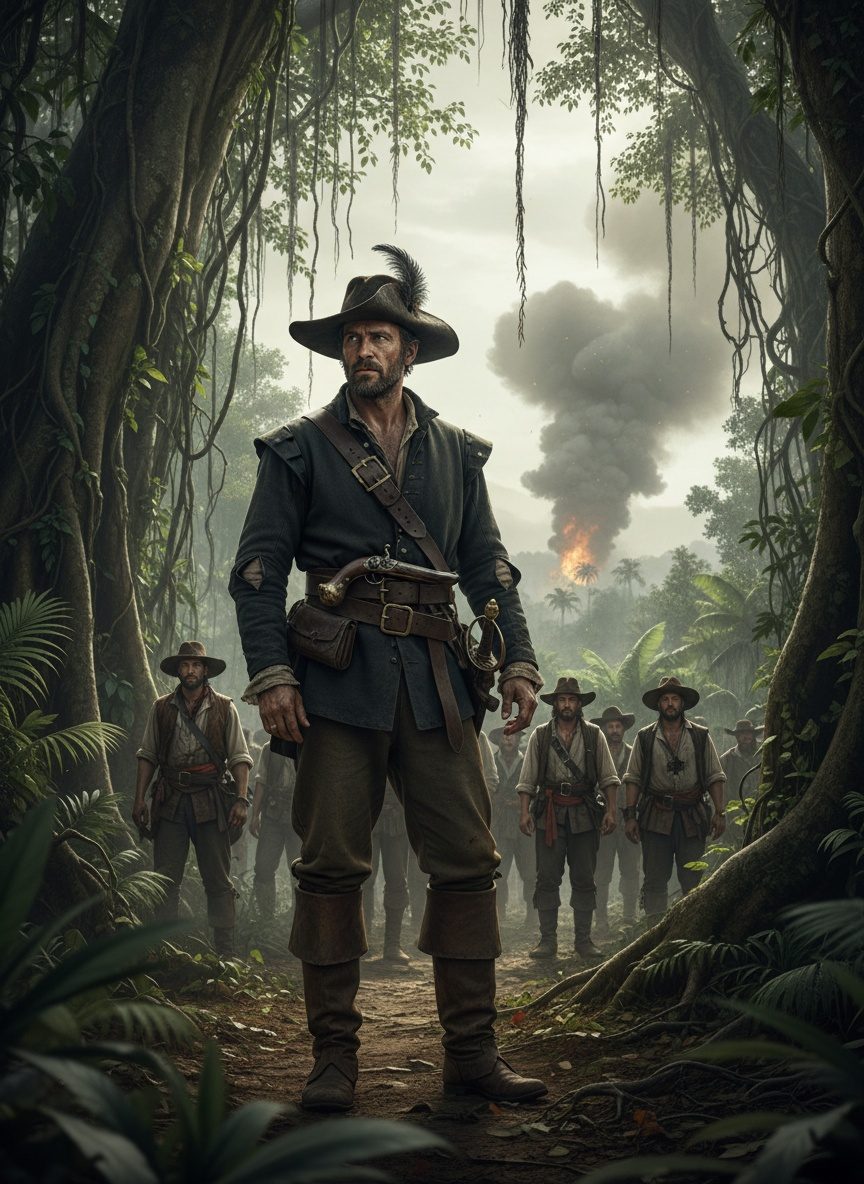
January 1671. The jungle loomed thick and unyielding, an impenetrable green wall between the world of pirates and the legendary riches of Panama.
The Welshman in the New World
Henry Morgan, a name synonymous with buccaneering legend, began his daring escapade on the Caribbean stage at a time when the Spanish Empire, the most formidable power in the New World, was ripe for plundering. As a privateer, sanctioned by the English crown, he skulked the seascape with a letter of marque, a license to raid Spanish holdings. Morgan's audacity and strategic brilliance earned him a reputation among the swashbucklers of the sea, captaining vessels that struck fear into those under the Spanish allegiance.
Yet, it was in January 1671 that Morgan executed his most audacious raid. With Panama City as his target—a city fabled for its wealth, a glittering outpost on the Spanish Main—Morgan's eyes were set on a prize unlike any taken before. It was not just a raid for treasure; it was a gambit against the intricate Spanish trade network that ferried precious metals from Peru to Spain's coffers. The city was the bullseye in an empire-spanning game, and Morgan was determined to hit it.
The Gruelling Jungle Trek
With a band of 1,200 men, Morgan embarked on the perilous journey through the dense, unforgiving Panamanian jungle. The plan was fraught with risk from the outset. Without a proper supply line or logistics in place, Morgan's forces faced the very real threat of starvation. The Spanish had assumed the jungle would serve as a natural defense, an impassable barrier protecting their wealthiest city. They underestimated the resolve of this Welsh privateer and his ragtag army of buccaneers.
For nine days, the expedition hacked through the dense foliage, contending with both the suffocating heat and sporadic attacks from indigenous tribes whom the Spanish had enlisted as allies. Hunger gnawed at their morale, a punishing specter over their desperate march. Yet, Morgan's charisma and leadership emboldened his men, forging on with promises of untold riches. Such allure was potent enough to stave off mutiny, a common fate for many a pirate band.
The Sacking of Panama
On the ninth day, the bedraggled company of buccaneers finally emerged from the jungle's grasp, laying eyes on the looming walls of Panama City. The Spanish, forewarned of the incoming assault, had prepared for a desperate defense, though they could not foresee the fervor of Morgan’s attack. Battle ensued, with charges crashing against fortifications, cannon fire thundering like an orchestral prelude to chaos.
Yet, the greatest destruction was neither by blade nor bullet. A devastating inferno swallowed the city—a calamitous blaze that consumed wooden structures and sent its dismayed populace scattering. Amidst this conquest, the famed wealth of Panama lay within reach. Though much of the surface treasure perished in flames, Morgan's ingenuity revealed hidden caches, secreted by residents in vain attempts to avoid the inevitable plunder.
A Legacy of Infamy
As the smoke cleared, Morgan emerged, his fortune beyond counting, reputation soaring amidst the ashes of Spanish defeat. News of Panama's sacking thundered across oceans, escalating tensions between the British and Spanish crowns, an unforeseen political fallout of Morgan’s raid. Although later commanded to answer for his actions by the English government—politically motivated by unsteady peace negotiations—Morgan’s exploits clinched his infamy in maritime history.
In the annals of empire, Morgan's siege of Panama is a chapter illustrating both the audacity and hubris of early imperial expansion. It wasn't merely about gold or glory; it demonstrated one man's ability to unsettle the axis of power with sheer determination, altering the course of colonial history. Morgan’s boldness, immortalized in the legends of the Caribbean, serves as a vivid reminder of the fragile lines between sanctioned soldiering and anarchy on the high seas.