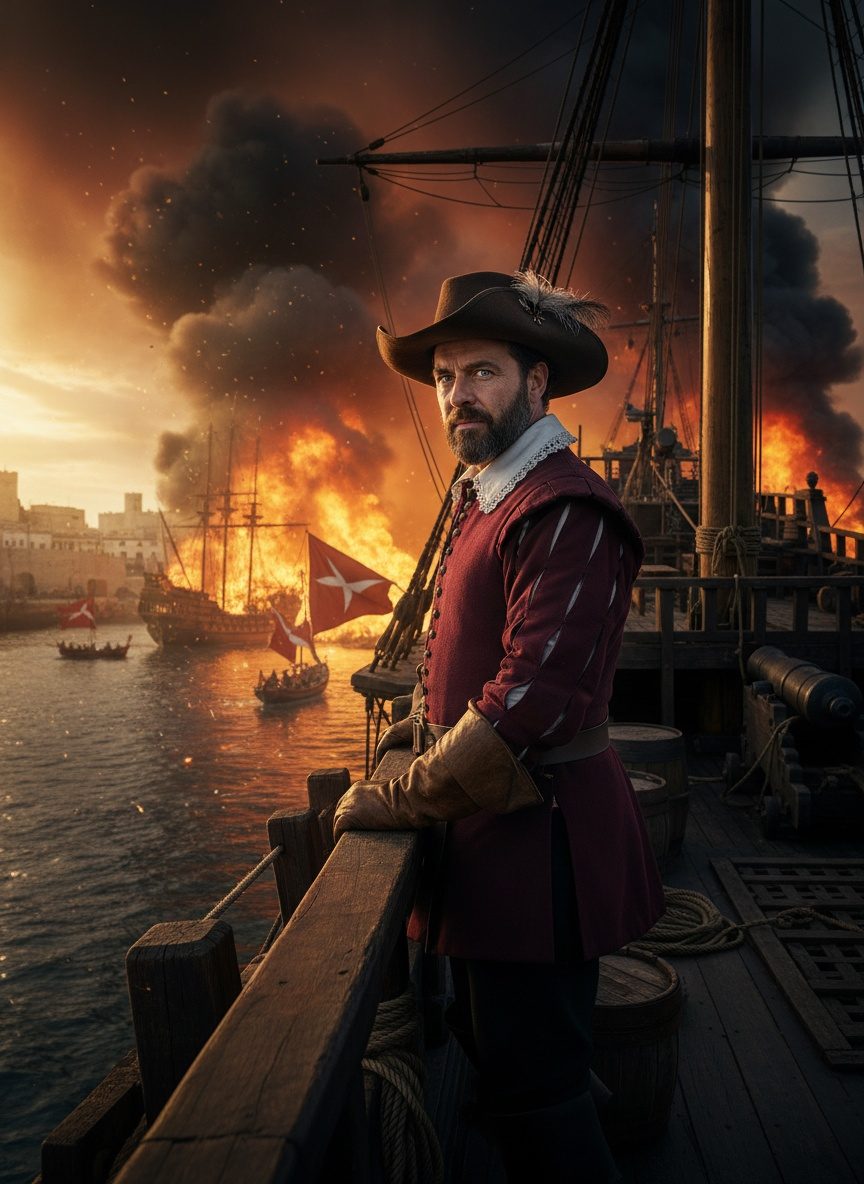
The sea was alive beneath him, a roiling beast of tumultuous waves and salt spray flung into his face. Captain Francis Drake gripped the weathered wheel of his ship, his mind focused intently on the task at hand—reining in chaos, orchestrating precision amid the thunder of cannon fire and the sharp sting of panic in the air. Around him, Cadiz exploded in a cacophony of yells, foreign screams blending with the crash of wood against wood as English cannonballs met the Spanish hulls. Masts were sheared off like trees cast aside in a gale. It was pandemonium, brilliantly orchestrated by England's indomitable sea dog.
As dusk approached on that April day in 1587, the fiery glow of burning ships painted the sky over the Spanish port in hues of orange and red. The city, known for its robust defenses and bustling maritime presence, had never anticipated such audacity—a direct strike into the heart of Spanish naval power by a relatively small fleet. This brazen move by Drake was boldness incarnate, a tactic not recorded in the annals of conventional warfare but rather in the tomes of legends. The Spanish hurriedly scrambled to retaliate, though it already seemed too late; their ships were ensnared in an inferno of wooden splinters and smoldering cordage.
Before this assault, Spain was meticulously constructing a naval armada that would stand unrivaled, a force intended to end the Protestant English threat once and for all. Under King Philip II, the Spanish Empire was at its zenith, sprawling across continents and seas, a symbol of Catholic might. The Armada's breadth was designed to be so intimidating, its sheer scale would obliterate any English resistance—but the English had no intention of waiting for that fate to befall them.
Sir Francis Drake, veteran privateer, part-time pirate, and full-time patriot, had different plans. Sensing the looming specter of the Spanish Armada—a weapon of annihilation aimed at Elizabethan England—he sought both to delay it and sap its power. This strategy was cunning and a touch reckless, yet in his audacity lay his genius. Commanding a small flotilla, Drake ventured into the lion's den: Cadiz's harbor, one of the most guarded in Europe.
What happened next would be recounted as the singeing of the King of Spain's beard. Drake's raid was unprecedented in its success. Over the course of a single afternoon, he commanded the destruction of roughly 30 Spanish ships, each one meticulously targeted for maximum impact. Destruction was swift and absolute. Ships laden with vital supplies destined for the Armada were engulfed in flames, and the fate of Philip II's grand vision of conquest flickered precariously amidst the rising smokescreens.
This attack was not solely about destructive force. Each blasted hull, each fiery shipwreck was as much a psychological blow as it was a physical devastation. For King Philip II, it was an unwelcome wakeup call that his empire's naval supremacy could be challenged and disrupted by the cunning English sailors. Cadiz was intended to be an impenetrable fortress, a symbol of Spanish maritime dominance. Yet here it lay, not impregnable, but wounded—its pride as charred and splintered as the ships that floated to the harbor floor.
The political reverberations were immediate. The raid on Cadiz delayed the launching of the Spanish Armada by a full year, buying England precious time to reinforce her defenses and muster her own fleet. This delay was a godsend for Queen Elizabeth I and her island nation, gifting them the opportunity to prepare for a confrontation that seemed inevitably destined.
Drake's tempestuous assault is more than a tale of naval derring-do; it epitomizes a pivotal moment when cunning seamanship and audacity tipped the scales of history. It is a remarkable reminder of the profound impact that a single act of adaptability and bravery can have on the course of human events. The fires of Cadiz set more than just ships alight; they enkindled a realization in the heart of the Spanish that the scales of power could be reshuffled through sheer audacity and tactical brilliance.
The story of Drake and the singeing of Philip's beard is not merely about setting back military ambitions; it is a resonant testament to the indefatigable human spirit. By refusing to await destruction and instead opting to confront danger head-on, Drake managed to rewrite the destiny of not just a battle, but a nation. A testament to the courage and tenacity of those who dare challenge seemingly insurmountable odds, for in those daring moments of action, history itself is forged anew.