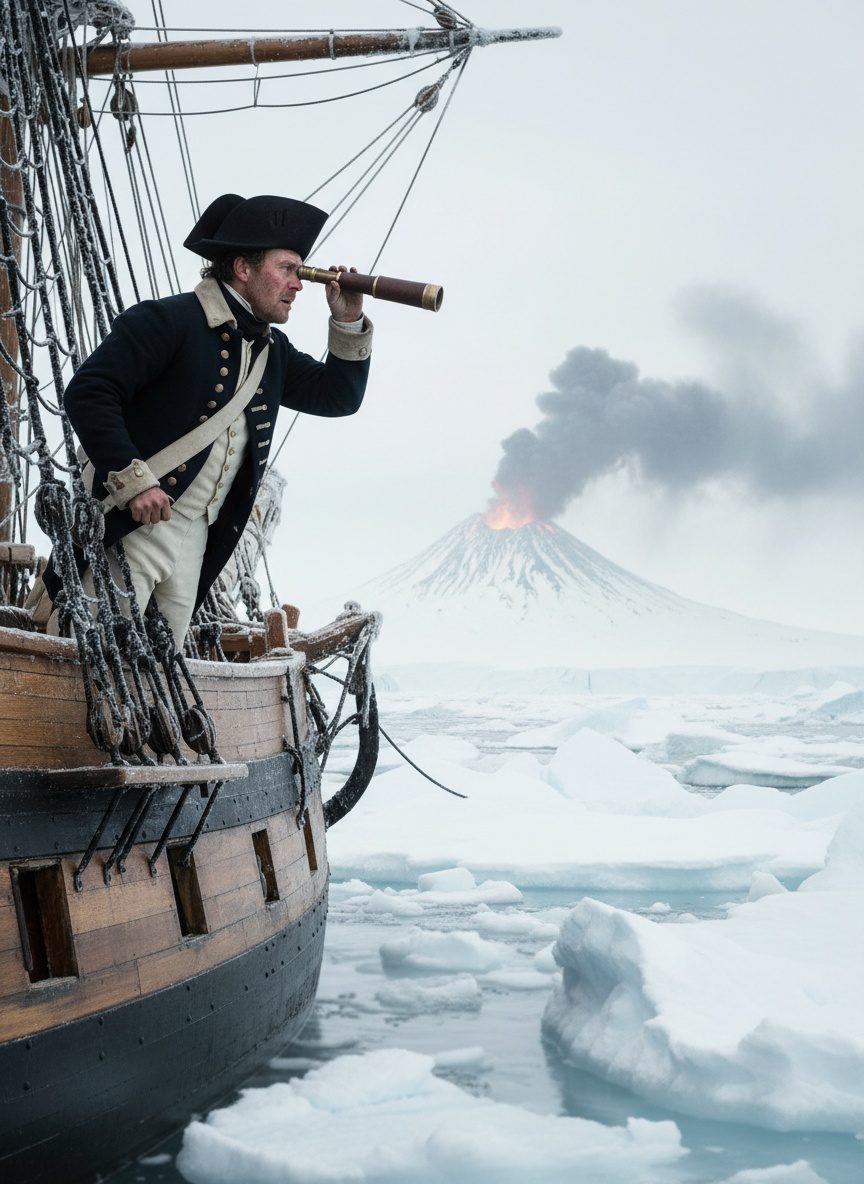
He was a man of the sea, not a volcanologist or a geologist. Yet James Clark Ross's voyage led him directly into the heart of Antarctic mysteries. It was his eyes that first caught sight of the volcanic beacon now known as Erebus.
The Uncharted Frontier
The vast, icy wilderness of Antarctica lay largely untouched by human feet in the early 19th century. These legendary waters whispered of unknown wonders beyond the grasp of even the most intrepid explorers. In January 1841, that heritage of enigma would be challenged as Captain James Clark Ross embarked on an expedition that would rewrite the map of the southern extremities and redefine human understanding of Earth's harsh frontier.
James Clark Ross, renowned for charting the Arctic, now turned his attention south aboard the HMS Erebus and HMS Terror. These wooden sailing ships were small specks of dust against the white canvas of the Antarctic ice, yet they carried with them the burning determination of their captain. As they approached what would eventually become known as the Ross Ice Shelf, the formidable sea-ice barrier weighed heavily on their journey, captivating the imaginations of those who dared. Packed ice, to this day synonymous with impenetrable fortitude, tested the crew's endurance. Struggling through conditions unthinkable in modern nautical voyages, Ross's determination became the thread stitching his way towards the unknown.
A Volcano Arises
On reaching the unfathomable destination, a surreal spectacle unfolded before the men's eyes. There, between sky and ice, chaos erupted. Against the monochrome stillness of Antarctic ice appeared a mountain roaring with fire and cinder, its violent eruptions punctuating the otherwise pristine silence. Ross had discovered a sight that seemed to defy natural order—a fiery outpost rising like a phantom in a stark, frozen world.
The volcano, a fiery anomaly amid the desolation, was officially named Mount Erebus. The decision was undoubtedly symbolic, conveying both a voice of authority and a token of Ross’s deep connection with his ship and crew. Yet it was also an echo of Erebus, the personification of deep darkness from Greek mythology—a fitting tribute to the foreboding limbo that Erebus represented for an adventurer stepping into the ominous façade of the unknown.
This spectacle of nature was like nothing else encountered by human eyes. As Ross's men craned their necks, choking back smoke mixed with frost, the awe-inspiring sight of an active volcanic eruption playing out amidst glaciers remains as much a geological wonder as it is a testament to human perseverance. It marked the first recorded sighting of volcanic activity in the heart of Antarctica—a frozen land the victors would now remember as one possessing both ice and fire.
Endurance in Extremes
For the crew of Erebus and Terror, the Antarctic expedition was not merely a test of navigation. It was a true odyssey through Earth’s ultimate extremities. The relentless cold bit at flesh and bone, while high seas tested the mettle of ships and men. While nature was adversarial, the frosty silence around promised solace in solitude, and the grandeur of discovery propelled the crew forward.
Here lies the human nature that thrives in adversity—it is the belief rooted within explorers that the next breach of horizon may unlock the wonders that others have only dreamed of. Ross, leading his men with fortitude and vision, faced an unforgiving battlefield of nature. The volcano they found had become a mnemonic metronome, shaping tales told far beyond the expedition's boundaries.
In many ways, the conditions and resolve paralleled those legendary chronicles told in Homeric tales—the rising and falling of hardship and hope where nature's tapestry paints the ultimate picture. Erebus, sustaining life despite freezing isolation, became a totem of survival and determination, carving its own legend into the annals of exploration.
A Legacy of Discovery
James Clark Ross’s Antarctic voyage stands as a critical milestone in the tapestry of human exploration. The naming of Mount Erebus forever immortalizes a voyage etched with discovery, adversity, and wonder. Though often overshadowed by the fierce pursuit of unlocking Antarctica's secrets, the naming itself represents the duality of triumph and tribulation—the dance between mastery sparked by the flames of curiosity and the sheer, unfathomable power of nature.
The contrast of fire upon ice reminds us of the explosive power residing within the planet’s heart, rendered dormant by ages in most lands. For explorers like Ross and his courageous crew, such demonstrations reignite the keenness of humanity's unquenchable thirst to see beyond veils of mystery—expanding boundaries and enriching the collective human spirit.
As today’s explorers delve further into the unknown, embracing technological marvels available to them, the legacy of Mount Erebus calls us back to the churning, raw human undeterred by danger. This chapter in Antarctic exploration reverberates through time, urging us that beyond academia and exploration planning lie unspoken terrains that beckon fearlessly bold souls to their irresistible horizons.