The air was thick with the scent of eucalyptus as Samuel Marsden steadied his hands, calloused and rugged from months of labor, wrapping them protectively around the vibrant green seedlings he had carried across oceans. The sun cast long shadows over the fledgling settlement in New South Wales, a world far removed from the Georgian civility he had left behind. Surrounding Marsden were the echoes of unfamiliar birdsong, the invasive shouts of overseers, and the harsh clang of iron chains against the relentless sandstone of Parramatta. This penal colony at the edge of the empire was to be his new home, and in its rugged soil, he'd sow the seeds of hope.
Marsden, a young surgeon turned clergyman, had arrived in 1793 with little more than his resolve and a purpose that burned brightly amidst the harsh realities of colonial life. His mission was spiritual, but his path was strewn with the tangible—building a church, but first, building a congregation out of convicts. These men, branded by society but human nonetheless, became Marsden’s unlikely partners in what seemed an impossible endeavor.
With his medical knowledge came a pragmatic determination that saw him quickly adapt to the harsh environment. Parcels of land were allotted, not to the wealthy or free, but to those bound in iron. Marsden's vision was profoundly egalitarian for its time, rooted in the belief that transformation was possible, even at the edge of the known world. Through clearings in the dense bush, his sights were set on creating not just a place of worship, but a symbol of salvation and renewal in a land marked by its isolation and punishment.
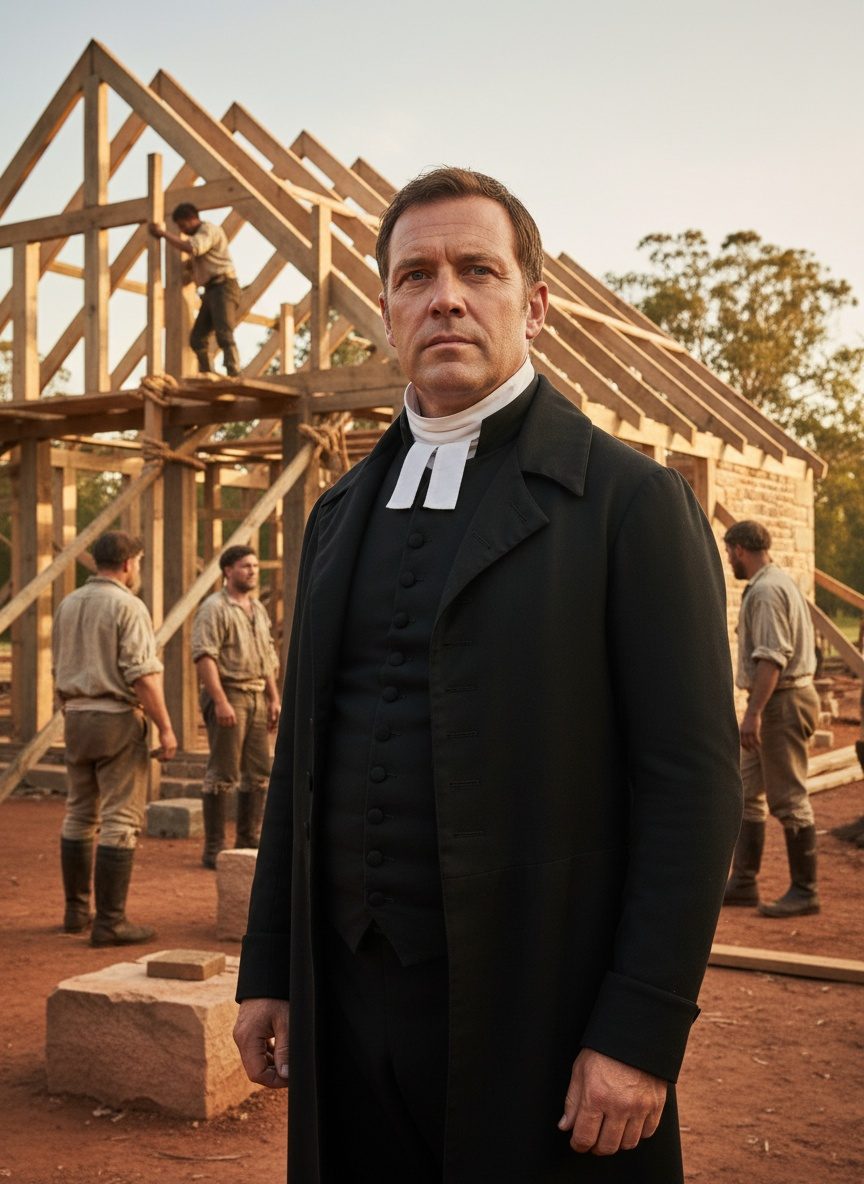
The convicts, under his stewardship, transformed the barren plots into fertile grounds. Marsden stood shoulder to shoulder with these new Australians, learning their stories as they carved out paths and built crude dwellings from the native timbers. Despite the abrasive bark of the trees, which would peel and crack under the harsh sun, the timber yielded under skilful hands. With the green of new seedlings came the dull thud of axes against trees, the relentless clang of chisels, and the hushed whispers of prayers yet to fill a hallowed space.
In the heart of Parramatta, a modest stone foundation emerged, against the odds. It was not merely a building, nor simply a church, but a new beginning for those the world had once discarded. The walls climbed skyward, one stone laid atop another, each fitting neatly, a testament to the skill of hands often only commended for their criminality. Inside, the coarse echo of hammers against wooden pews mingled with the soft rustle of holy texts, as Marsden endeavored to teach literacy where there had been none, enabling the first convicts to read scriptures for themselves.
The years that stretched ahead were far from easy, yet Marsden's commitment never wavered. His school's doors were open to all, irrespective of their past transgressions, a radical approach that rankled many of the colony's authorities and settlers alike. To him, education was as much a tool for survival as for salvation. It was to provide a path out of ignorance, imparting skills that might one day shape a new society in this antipodean outpost of empire.
With time, the echoes of hymns intertwined with the settlers' stories, their melodies woven into the land's history. A new congregation took shape, one that mirrored the rugged land it called home. As they gathered within those sandstone walls, the church became a sanctuary—not only from the elements but from the fear and destiny that had accompanied so many to this distant shore.
Marsden’s influence inevitably stretched beyond these stone walls. His ambitions—and compassion—found fertile ground in New Zealand, a few blue horizons away. There, he negotiated peace and established new missions, his impact reverberating across the Pacific like ripples on water. Yet, it was in New South Wales that his legacy remained most grounded, quite literally with the church at Parramatta.
Standing testament today, the church remains alive with the stories of its constructers, those convicts whose hands wrought its being. This building stands still, a physical monument but also a metaphor for transformation and redemption. Reflections of sunlight off its weathered stone tell tales of irrevocable change unseen in history books yet vital to the crafting of Australian identity.
Samuel Marsden's tale, and that of his convict congregation, is one of humanity—a seldom-captured chapter where determination and compassion paved the way for societal metamorphosis. The church in Parramatta is not merely an ancient structure from a forgotten era; it symbolizes a vital chapter of resilience and redemption within the larger narrative of human perseverance. And amidst today’s increasingly fragmented societies, it serves as a potent reminder of how even the most unexpected alliances can forge enduring legacies of hope.