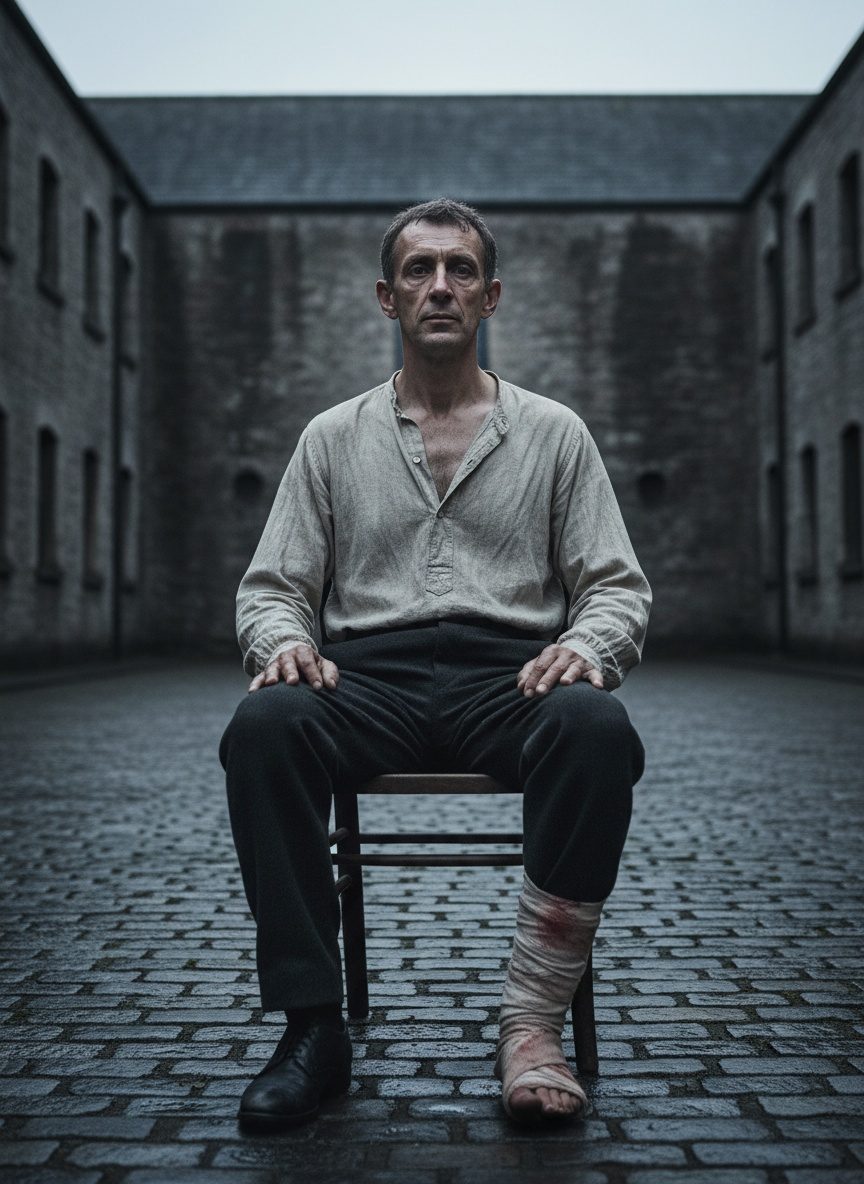
May 12, 1916. The sun had just begun to cast a dim light over the cobblestone courtyard of Kilmainham Gaol. A somber procession made its way into the cold morning air, the air heavy with a sense of impending finality. Among them was a man whose very presence represented the complex tapestry of resistance, rebellion, and a poignant moment of transformation for an entire nation. His name was James Connolly.
Born on June 5, 1868, in the squalid surroundings of Edinburgh's Cowgate, known as "Little Ireland," Connolly was no stranger to hardship from the beginning. His life was marked by the strains of poverty faced by many Irish immigrants in industrial Scotland. From a young age, Connolly developed a keen sense of social justice, an understanding sharpened by the injustices he witnessed in working-class neighborhoods. His early years laid the groundwork for what would become a lifelong commitment to the cause of Irish freedom and the rights of the working class.
Connolly's political journey took him across the seas to the United States, where he organized for the Industrial Workers of the World. Upon his return to Ireland, he became a pivotal figure in both the Irish Transport and General Workers Union and the Irish Citizen Army. The latter, formed to protect workers from political assaults during strikes, became an instrumental force during the Easter Rising of 1916.
The Rising, conceived in whispers and in shadows, erupted on Easter Monday, April 24, 1916. Connolly, alongside other prominent leaders such as Patrick Pearse and Thomas Clarke, led the insurrection against the British rule, seeking to establish an independent Irish Republic. The takeover of strategic buildings in Dublin was met with unexpected ferocity by British forces. For a week, the rebels stood their ground, but their courage and determination could not withstand the overwhelming military response.
The fall of the General Post Office, the heart of the rebellion, symbolized the collapse of hope for a swift victory. Connolly, who had been seriously wounded in the leg by a sniper's bullet, was among the last to be carried from the burning building. Despite his injury, his resolve remained unbroken, even when the decision came to surrender on April 29th. In the aftermath, approximately 3,500 people were taken prisoner, and harsh martial law was imposed.
As the leaders of the Rising were rounded up and sentenced to death by field court martial, Connolly's condition was precarious. Confined to a stretcher, gangrene spreading through his leg, the British authorities faced a dilemma. The execution of a severely wounded man presented not just a logistical challenge but a moral question that reverberated far beyond the prison walls of Dublin.
When the day of reckoning arrived, the attempt to preserve the rules of war in executing a bedridden man became an exercise in grim pragmatism. On that cold morning of May 12, Connolly was transported in an ambulance from Dublin Castle to Kilmainham Gaol. Too weak to stand, he was carried from the vehicle and tied to a chair, which was then leaned against a thick stone wall.
The execution squad lined up before him, rifles at the ready, the moment heavy with the knowledge that this firing would signal more than the end of a man's life. It was a macabre spectacle, one that etched itself deeply into the fabric of Irish consciousness. Connolly's execution became seared not just into the memory of those who witnessed it but also into the hearts of the Irish people, galvanizing a profound shift in public opinion.
Ironically, the British aim of quashing the insurrection by executing its leaders had the opposite effect. Their heavy-handed response ignited a burning resolve for Irish independence and turned the executed leaders into martyrs—including Connolly, the socialist who drew upon not only Irish republican motifs but also universal tenets of social justice.
The way Connolly met his death, strapped to a chair, symbolized the brutality of the oppressive regime and awakened a dormant national spirit. The image of a man unable to stand, yet unyielding in his belief for a free Ireland, transcended the immediate political failures of the Rising itself to become a powerful emblem of defiance.
James Connolly's legacy would come to shape the political landscape of 20th-century Ireland. While he may have been executed as a revolutionary, he was remembered as a visionary who understood that the fight for freedom cannot be divorced from the fight for equality. For Connolly, the struggle was not just a clash of arms but a broader fight against economic exploitation and social tyranny.
With each passing anniversary of the Easter Rising, the haunting memory of Connolly's final moments continues to resonate. It serves as a reminder of the costs exacted by struggles for national liberation, the perils of pursuing justice, and the enduring hope for a better world. Connolly's story, left out of traditional textbooks yet alive in the hearts of a nation, remains a poignant testament to the enduring power of ideas and the indomitable spirit of resistance.