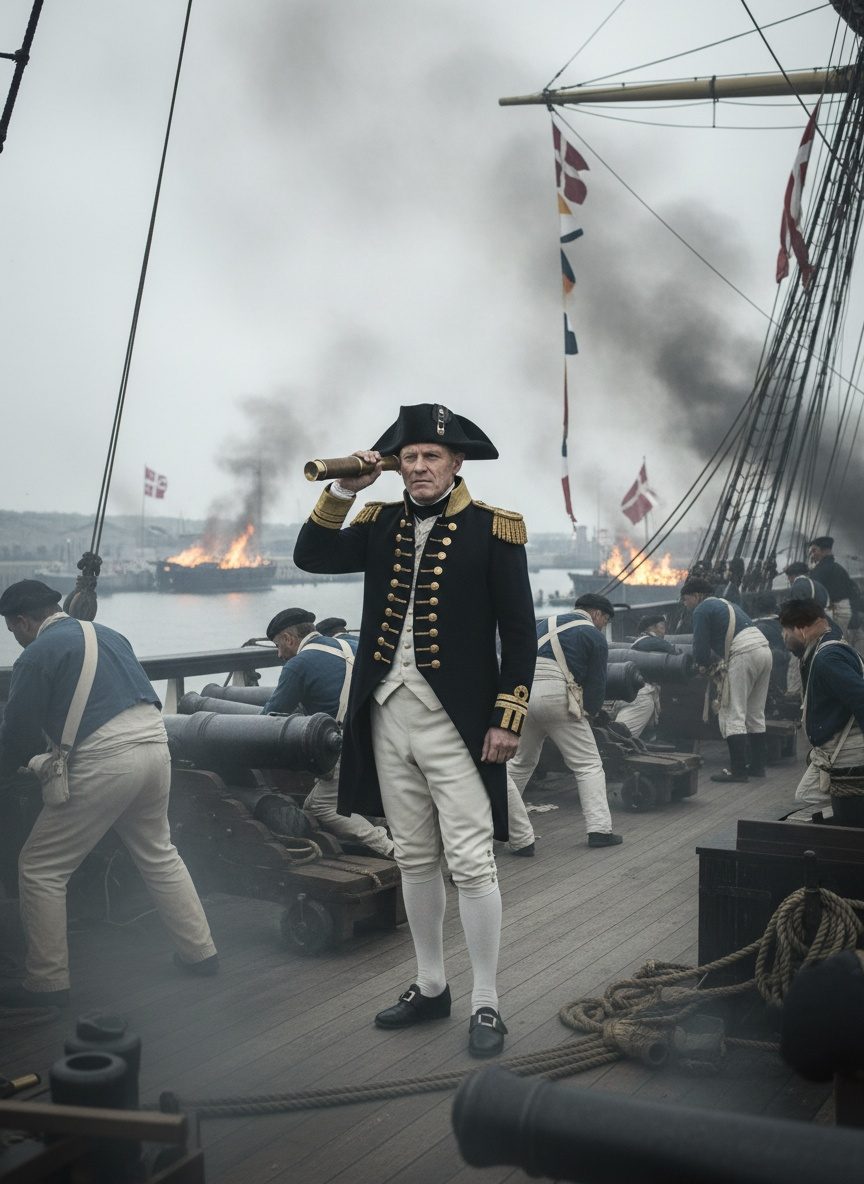
He was a commander who feigned deafness at a critical moment in history. Perhaps less known is the fact that Horatio Nelson had a remarkable penchant for bending rules when it suited him. This very characteristic would lead to one of the most dramatic acts of defiance in naval history, an act that saved his fleet and secured his legend.
The Brink of Defeat
April 1801 brought turbulent seas and unsung tensions to the waters near Copenhagen. The Battle of Copenhagen was more than just a clash of naval might; it was a desperate attempt by Britain to break the armed neutrality of Denmark, which had aligned with Russia, Sweden, and Prussia against them. As the battle unfolded, the situation was dire for the British fleet under Vice-Admiral Horatio Nelson. Smoke and the cacophony of cannon fire filled the air as both sides suffered heavy losses.
Navigating the choppy waters strewn with sandbanks and hidden dangers was a monumental task. The Danish fleet, entrenched and fiercely defending their capital, appeared impregnable. As the battle wore on, the British fleet found itself embattled, constrained by the geography and the formidable Danish resistance. Boats were stuck on sandbanks, trapped, and vulnerable under relentless Danish fire. The chain of command saw signals emerging through this haze, diktats from their superior officer, Admiral Sir Hyde Parker, positioned farther out at sea.
Amidst this chaos, the signal for retreat was hoisted—a command to disengage, a retreat to regroup and possibly fight another day. It was a moment where most naval officers would have capitulated to the order, accepting the harsh reality of circumstances. But Nelson was not like most commanders. Instead of conceding, he seized upon his infirmity, raising his telescope to his blind eye and proclaiming, "I see no signal." This was no act of ignorance but rather an embodiment of calculated bravado.
Navigating Chaos and Courage
The wind whipped through sails like the spirits of ancient mariners urging the British toward victory. Tactical maps left little room for creativity, yet creativity was precisely what Nelson would muster. His refusal to retreat flipped a narrative of desperation into one of aggressive advancement. Often depicted as reckless, Nelson's strategic mind was anything but; it danced like a tactician's chess game, scrutinizing the enemy's weaknesses.
With his feigned blindness, Nelson not only ignored the signal but also took command dangerously close to enemy lines—a bold display of audacity and defiance. As cannonballs whistled perilously close, Nelson issued orders to intensify the bombardment. His decision was not met without trepidation among his officers, but his charisma and confidence swayed them into unwavering support. The stakes were monumental: defeat meant a crippling blow to Britain's mastery of the sea.
The Danish navy, astounded by the sheer tenacity of Nelson's assault, found its defenses faltering. Ships, once steadfast against the onslaught, began to waver under the British barrages. In a masterstroke of warfare, Nelson declared a truce, all the while positioning his fleet advantageously. He played on the Danish fears of further destruction and loss of life, establishing terms that led to their eventual surrender.
A Moment that Echoes Through History
Within hours, the Danish capitulation turned a seemingly certain British defeat into a strategic victory. Nelson's defiant stand at Copenhagen didn't merely alter the tide of one battle; it cemented his legacy as an embodiment of the indomitable British spirit. Through this pivotal impressive maneuvering, Nelson safeguarded Britain's crucial maritime interests in the Baltic Sea, ensuring supply lines and securing dominance in the region.
But beyond the immediate strategic gains, the incident at Copenhagen offers a meditation on leadership. Nelson's audacity, defying commands yet achieving undeniable success, posed questions about the balance between obedience and initiative in military hierarchies. Like a masterful storyteller, Nelson weaved a narrative that wasn't in the script, challenging the boundaries of authority with a conviction that inspires even today.
The clangor of maritime victory reverberated far beyond the waves of Copenhagen. It is a reminder of a time when naval battles decided the fate of empires, and a single decision could shift the course of history. The man who ignored the signal also dismissed the idea of inevitable defeat, transforming peril into an opportune resurgence. As history often shows, the legends they left out of textbooks sometimes shine brighter, not because they defied orders, but because they defied expectations. In Nelson's refusal to retreat, one sees an emblem of formidable resolve that echoes through the annals of naval history, forever inspiring audacity and the courage to confront adversity head-on.