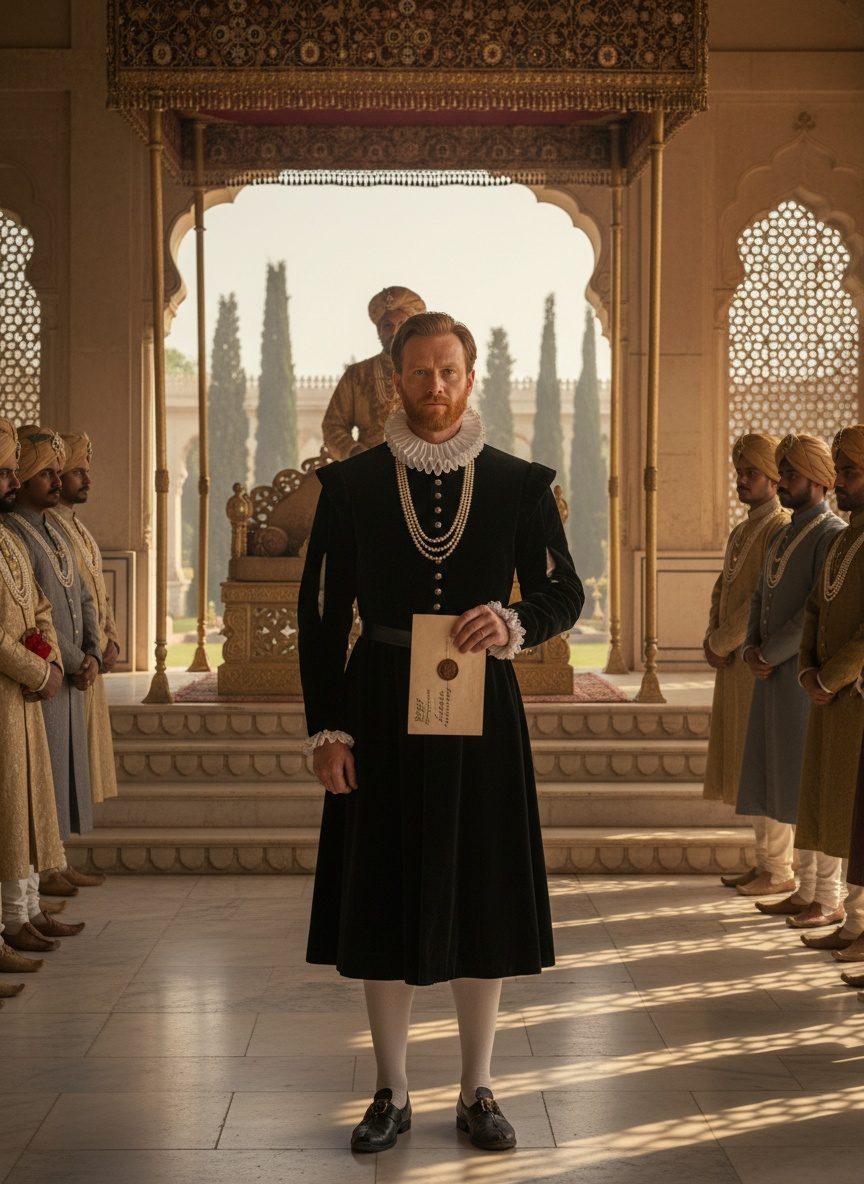
He wasn't an imposing figure of his era. In fact, Thomas Roe was a man of letters, not swords; diplomacy, not conquest.
The Unexpected Envoy
In 1615, Sir Thomas Roe cast a solitary shadow at the gates of Agra, a city teeming with life and the nerve center of the Mughal Empire. Agra thrived under the rule of Jahangir, whose authority spread across a colossal tract of land, casting a net over various cultures and languages. Here was Roe, an envoy equipped only with a letter from King James I, facing a ruler whose court was an opulent display of power and exoticism.
What most found intriguing about Roe's mission wasn't just the audacity of its simplicity—no army flaunted behind him, nor treasures to offer—but the frail promise of trade alliance from a distant island perceived by Jahangir as exotic and somewhat naïve. Yet this very naivety camouflaged English ambition. The reality was the English were astute, their desires camouflaged beneath the guise of humility and cooperation. Roe's arrival marked a pivotal moment ordained not by force, but the art of dialogue.
Walking through the marble-pillared hall of Jahangir's palace, Roe understood the magnitude of his diplomatic dance. The Mughal court was adorned with lavish attire, shimmering jewels, and an air of grandeur that choked any who didn’t approach with reverence. Roe, unadorned by such opulence, relied on his understanding of human nature and the strategic advantage of princely pedigrees—the son-in-law to an earl, he hoped his lineage would lend prestige to his words.
No stranger to diplomacy, Roe had been selected for this challenging task not merely for protocol, but because he represented England’s rising ambition in a world balancing on trade routes and the commodities they veiled. The stakes were towering. He wasn’t simply facing a sovereign; he was facing the intricacies of a culture where every gesture was a language of its own. Roe wielded no weapon save for the formidable power of patience, humility, and intellect, trusting these would carve a niche in the heart of a sovereign whose empire seemed unreachable.
Breaking Bread with Giants
In the days that followed, Roe navigated the complex currents of diplomacy with the Mughal court, determined to secure free trade rights for England. Unlike the Dutch and Portuguese, whose aggressive and monopolizing strategies had often put them at odds with local rulers, Roe's subtle approach played to the English advantage. By crafting an image of friendly cooperation, he differentiated himself from his European peers.
Roe initiated his quest by carefully embedding himself in the life and ritual of the court, acquiring an understanding of local customs and language that could act as bridges between cultures. He approached Jahangir each day with a patient persistence, presenting arguments not as dictates, but as mutually beneficial propositions. The emperor was intrigued by this different approach—a stark contrast to the more forceful methods often employed by Europeans seeking influence in his realm.
Roe’s masterstroke was the letter from King James, which he presented with deference so palpable it impressed Jahangir. This letter, a humble parchment from a small, ambitious island, promised not only mutual respect but unfettered opportunities for trade with no interference in local sovereignty. More than words, it was Roe’s persona, a narration of genuine interest in Jahangir’s court, art, and religion, that became the linchpin of his successful negotiations.
The Mughal court danced through nights of celebrations, banquets, and intellectual exchange, offering Roe glimpses into the world he aimed to enmesh with England’s budding commercial ambitions. Unlike before, where diplomacy was drenched in intimidation, Roe’s steadfast patience paid off, earning the trust of Jahangir, who began to regard this Englishman, this stranger, as less of an outsider and more of an ally to the empire’s affairs. Here, amidst the opulent settings, Roe had laid the groundwork for what would become a commercial empire, each word carefully chosen to bind ambitions across oceans.
The Quiet Revolution
What Thomas Roe achieved in Agra in 1615 was no ordinary treaty. This time, England had managed to crack open the gates of the Indian subcontinent not with cannon fire, but with the potent artillery of words. The golden opportunity was what the British East India Company sought, an unassuming beginning that would sew the fabric of a trade empire for centuries to come. England's merchants, masters of the sea, now had a legitimate foothold in a land rich with spices, textiles, jewels, and history.
The effects of Roe's diplomacy extended beyond the immediate cosmetic agreements. By sidestepping potential conflict, Roe had sewn seeds of trust and laid a foundation where the future mechanizations of empires would unfurl. This was a quiet revolution, masked not with the bloodshed of conquerors, but with the thoughtful ink strokes of a diplomat. Roe’s endeavor marked a turning point—a peaceful alliance that offered prospects for both the Mughal Empire and England.
As years turned into decades, the bridges Roe built allowed for the ebb and flow of cultures, trade, and ideas. It was a path paved with patience and the delicate art of negotiation. This story reminds us that history often turns not with the clang of swords but with the soft, indistinct echo of diplomacy’s successful gambits. In the grander tale of empires rising and falling, Roe’s moment in Agra remains a testament to the power of words and the unforeseen ripples one man can cast in the ocean of history. It is a reminder that at the heart of every great empire lies a moment of transformation—instigated not by force, but by the persuasive embrace of peaceful intent.