The night was velvet in Accra, teeming with a sense of anticipation that mingled with the smoky sweetness of burning wood. Above, stars blinked indifferently, as if unaware of the waves of change about to break below them. The thick air hummed with human voices gathered for a singular purpose, rippling through the city streets — old colonial roads that had carried the burden of empire and were now poised to witness the dawn of a new era. It was the early hours of 6 March 1957, and the Gold Coast was holding its breath. History was about to clear its throat.
The Winds of Change
Accra had been many things. Beginning as a fishing village, it was touched by the clashing forces of European trade ambition and indigenous tenacity. In the era of colonization, it grew into a nucleus of British colonial enterprise, the seedbed of what would be known as the Gold Coast Colony. For decades, the Union Jack proudly flapped over its forts and administrative buildings, a distant kin looking over its colonial offspring. Yet by the time midnight slipped into the calendar's 6th day of March in 1957, a new wind was whispering through its palm leaves.
Here, among the sprawling markets and the rhythms of drumming circles, a political awakening had blossomed. Nationalism had surged like a potent tidal wave, echoing the cries for self-determination resounding across the globe. This was not just a local phenomenon but part of the larger decolonization process gripping the once all-powerful British Empire. The world was transforming, with empires unraveling and nations reassessing their destinies. In Accra, the sense of this inevitable change was palpable, charged, and filled the warm night like an electric pulse.
The Ceremonial Transition
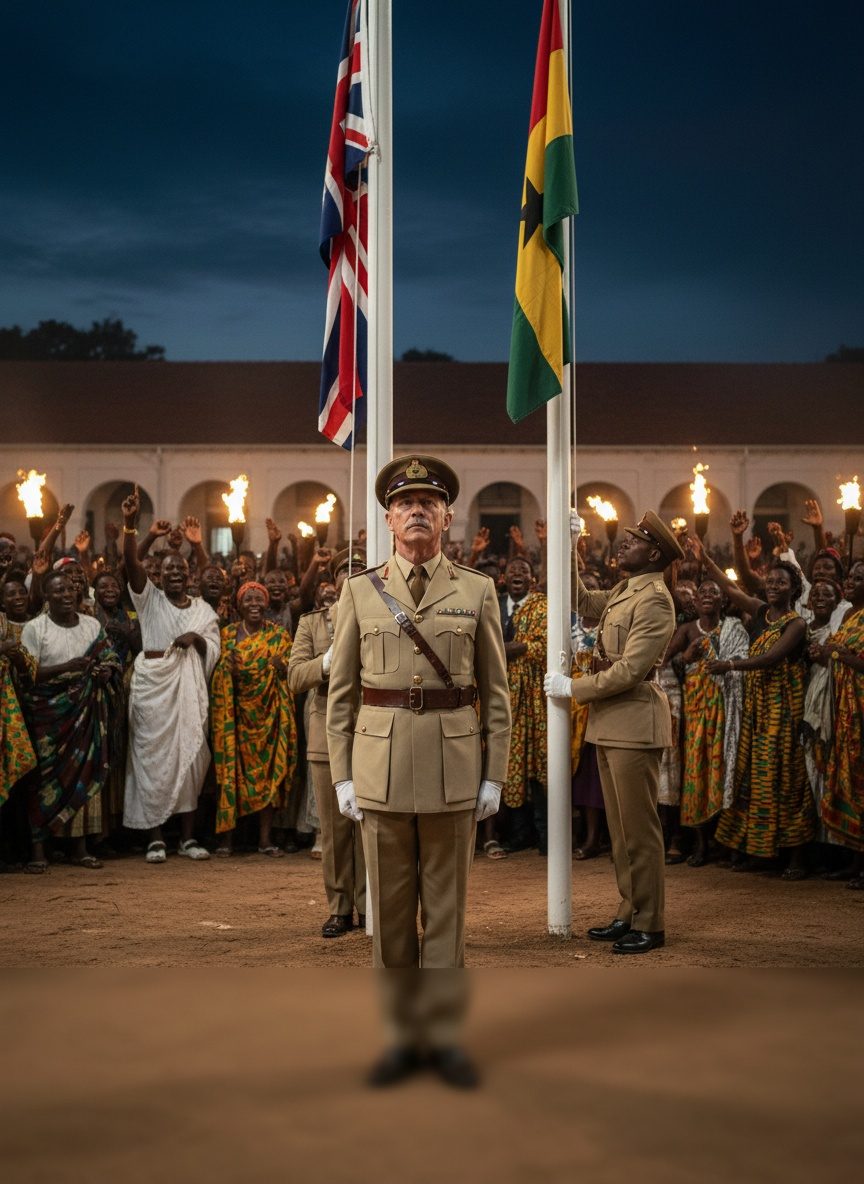
Through the engulfing darkness, the stage was set before Accra's Parliament House. Here, a British officer stood rigid, emotions encased beneath a disciplined exterior, while the Ghanaian crowd, buoyant and optimistic, surged with anticipation. It was a scene to be immortalized in the minds and hearts of those present and told in vivid detail to generations yet to come. The air was thick with the sounds of fluttering fabrics — for tonight marked the final unfurling of the Union Jack.
As the flag descended for the last time in the warm glow of firelight, a hush momentarily stilled the voices. Watching alongside the British officers were proud Ghanaians, for whom this was a culmination of blood, sweat, and ink on manifestos of independence. As the Union Jack was respectfully folded and the fresh, luminous colors of Ghana's own flag took its place, the crowd roared with an eruption of joy. Music swelled and feet danced beneath a new banner, its black star a beacon of hope. It was a moment unparalleled in significance — the peaceful, orderly transition of power, the final act in handing back the Gold Coast.
A Nation is Born
This transfer was not merely a political rite but embraced as the birth of a nation. As the morning light broke on 6 March 1957, the Gold Coast, renamed Ghana, emerged as Africa's first independent nation south of the Sahara. The name "Ghana" was chosen to evoke memories of ancient glory, echoing the storied realm of medieval West Africa, a callback to times when its ancestors reigned supreme over thriving empires.
As the sun took its place above this newborn country, there was a collective understanding that the stakes were high. Dr. Kwame Nkrumah, the towering leader of this transformative journey, now faced the monumental duty of shepherding his people through self-rule. The momentous joy of independence was tempered by the awareness of challenges ahead: economic self-sufficiency, social unity, and leveraging newfound autonomy into a tangible improvement of life for all Ghanaians.
A Shared History
The events of that March night represent more than the inception of modern Ghana; they encapsulate a profound moment in global history. When the soldiers of Britain handed back the Gold Coast without resentment, they participated in an event characterized by dignity and respect — a rare commodity in tales of imperial withdrawal. The ceremony marked the end of an epoch and the birth of another. Britain, in its acceptance of the inevitable waves of decolonization, set a precedent for the relinquishing of empire with grace.
For those who witnessed it — in Accra and across the world — it stood as proof that history could be rewritten with courage and dignity. And therein lies the significance of the Gold Coast's metamorphosis into Ghana. It is a story of a peaceful handover, a testimony to the dreams of millions who envisioned a liberated future, and a reflection on the broader human journey toward self-determination and equality. In the reverberating echoes of that night, there was a promise: the promise of possibility, of a new chapter — begun not with a gunshot, but with a flag-change, under a sky filled with newfound stars.