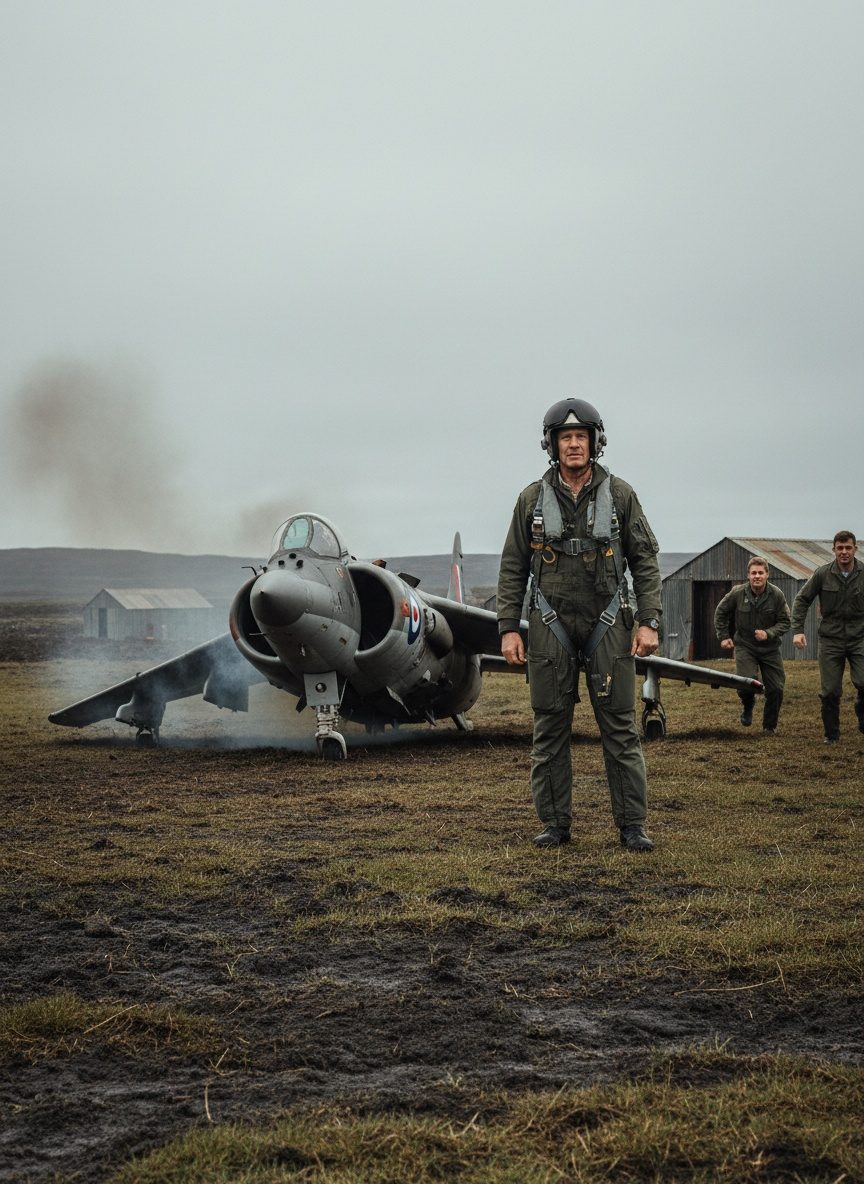
The Harrier GR.3 touched down at Port San Carlos. It was a brutal landing that nearly shattered Britain's strategic hopes in the South Atlantic.
A Desperate Gamble in the South Atlantic
In June 1982, the Falklands War was hurtling toward its climax. Britain and Argentina were locked in a fierce battle over these remote, wind-swept islands. For the British forces, operating at the teeth of logistical limitations, every maneuver was a finely balanced gamble. Supplies, men, and machines were constantly stretched to their limits, and Port San Carlos was a crucial cog in their military machine. It operated as a makeshift airstrip wedged between the rolling hills, with little margin for error in such an improvised setting.
Wing Commander Peter Squire and his Harrier GR.3, known affectionately as XZ989, were part of a critical air support mission that day. These jump jets were the epitome of British engineering prowess, able to take off and land vertically — a crucial capability as most of the established airstrips were under Argentine control. However, operating from forward bases like Port San Carlos came with a price. Makeshift and rudimentary at best, these strips were a testament to wartime ingenuity but also profoundly vulnerable.
The Crash that Shook the Base
On June 8, as Squire approached the strip, the tension was palpable. With the eyes of the world on the unfolding conflict, each mission carried immense pressure. The Harrier came in low, but the landing wasn't just rough — it was catastrophic. The aircraft slammed into the merciless ground, throwing up clouds of debris and twisting metal. The sight was that of a scene from a chaotic war film rather than a calculated military operation.
In those fleeting seconds, as XZ989 ground to an unceremonious halt, the fragility of Britain's position was laid bare. The Harrier itself was a resilient machine, designed with the robustness necessary for exactly such harsh conditions, and it had saved Squire's life. He miraculously walked away uninjured, a testament to both the aircraft's design and a pilot's instincts.
However, the incident starkly highlighted the precariousness of the British forward operations. Port San Carlos, already strained under a relentless operational tempo, suffered a significant setback. Its fragile infrastructure wasn't built to absorb such shocks, and the damage to the base's capability to handle fixed-wing aircraft operations was a brutal blow, reminding all involved just how perilously thin the dividing line between control and chaos was.
The Larger Picture: A War on the Edge
The crash underscored the broader stakes of the conflict. The Falklands War, fought thousands of miles from home, demanded unprecedented logistics and determination from British forces. Every Harrier sortie, every supply mission, was a testament to the tenacity of the forces involved.
Operating from a forward base at the edge of the empire meant the British couldn't afford such mishaps. It wasn't just about military victory but about reasserting Britain's standing in a rapidly shifting global order, in which colonial legacies were being challenged across the board. Each operation from places like Port San Carlos was also a message — a high-stakes endeavor proving that Britain, despite the decline of its imperial reach, still possessed both the resolve and the capability to project power.
The Harrier's crash landing was a microcosm of the conflict's many logistical and tactical challenges. For those on the ground, it was a dramatic reminder of their vulnerability and the enormous risks taken to ensure Britain's military objectives were met.
Reflections on Triumph and Turmoil
The Falklands War stands out as a conflict fought on the margins of history — geographically remote, yet symbolically significant. The incident with XZ989 at Port San Carlos might seem like just another event in the fog of war, but it was a vivid illustration of the razor-thin margins Britain operated within. It highlighted how the war's outcome depended not just on the bravery of its soldiers and pilots but also on the delicate clockwork of logistics and strategy that powered them.
As Wing Commander Squire walked away from the wreckage, unscathed yet acutely aware of the day’s implications, it showed that victory in such conflicts required more than superior firepower. It demanded resilience, ingenuity, and an unyielding spirit — qualities that, while often overlooked, are the unsung pillars of historical narratives. The legacy of that day at Port San Carlos is a potent reminder that in the annals of war, the smallest events often carry the greatest weight.