He wasn't a seasoned African explorer. He was a military doctor sent to heal a mystery killing thousands. Major David Bruce had spent his career in India and Malta, dealing with ordinary ailments and military logistics — until Africa called.
In 1902, the British Empire turned its anxious eyes towards Uganda, a protectorate grappling with a crisis so dire it echoed an apocalypse. The mysterious illness, aptly named sleeping sickness, spread insidiously through villages along the marshy banks of Lake Victoria. People fell into a slumber from which few would ever reawaken. As panic rippled across the European establishments in East Africa, the decision was made: someone had to venture deep into this murky terror to find answers. That solitary endeavor fell to Bruce.
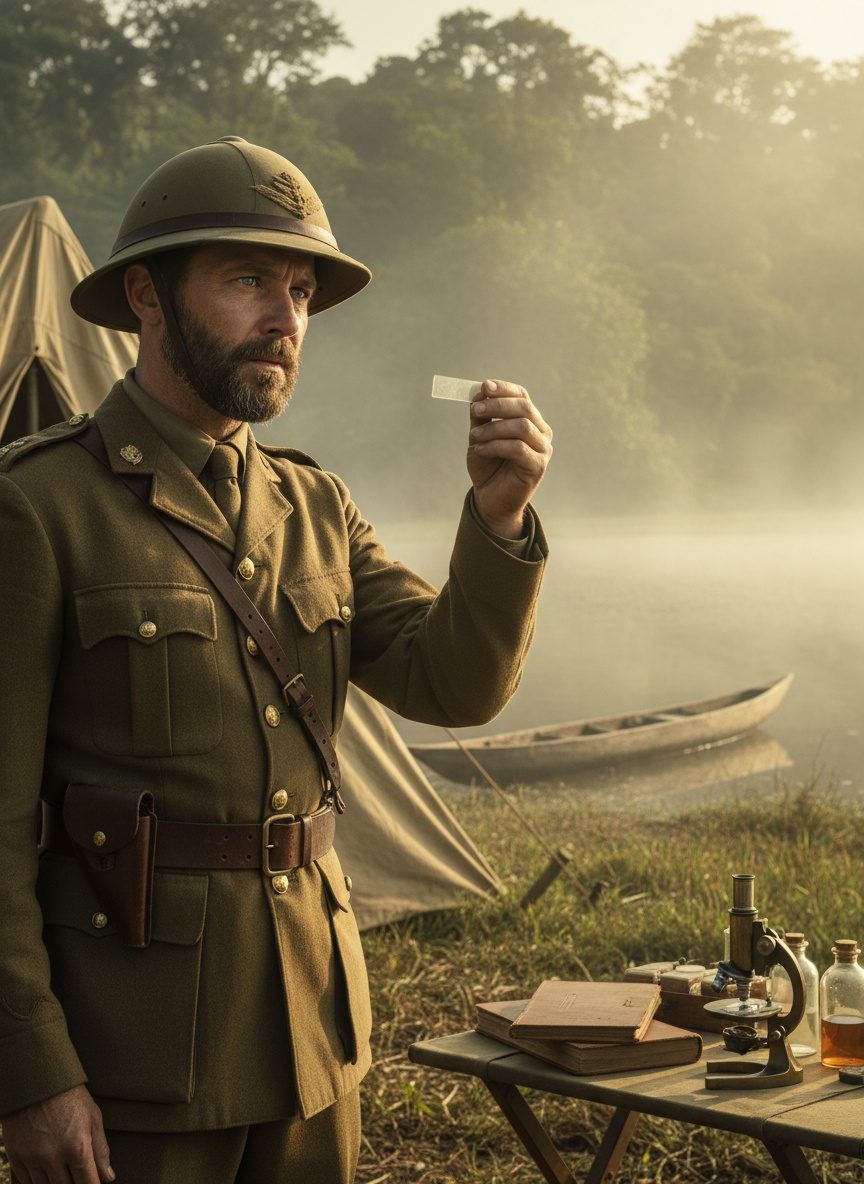
His training prepared him for many challenges, yet nothing could have readied him for the living wallpaper of the Nile’s swamps. The treacherous landscape of suffocating humidity and relentless mosquitoes became his laboratory. To those comfortably stationed back in England, Uganda seemed an enigma. To Bruce, it became an ongoing dialogue with death itself. Yet, amidst this chaos, his military discipline remained unyielding. The expeditionary trappings he brought — notebooks, the primitive microscopes, and medical supplies — became his arsenal against an invisible enemy.
Despite the daunting solitude, Bruce's task was straightforward: discover the truth. The journey up the Nile was a Herculean task in itself, but once at the heart of the epidemic, he faced a bustling throng of potential causes. Was it a virus? A bacteria? Nature, however, is not wont to reveal its secrets easily. The swamps of Lake Victoria burgeoned with life — birds, telegraphing their presence with each swaying branch, and the ubiquitous buzzing of insects, the possible conveyors of doom.
With each examination of the dead's blood, Bruce's confidences ebbed and flowed. The microscopes of the era, while state-of-the-art, could barely magnify what was necessary. Even so, it was these limited lenses that brought a tiny terror into view: the Trypanosoma parasite. This minuscule organism wielded the power to decimate a populace, evidenced by the skeletal remains of villages Bruce had passed. It was the tsetse fly, common and undistinguished to the indifferent observer, that carried this deadly cargo.
For the rural dwellers, however, life had been interrupted by this external predation long before science sanctioned its name. The tsetse belt, seemingly innocuous, was a death zone for those who could scarcely comprehend the microbial pathways of disease. Bruce’s military acumen, married with a scientist’s tenacity, allowed him to see the patterns missed by others. The insect’s bite was the vector, the parasite its payload, and the human body its casualty.
Majestic yet mournful, Bruce’s discovery was a double-edged paradox. It was a revelation that could lead to salvation, yet there existed no immediate cure. Mechanisms of dissemination could be disrupted, but not entirely erased. Nevertheless, identifying the threat allowed colonial authorities to develop prevention strategies aimed at reducing human contact with the tsetse fly.
One might wonder about the personal toll on Bruce, immersed in solitude amid sweeping fields of suffering. That he pressed on, steadfast, bore testament to an often unsung breed of heroism less about conquest and more about compassion. His work laid pathways not only to avert further disaster but also illuminated the field of tropical medicine, unveiling the vast ecological interplay between organisms long neglected by conventional European medicine.
But what of Africa itself, so often cast defensively against the shadowed background of colonial machinations? The epidemic underscored the fundamental need for global understanding. The expanse of the continent was a canvas of ecological riches and diseases waiting to be explored scientifically. As sleeping sickness abated its stranglehold due to preventative measures, a lesson lingered: tackling such afflictions demanded cross-continental cooperation, with empirical knowledge lining the forefront.
Major David Bruce’s singular voyage into the unknown was not merely a case of restriction by alleviation. Instead, it illustrated a poignant, sprawling scenario: that even the smallest creature held power to shape destinies. Villages by Lake Victoria, homes to vibrant cultures, offered harsh reminders of resilience even in the cruelest face of nature’s whims. Bruce took the sighs of a disease that thrummed like a low dirge and wielded them into an echo of disturbance, heard loud and clear by those willing to listen. In an age characterized by clashing empires and frenzied explorations, this single man's journey underscored the quiet battles fought in the realm of the microscopic and the mighty lives saved by understanding their trace.