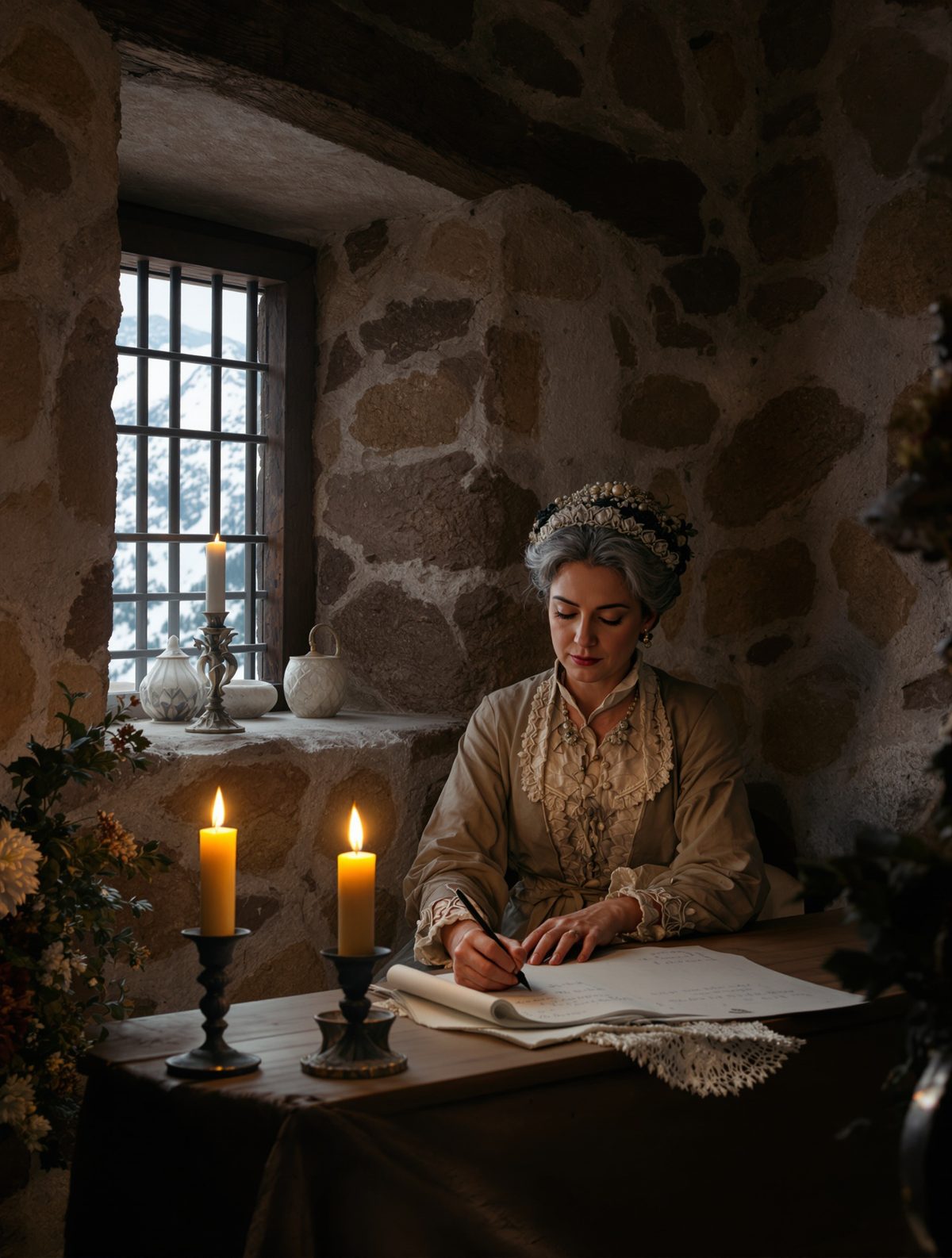
In the dusty corridors of Delhi's Red Fort on a sweltering afternoon in October 1838, an extraordinary scene unfolded. A 41-year-old Englishwoman sat cross-legged on silk cushions, her watercolor palette balanced precariously on her lap, painting portraits of men whose ancestors had once commanded armies from the gates of Vienna to the Bay of Bengal. Emily Eden had come to India expecting to sketch her brother's colonial residences. Instead, she found herself documenting the twilight of the Mughal Empire—a world that would vanish forever just nineteen years later in the blood and smoke of the 1857 rebellion.
What makes Eden's story remarkable isn't just that she was the first British woman to paint at the Mughal court. It's that her delicate watercolors preserve the humanity of a moment when two civilizations stood at the crossroads of history, neither quite understanding that everything was about to change.
An Unexpected Artist in an Imperial Entourage
Emily Eden never intended to become a historical witness. Born into privilege in 1797 as the daughter of William Eden, 1st Baron Auckland, she was an accomplished amateur artist and sharp-witted writer who had already published satirical novels about London society. When her unmarried brother George was appointed Governor-General of India in 1835, Emily and her sister Fanny accompanied him to Calcutta—partly for companionship, partly because Emily's health was deemed too delicate for the English climate.
The sisters were among only a handful of British women in India's highest colonial circles. While Fanny managed the social demands of Government House, Emily retreated to her easel. She had expected to paint familiar subjects: English gardens transplanted to Indian soil, portraits of colonial officials in their dress uniforms, perhaps some picturesque "Oriental" scenes for the folks back home.
But in 1838, as tensions mounted on India's northwestern frontier, Governor-General Auckland decided to undertake a grand durbar—a ceremonial court—in Delhi. The ostensible purpose was diplomatic: to shore up alliances before launching the disastrous First Afghan War. The deeper truth was that the British needed to demonstrate their legitimacy as successors to Mughal power, and the Red Fort remained the symbolic heart of Indian sovereignty.
Into the Forbidden City of the Mughals
When Emily Eden stepped through the Lahori Gate of Delhi's Red Fort in October 1838, she entered a world that had remained largely closed to European eyes for three centuries. The Red Fort—or Lal Qila—had been the seat of Mughal power since Shah Jahan built it in 1648. Its red sandstone walls enclosed a city within a city: marble palaces, intricate gardens, the legendary Peacock Throne room where emperors had once received tribute from half the known world.
By 1838, the Mughal Emperor Bahadur Shah Zafar still held court here, though his empire had shrunk to little more than the walls of Delhi itself. The British East India Company paid him a pension and allowed him the fiction of imperial dignity, but real power lay with the British Resident who lived just outside the fort's walls. Zafar, then in his early sixties, was more poet than emperor—a talented Urdu writer who composed verses lamenting the faded glory of his ancestors.
Eden found herself in an unprecedented position. As the Governor-General's sister, she was accorded the respect due to imperial family. As a woman, she could move between the male and female quarters of the court. And as an artist, she possessed the perfect excuse to observe closely and record what she saw.
Painting the Last Princes
Eden's watercolors from this period reveal an artist grappling with a world that defied every assumption she'd brought from England. Her portrait of Prince Mirza Salim, one of Bahadur Shah's sons, shows a man of evident dignity dressed in flowing white robes, his beard hennaed red in the traditional style. The painting captures something that no official diplomatic correspondence could: the quiet melancholy of inherited greatness in decline.
She painted Princess Begum Hazrat Mahal in her private apartments, surrounded by attendants in silk and brocade. The technical challenge was immense—Eden had to work quickly in the dim light filtering through marble screens, capturing fleeting expressions before her subjects grew restless. But the artistic challenge was even greater: how do you paint the end of an empire?
Her letters home, which survived and were later published, reveal her growing fascination: "The court retains all its ancient ceremonial, though shorn of its power," she wrote. "Yesterday I watched the Emperor receive petitioners in the Diwan-i-Am, and for a moment could almost forget that these marble halls now echo with the footsteps of ghosts."
Eden documented details that male British officials either couldn't access or didn't think worth recording. She painted the intricate henna patterns on courtesans' hands, the way afternoon light fell through the perforated stone screens of the zenana, the expression on an aging prince's face as he fed peacocks in a garden that had once entertained ambassadors from Persia and Central Asia.
The Art of Cultural Translation
What makes Eden's work extraordinary is how it navigates the treacherous waters of cultural representation. She was, undeniably, a product of her time—her letters contain casual assumptions about British superiority that make modern readers wince. Yet her paintings reveal something more complex: a genuine attempt to see her subjects as individuals rather than exotic specimens.
Her technique adapted to her environment in ways that suggest real artistic growth. The hard-edged precision of her early English landscapes softened into something more fluid and atmospheric. She learned to work with the intense Indian light, letting watercolors bleed and blend in ways that captured the dreamlike quality of palace interiors where mirrors and marble created infinite reflections.
Perhaps most remarkably, she began to understand that she was documenting not just costumes and architecture, but the emotional reality of a world in transition. Her portrait of a young Mughal nobleman shows him wearing traditional dress but standing in a European pose—a visual metaphor for a generation caught between worlds.
When Empires Collide in Watercolor
The irony of Eden's position wasn't lost on her contemporaries. While she painted intimate scenes of Mughal court life, her brother was orchestrating policies that would accelerate the dynasty's decline. The durbar of 1838 was meant to demonstrate British respect for Indian traditions, but it actually marked the beginning of more aggressive colonial control.
Eden seems to have sensed this contradiction. In her painting of the Diwan-i-Khas—the emperor's private audience hall—she included both Mughal courtiers in traditional dress and British officials in military uniform. The composition is carefully balanced, suggesting equality, but the historical context makes it clear which group held real power.
Her work captures a moment of profound historical irony: the last Mughal court was more culturally sophisticated, more religiously tolerant, and more artistically accomplished than the British administration that was replacing it. Yet the Mughals' political power was already a fiction, sustained only by British convenience.
The Last Witness
Emily Eden left India in 1842, never to return. Her watercolors, carefully preserved, became historical documents of immense value when the world she had painted vanished forever in 1857. During the Indian Rebellion, British forces stormed the Red Fort, ended the Mughal dynasty, and exiled the last emperor to Burma, where he died in obscurity.
The palaces Eden had painted became military barracks. The gardens where she had sketched princes feeding peacocks were turned into parade grounds. The Peacock Throne itself had been carried off to Persia decades earlier, but the throne room where it once sat was converted into British officers' quarters.
Today, Eden's paintings are scattered across museums and private collections, treasured not just as art but as historical evidence of a world that existed only in the narrow space between the decline of Mughal power and the consolidation of British rule. They remind us that history's great transitions are lived by individuals—emperors and artists, princes and painters—who often don't realize they're witnessing the end of an age.
In our current moment, when cultures collide and blend with unprecedented speed, Emily Eden's watercolors offer a different way of understanding empire and encounter. They suggest that the most profound historical truths sometimes emerge not from official documents or military dispatches, but from the quiet moments when one person really looks at another—and takes the time to get the colors right.