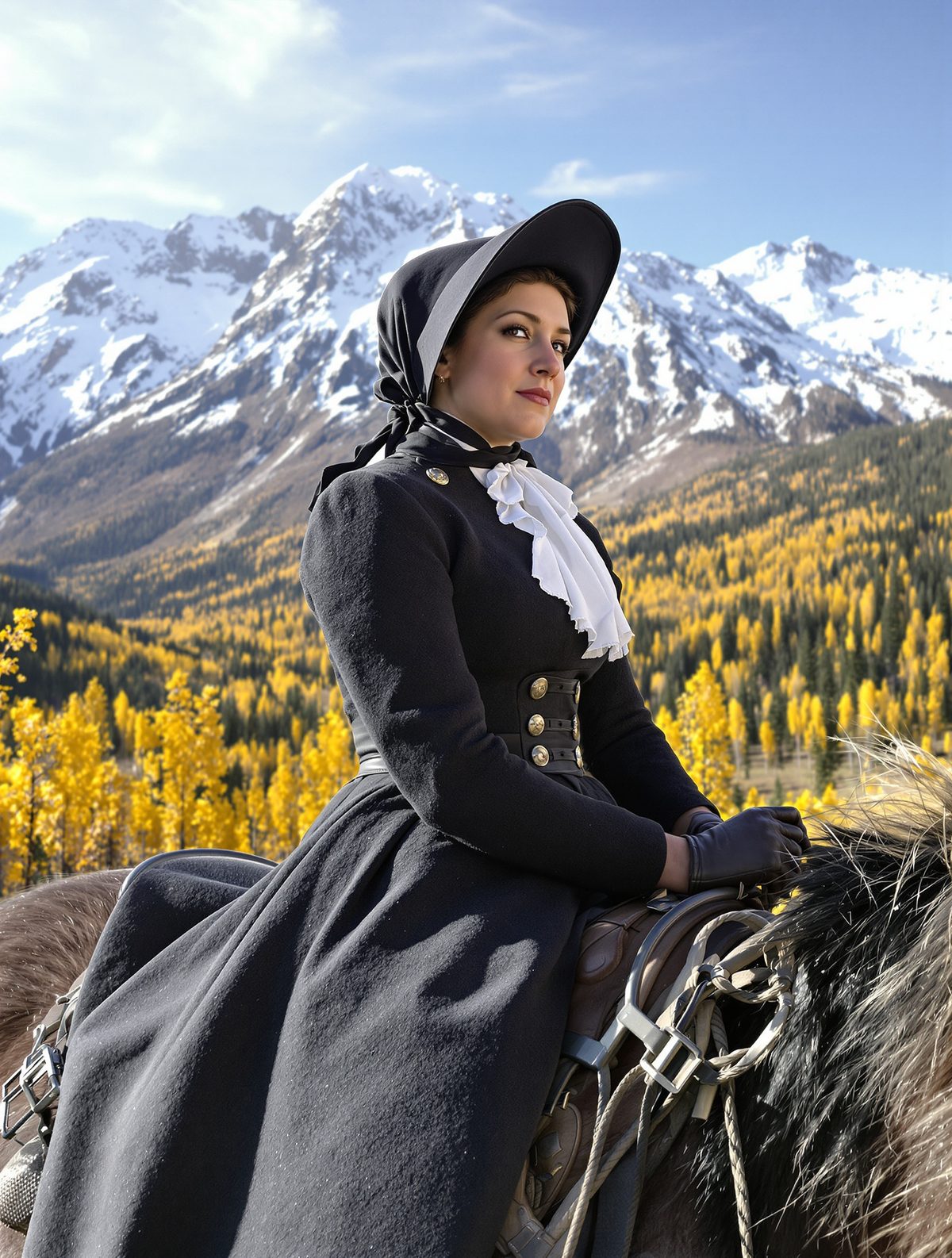
Picture this: somewhere high in the Himalayan foothills in 1838, the haunting notes of Beethoven's Moonlight Sonata drift across snow-capped peaks. The music seems impossible in this wilderness of rock and ice, yet there it is—crystal clear piano notes echoing through valleys where only the wind should sing. The source? A full-sized Broadwood grand piano, carried on the shoulders of 300 exhausted Indian coolies, so that one determined English lady could bring civilization to the edge of the world.
This is the extraordinary true story of Lady Emily Eden's piano—perhaps the most pampered musical instrument in imperial history.
The Lady Who Refused to Leave Music Behind
Lady Emily Eden was no ordinary Victorian woman. Born into the political aristocracy in 1797, she possessed a razor-sharp wit, a talent for watercolor painting, and an absolute devotion to her Broadwood grand piano. When her unmarried brother George Eden, Lord Auckland, was appointed Governor-General of India in 1836, Emily made a decision that would become the stuff of legend: she would accompany him to the subcontinent. More shocking still—her beloved piano would come too.
The piano itself was a monster by any standard. Weighing nearly 800 pounds and stretching over six feet in length, the Broadwood grand was a masterpiece of English craftsmanship. Its mahogany case gleamed with the kind of polish that took servants hours to maintain, and its ivory keys had been caressed by Emily's fingers through countless London soirées. To leave it behind would be, in her mind, like leaving behind her very soul.
But in 1838, Lord Auckland received orders that would test even Emily's determination. The British government, paranoid about Russian expansion into Central Asia, demanded a show of force. Auckland was to march toward Afghanistan with a massive diplomatic and military expedition—through some of the most treacherous terrain on Earth.
An Army Marches on Its Stomach (and Apparently Its Sheet Music)
What followed was perhaps the most elaborate camping trip in imperial history. Lord Auckland's mission, ostensibly diplomatic but bristling with military might, included 12,000 troops, 40,000 camp followers, and enough supplies to stock a small city. The procession stretched for miles across the Indian landscape, a serpentine display of British power and excess.
And somewhere in the middle of this vast caravan, 300 Indian coolies took turns carrying Emily Eden's piano.
The logistics were staggering. The piano had to be specially crated and cushioned, then mounted on poles that required dozens of men to lift. As the expedition moved through the blazing heat of the Indian plains, past Delhi and toward the Northwest Frontier, the piano became both symbol and burden—a 800-pound reminder of just how far the British would go to maintain their creature comforts.
The coolies, earning roughly four annas per day (about six pence), rotated in shifts throughout the grueling journey. They wrapped the piano's legs in cotton batting, secured its lid with leather straps, and developed an intricate system of calls and responses to coordinate their steps across uneven ground. Many had never seen such an instrument before, yet they guarded it as carefully as if it were made of spun glass.
Beethoven at 8,000 Feet: Music in the Mountains
As the expedition pushed northwest toward Simla and beyond, the real challenge began. The flat, dusty plains gave way to foothills, then to genuine mountains. Rivers had to be forded, ravines crossed on improvised bridges, and narrow passes navigated with the precision of a military operation.
At one point, near what is now the Pakistan border, the piano had to be lowered down a cliff face using ropes and pulleys—a operation that took an entire day and left everyone's nerves frayed. Emily herself described watching "300 brown arms straining against leather and wood" as her precious instrument swayed precariously over a 200-foot drop.
But the most extraordinary moment came at Simla, nearly 8,000 feet above sea level in the Himalayan foothills. There, in a hastily erected camp surrounded by peaks that touched the sky, Emily Eden gave what may have been the highest-altitude piano recital in history. British officers, Sikh princes, local chieftains, and bewildered mountain villagers gathered to hear Beethoven, Mozart, and English ballads echoing through valleys that had never known such sounds.
One witness, Captain Claude Wade, wrote in his diary: "The absurdity of the scene struck me powerfully—here we were, thousands of miles from London, surrounded by peaks that have watched empires rise and fall, listening to a lady in silk gloves play European music on an instrument that required 300 men to carry. Yet somehow, it seemed perfectly natural."
The Human Cost of Imperial Comfort
What the British accounts rarely mention, but local records suggest, is the toll this musical odyssey took on the coolies themselves. Carrying 800 pounds of dead weight through mountain passes at altitude was back-breaking work. Several men were injured when the piano slipped during river crossings, and at least one coolie died—crushed when a makeshift bridge collapsed near what is now Peshawar.
The British paid compensation, of course—a few rupees to the man's widow—but pressed on without missing a beat. The piano, after all, had concerts to attend.
Emily herself seemed largely oblivious to the human drama unfolding around her musical companion. Her letters home sparkle with delight at the "amusing spectacle" of her piano's journey, and she boasts of playing for "rajas and chieftains who had never heard proper music." The disconnect between her joy and the coolies' suffering reveals much about the casual cruelty that underpinned the British Empire.
The Legend Lives On
By the time Lord Auckland's expedition reached its furthest point—somewhere in the mountains between Afghanistan and British India—Emily Eden's piano had become famous throughout the region. Local rulers requested private concerts, British officers composed drinking songs about it, and the coolies themselves began treating it with something approaching religious reverence.
The journey home was no less remarkable. When the political situation in Afghanistan deteriorated and Auckland's mission was curtailed, the entire massive expedition had to retrace its steps. Once again, 300 coolies hoisted the piano onto their shoulders and began the long march back to civilization.
Emily continued to give impromptu concerts along the way. In one particularly surreal scene, she played "God Save the Queen" at a mountain pass while snow fell gently on the piano's mahogany case and British soldiers stood at attention against a backdrop of peaks that seemed to stretch into infinity.
Why One Piano Tells the Story of Empire
Today, Emily Eden's piano saga might seem like nothing more than an amusing footnote to Victorian excess. But it reveals profound truths about the nature of empire and the psychology of colonialism. The determination to carry European culture—literally on the backs of colonized people—into the furthest reaches of the known world speaks to both the arrogance and the deep insecurity of imperial power.
The piano was more than an instrument; it was a declaration. It announced that British civilization was so superior, so essential, that no amount of difficulty or human cost could justify leaving it behind. When Emily Eden played Beethoven at 8,000 feet, she wasn't just making music—she was performing empire itself.
The 300 coolies who carried that piano became unwilling participants in this performance, their labor transformed into a metaphor for colonial rule. They bore not just the weight of mahogany and ivory, but the entire burden of one culture's assumption that its values should echo in every corner of the Earth—no matter the cost to those who had to carry them there.
Perhaps that's why the image remains so powerful: somewhere in the Himalayas, Beethoven once played while empires rose and fell, carried on the shoulders of men whose names history never bothered to record.